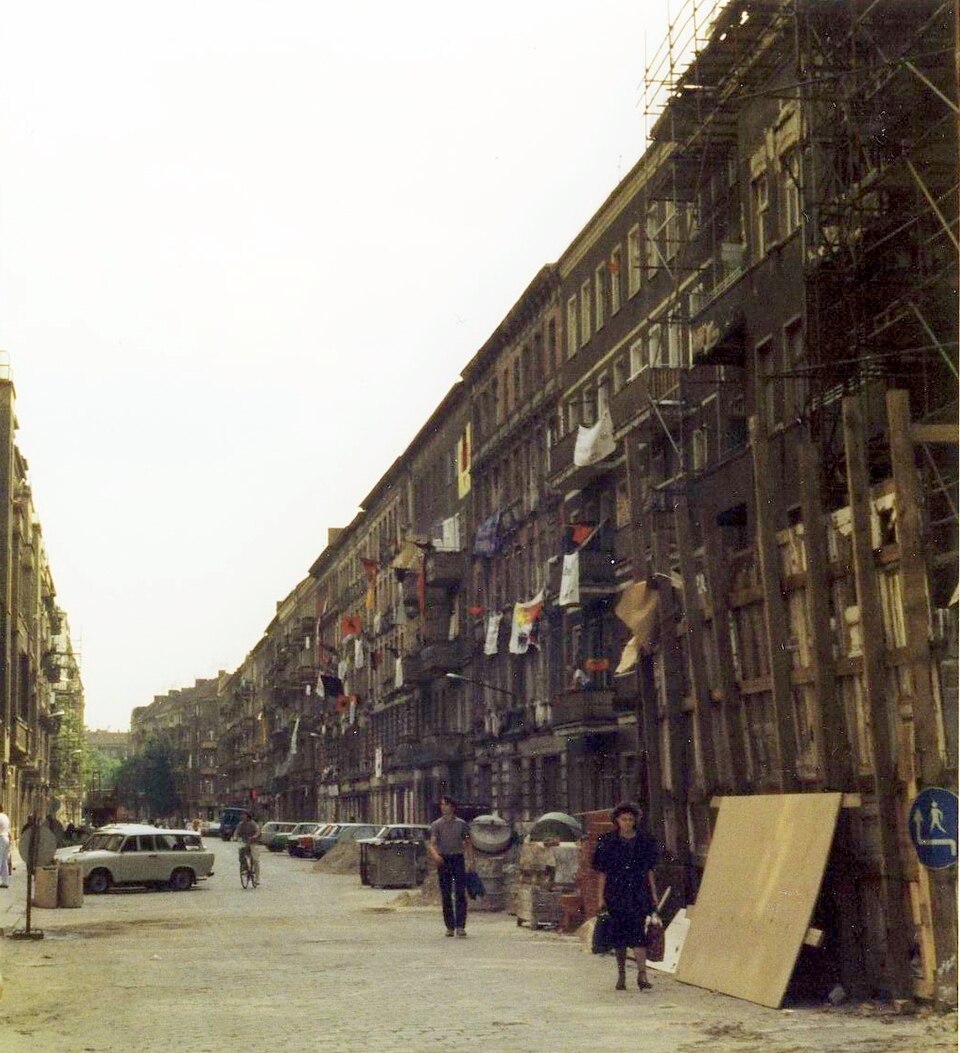
East Germany froze rents at 1936 levels, which kept housing cheap but left landlords with too little income to repair their building. Instead, the state put its money into new estates, so the old inner-city tenements rotted. With flats sitting empty and the authorities losing track of them, historian Udo Grashoff estimates that more than 10,000 East Germans had quietly moved into them, usually as a private way of getting a home. When the Wall fell, the state lost its grip before West Germany’s property law arrived. In that gap, members of East Berlin’s Church from Below published the addresses of empty houses in a West Berlin autonomist paper and urged people from East and West to take them before it was too late. West Berliners, who treated squatting as a political act, answered in numbers. About 250 young people, mostly from West Berlin, took over a row of houses on Mainzer Straße in Friedrichshain, setting up a women’s house, a gay squat, and a people’s kitchen.
East Berlin’s city government had agreed to tolerate, for the time being, squats occupied before 24 July. That tolerance did not outlast reunification. After 3 October, West Berlin’s police chief took charge of the city and negotiations with the squatters were broken off. On 12 November, police cleared three squats occupied after 24 July. Mainzer Straße answered with barricades and street fighting, and early on 14 November, a human chain of supporters, among them Bärbel Bohley, a co-founder of the civil rights group New Forum, stood in front of the barricades calling for no violence and no eviction. About 3,000 officers attacked them with water cannon, helicopters, and tear gas. Though the fight was in East Berlin, most people on both sides were West Germans. More than 300 arrested, and only 17 percent were from East Berlin. Bohley later said many squatters seemed to be performing a play, and had acted as foolishly as the politicians. Once police cleared the rooftops, some officers took advantage of the opportunity for violence and badly beat people who had already given up.
At a press conference that afternoon, Mayor Walter Momper, a Social Democrat (SPD) whose Senate governed with the left-green Alternative Liste, accused the squatters of “murderous intent” and said they had refused to negotiate. Taz reported days later that documents showed the squatters had been ready to talk, and Bohley said the government had shown little readiness for a political solution. Why negotiate when you can violently force? That evening about 10,000 people marched in solidarity. Overnight, neighbors watched police wreck the flats and throw the residents’ belongings into the street. Three Alternative Liste senators resigned, and on 16 November the party ended the coalition, weeks before an all-Berlin election in which the SPD lost heavily and the conservative CDU won.
What the Senate restored was property. The Senate’s show of force worked: most remaining squats went on to negotiate dubious contracts despite previous promises. Some East Berliners read the eviction as a warning that capitalist property rights would no longer be challenged. Squatters had argued that housing had been turned into a commodity whose price had drifted from its purpose as shelter. The Senate then paid about 25 million euros to renovate the cleared houses and returned them to their former private owners in 1992. As of 2003, those owners had paid nothing for the work.
The question has not gone away. In 2021, 59.1 percent of Berliners voted to take large landlords’ flats into public hands, and five years later nothing has been expropriated. Now the SPD, Greens, and Left are in the final stage of coalition talks on a plan to move holdings above 10,000 flats into public ownership, about 160,000 homes. More than 1,000 SPD members, including Defense Minister Boris Pistorius, have signed a letter against governing with the Left. The federal government, in which the SPD governs with the conservatives, decided in July to bar states from socializing private rental housing. In 1990, an SPD-led Senate sent about 3,000 police to restore property rights. It was a choice about what a home is, a place to live or an asset to hold, and Berlin’s government chose the asset. How about: The fight now is about whether Berlin is allowed to choose differently.