The attack on the World Trade Center on 11th September 2001 led President George Bush to increase US militarism. One month later, the US invaded Afghanistan. One year later, in September 2002, Bush used fabricated stories of Weapons of Mass Destruction to prepare the way for a similar attack on Iraq. One of his motivations was to overcome the “Vietnam syndrome”. Since being ejected from Vietnam in 1975, many working class people in the US were no longer prepared to fight and die for their country.
The attack on the World Trade Center on 11th September 2001 prompted President George Bush to escalate US militarism. Just one month later, the US invaded Afghanistan. By September 2002, Bush utilized fabricated claims of Weapons of Mass Destruction to justify a similar invasion of Iraq. One of his motivations was to overcome the “Vietnam syndrome”; since the US withdrawal from Vietnam in 1975, many working-class Americans were reluctant to fight and die for their country.
As Bush prepared for war, the international anti-capitalist movement was gaining momentum. In 1999, the Battle of Seattle saw trade unionists and environmentalists unite to shut down a meeting of the World Trade Organization. The first World Social Forum took place in Porto Alegre, Brazil, in January 2001, serving as a gathering point for anti-capitalist activists and intellectuals. A corresponding European Social Forum was held in Florence in November 2002.
In Florence, the anti-capitalist and anti-war movements converged. One million people rallied against the impending war in a city with a population of less than 400,000. During the forum, an additional meeting was organized, where hundreds of activists from various countries discussed strategies to counter the looming conflict in Iraq. An international day of action was set for February 15th the following year, aiming for demonstrations across the globe.
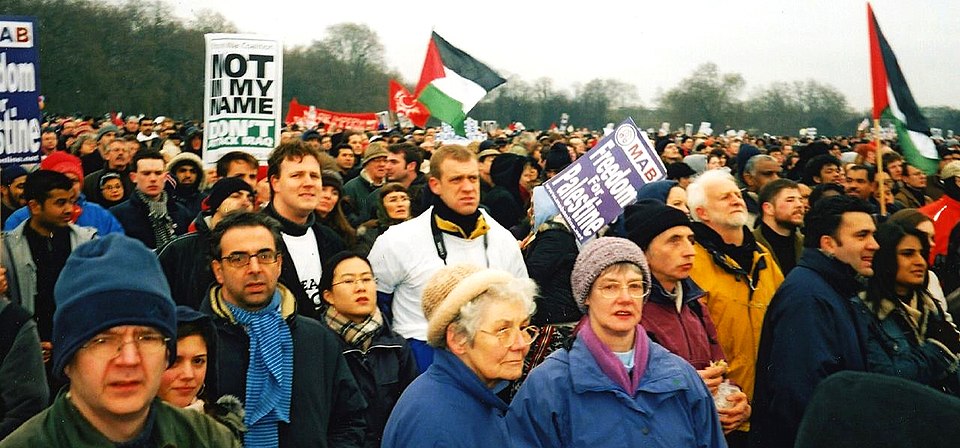
The outcome was significant. Over a million people demonstrated in Barcelona, Rome, and London. The Rome demonstration is recorded in the Guinness Book of Records as the largest anti-war rally in history, with 3 million participants. Protests occurred on every continent, including a gathering of 50 scientists in Antarctica. An estimated 15 million people demonstrated on February 15, and 40 million participated in the three months leading up to the war’s outbreak on 20 March.
Although these demonstrations did not prevent the war, they likely deterred further attacks. Two days after the protests, New York Times columnist Patrick E. Tyler remarked that the world now had two superpowers: the USA and the international anti-war movement. Many anti-capitalists shifted their focus from advocating for taxation on speculation to actively opposing imperialism. In North Africa, where the 2003 demonstrations were relatively small due to state repression, activists learned valuable lessons that contributed to the emergence of the Arab Spring.