A central scene in Hunger, the 2008 biopic of Irish Republican Army leader Bobby Sands, comes at just over halfway through its 96-minute runtime. As the film narrates, by 1981, Sands had been imprisoned for nearly a decade in Her Majesty’s Prison Maze—also known as H-Blocks for its quasi-panoptic cells. To reflect on H-Block today is to think of it, strangely, as the Irish equivalent of Guantanamo Bay, a place haunted by political ghosts both alive and dead. The scene itself is a long shot, metaphorically and literally: near-twenty minutes in length; the camera does not veer, and there are no cuts. Sands breaks down his reasoning in cold detail, between cigarette drags. He makes his final political confession of faith, to a republican-sympathetic Catholic chaplain who, with knowing futility, tries to call Sands off from his fate.
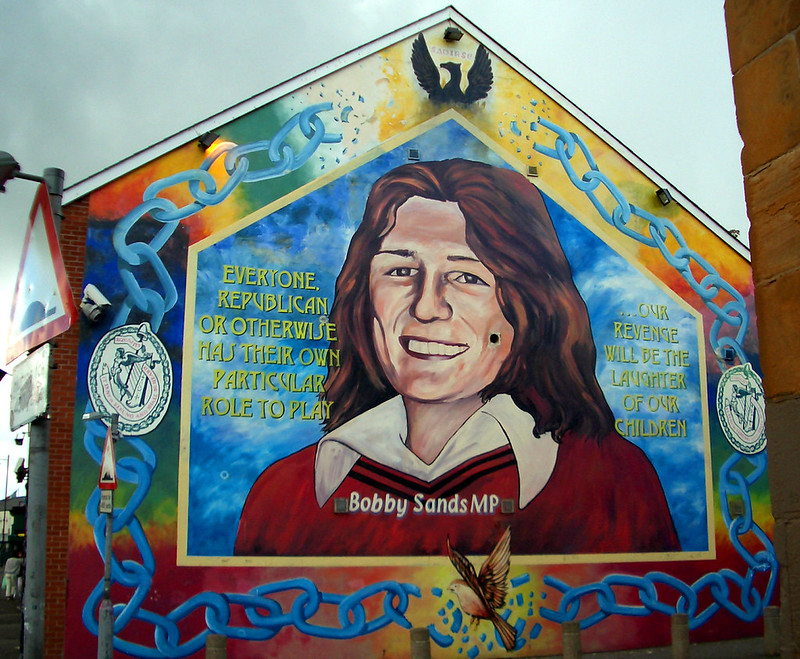
The film’s brilliance is captured in the intimate minor eternity of that scene. The real-life Bobby Sands died caught in the tensions of finitude: perishing after sixty-six days on-strike, along with nine other IRA political prisoners. At death, he was gaunt and unrecognizable, though before he died he was elected as a Member of Parliament, improbably, having stood among a slate of candidates under an “Anti H-Block” banner. Dying six weeks past his twenty-seventh birthday, Bobby Sands MP became immortal.
By the time of Sands’s depicted strike in March 1981, Irish hunger strikes had begun October 27, 1980 with seven republican volunteers in H-Block. Brendan Hughes, the Provisional IRA commanding officer in the prison led the other six strikers: Raymond McCartney, Tommy McKearney, Tommy McFeely, Leo Green, Sean McKenna and John Nixon. Per the Irish Times, they went on strike for five demands:
1. the right not to wear the prison uniform;
2. the right not to do prison work;
3. the right of free association with other prisoners, and to organise educational and recreational pursuits
4. the right to one visit, one letter and one parcel per week;
5. full restoration of remission lost during the protest.
This initial hunger strike ended after 53 days. The event is mired in controversy, as some republicans claimed to have a document from the British government setting out proposals to meet many of these demands but was gone back on, sowing distrust, and setting the stage for the next strikes, including that of Bobby Sands.
In 1976, Sands was arrested on charges of possession of a firearm, and sentenced by bench to fourteen years detention in the maximum-security facility at HM Prison Maze. After a number of prisoner actions—the famous “no-wash” and blanket protests—Sands and the other inmates considered the possibility of a hunger strike. The first plans were opposed by IRA leadership outside H-Block, though once it became clear the British would renege on any negotiation, another wave of strikers began their fast on March 1st, 1981.
After Frank Maguire, MP for Sands’s constiuency, Sinn Féin decided to run Sands as Maguire’s replacement. With the help of over 30,000 constituents, they were able to make this a reality. From his deathbed in prison, Bobby Sands was democratically elected as a Member of Parliament. This was a public relations disaster for the British Prime Minister, Margaret Thatcher, who was now letting a sitting Member of Parliament die and not just another random IRA volunteer.
Though he is remembered for his leadership and the actions he undertook during his imprisonment, the historical record makes clear that Bobby Sands MP had devoted his entire adult life to the Irish republican cause. Upon death, Bobby Sands’s funeral in Belfast was attended by some thousands of people, with several more witnessing the three-mile procession, flanked IRA volunteers. An Associated Press article published that day remarks that Sands “died early Tuesday … in support of the IRA’s demand that its members be given political status.” It continues, “Hours after his death, British Prime Minister Margaret Thatcher said the demand would be never met.”