In 1851 Washington signed a treaty recognizing a large territory for the Cheyenne and Arapaho, then reneged ten years later, according to the National Park Service, once it realized the land might hold rich mineral resources. The 1861 Fort Wise treaty took most of that territory, signed by six Cheyenne and four Arapaho chiefs while many more refused. In 1864 U.S. troops attacked a camp of more than 750 people at Sand Creek, whose chiefs believed they were safe inside the reservation that treaty had left them. The 1865 treaty that followed condemned the massacre and promised reparations to survivors, who were never paid.
Black Kettle survived Sand Creek and kept signing: at Medicine Lodge in 1867, he and Little Rock put their marks on a treaty that confined the Cheyenne and Arapaho to a reservation in Indian Territory and had them agree to drop all opposition to the Smoky Hill railroad, and to accept other railroads, roads, and mail stations settlers wanted to build. The treaty allowed hunting south of the Arkansas River only while the buffalo lasted, though the government’s chief negotiator, Senator John Henderson, gave spoken assurances that they could keep hunting in Kansas and need not move until the buffalo were gone; those promises never made it into the written treaty, which the chiefs could not read to verify the terms agreed orally. Settlers poured onto the plains, and when some young Cheyenne men raided Kansas farms, which the peace chiefs had no authority to stop, General Philip Sheridan answered with a plan to strike the winter camps when the people could not move. Black Kettle asked the Army for protection that November and was turned away.
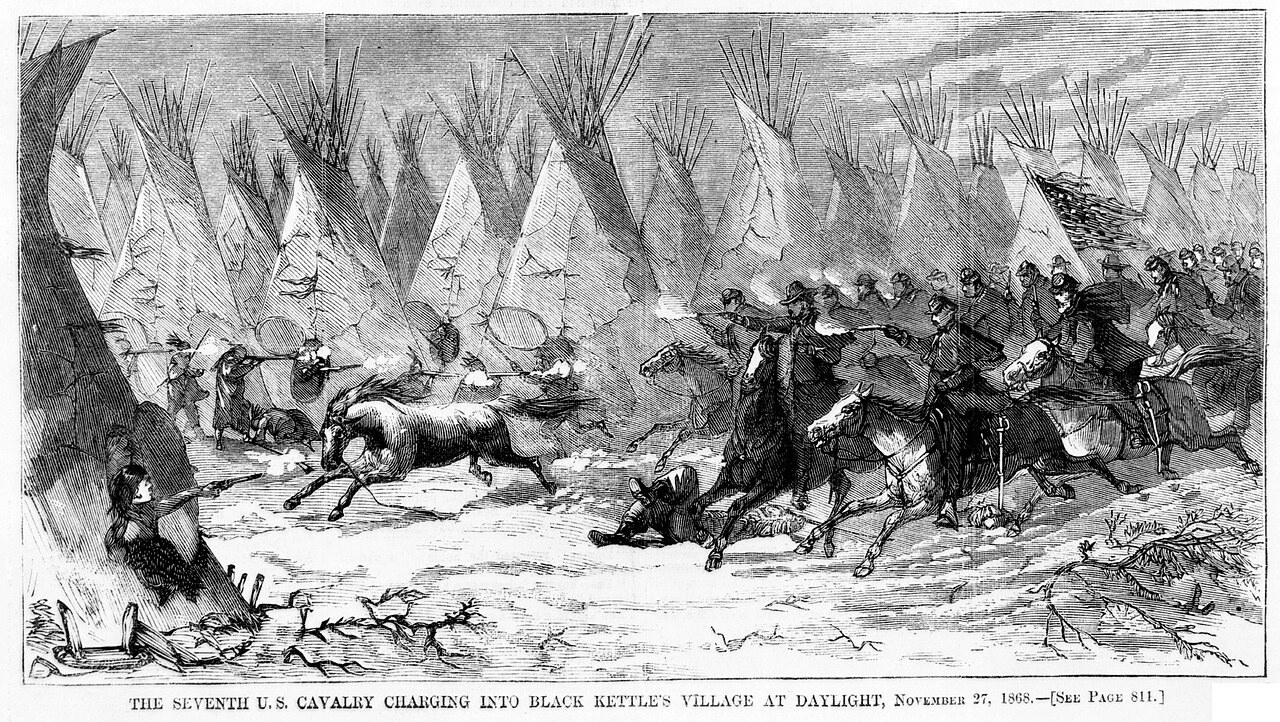
At dawn on 27 November, Lt. Col. George Custer’s 7th Cavalry attacked Black Kettle’s camp of about 250 people on the Washita River, in present-day Oklahoma. Black Kettle and his wife, Medicine Woman, were killed as they fled; soldiers took dozens of women and children prisoner, burned the lodges, and killed the pony herd, the camp’s means of survival, reminiscent of attacks on civilian infrastructure in modern imperial warfare. Arapaho, Kiowa, and Cheyenne warriors from the camps downriver rode to help, killed a detachment of soldiers, and massed on the hills until Custer withdrew with his prisoners. The Army hailed a victory over “hostiles,” and the site is still officially a “battlefield”. Moving Behind, then a girl in the camp, told her story shortly before her death in 1937, saying that “no one has ever asked me to tell the story.”
Washita was one attack in a longer pattern: gold in 1861 and the railroad in 1867 each wanted land the Cheyenne and Arapaho held, and each time a treaty supplied the legal cover, signed by a minority of chiefs or rewritten after the talks ended. As usual, the legal form followed the money. Marx called this primitive accumulation: the forced separation of people from the land that sustains them, so that land becomes property and capital can put it to use. The 1867 treaty required three-fourths of adult men to approve any sale of the reservation, but in 1892, after a contested signature drive, 3.5 million acres were opened to settlers in a land run.
The same logic is running today: in March 2026 the Forest Service transferred Oak Flat in Arizona to Resolution Copper, a venture of Rio Tinto and BHP. The land is sacred to the San Carlos Apache, and the government’s own environmental review found the mine would permanently damage it. Congress authorized the exchange in a 2014 defense bill, the courts upheld it, and the Supreme Court declined to hear the Apaches’ case. The paperwork has changed since 1868, but the dispossession methods have not: Indigenous land still ends up with whoever has the capital, and “legal support”, to take it.