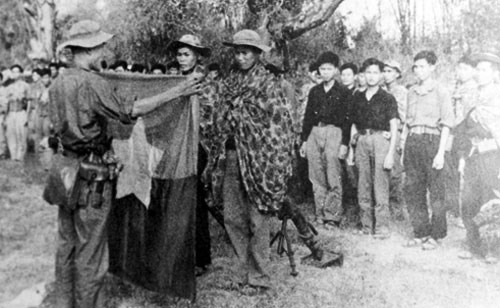
By early 1968, more than 500,000 U.S. troops were deployed in Vietnam, with bombing levels eventually surpassing three times the total of World War II. Forty thousand Americans were dead, hundreds of thousands wounded, and Vietnamese casualties were exponentially higher. Though opposition to the war existed from the start, it was the Tet Offensive that turned simmering dissent into mass resistance. On January 30 and 31, North Vietnamese People’s Army of Vietnam (PAVN) and its Viet Cong (VC) launched coordinated surprise attacks on more than 100 towns and cities across South Vietnam during the Lunar New Year (Tết Nguyên Đán). The campaign intended to trigger political instability, defections, and rebellions across South Vietnam. Over 80,000 fighters took part in the largest offensive of the war to date. However, militarily, Tet failed to spark the mass uprising and collapse of the South Vietnamese government that Hanoi had hoped for. Politically, however, Tet was decisive.
From 1964 to 1972, the wealthiest and most powerful nation in the world unleashed nearly its entire military arsenal—short of the atomic bomb—against a tiny, peasant country already decades into its struggle against imperial domination. After a successful Communist revolution in 1945 led by Ho Chi Minh, the Democratic Republic of Vietnam was established and briefly united from North to South. Promised self-determination under the Atlantic Charter, Ho Chi Minh appealed directly to U.S. President Harry Truman for aid to stave off postwar famine. His letters went unanswered. Vietnam, having already resisted colonial France, fascist Japan, Nationalist China, and the British Empire, now faced the rising power of U.S. capitalism.
Post WWII, the United States financed and armed France’s attempt to reclaim its colony from Ho Chi Minh’s Viet Minh. Publicly, this was framed as a necessary stand against Communism in Asia. China’s 1949 revolution and the Korean War soon followed, feeding Washington’s fears of a collapsing Pacific order. If Vietnam fell, the “domino theory” warned, Laos, Cambodia, and beyond would follow. As usual, ideology masked material reality: land and resources—rice, rubber, coal, iron ore—were at stake. When France failed to suppress the overwhelmingly popular movement, a peace agreement and withdrawal were reached in 1954.
The United States moved quickly to block Vietnamese reunification, backing the “democratic” Ngo Dinh Diem’s repressive and deeply unpopular puppet government regime in the South. Presidents Kennedy and later Johnson sold this intervention as a defense of “freedom” and a fight against Communism. After the assassinations of Diem and Kennedy, Johnson escalated dramatically to quell growing Northern support, using the fabricated Gulf of Tonkin incident to justify open war. As with Cuba just years earlier, the U.S. government lied to its public to manufacture consent—or at least indifference—for imperial violence.
The Tet Offensive shattered the carefully cultivated myth that U.S. victory was near. The scale of the offensive exposed official lies and shocked the American public, accelerating the collapse of support for the war as casualties mounted and draft calls expanded. Peace negotiations and troop withdrawals soon followed. The streets filled with protesters. “LBJ, LBJ, how many children have you killed today?” echoed across the United States. Tet marked the moment when millions saw through the war’s justifications—and when organized people proved they could resist, and ultimately defeat, an organized war machine.