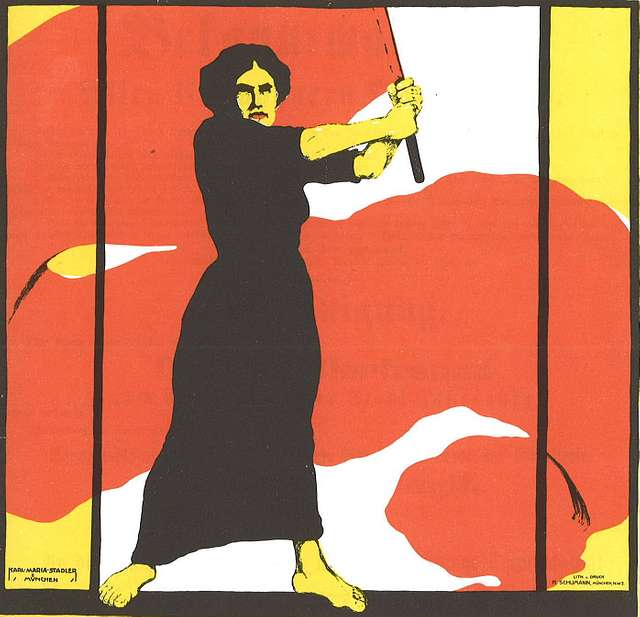
8 March was not always on 8 March, but it was always from the working class: in 28 February 1909, the first unofficial “Women’s Day” took place in different US cities (drawing inspiration from the previous year’s March in New York), with large demonstrations organised by socialist women of the Socialist Party of America across the country, demanding the right to vote.
A year later, in 1910, Clara Zetkin, Luise Zietz, and other comrades were at the Second International Conference of Working Women in Copenhagen, proposing an International Working Women’s Day. The conference approved it, although with no fixed date, under the slogan “The vote for women will unite our strength in the struggle for socialism”. The vision came to life, and on 19 March 1911, the day was officially marked in Europe for the first time – Germany, Austria, Switzerland, and Denmark saw over one million demonstrators take to the streets demanding the right to vote and for the end of gender discrimination in the workplace.
The year 1917 is particularly important for Women*’s Day history: in Petrograd, Russia, tens of thousands of women working in textile factories led a strike starting on 8 March (23 February in the Julian calendar) and lasting several days. They demanded “bread for our children and the return of our husbands from the trenches” – or bread and peace for short, as it became known. It was the beginning of the February Revolution.
In 1975, the United Nations celebrated International Women’s Day for the first time, formally recognising 8 March as an annual date through a resolution later on, in 1977. As the UN itself says on its website, “It is a day when women are recognised for their achievements” – dropping the “Working” from its name, and successfully co-opting the date to be globally welcomed by the feminist bourgeoisie with flowers and celebrations of femininity.
However, not all is lost when it comes to grassroots transnational processes: since 2017, feminist groups, first in Argentina, then expanding elsewhere (with highlights to other Latin American countries, Poland and the Spanish State), organised around the idea of an International Women’s Strike (IWS), with clear anti-capitalist demands and achieving impressive global coordination, under the slogan “if women stop, the world stops”. Besides recentering the strike as a tool, it also reappropriated it and went beyond the classic sense of strike, to connect productive and reproductive labour. Because a large number of women work in precarious conditions, unable to exercise the right to strike, and because a lot of the work carried by women doesn’t stop at the labour market, but extends to the home, the feminist strike proposed four axes: labour strike, student strike, consumer strike, and care strike.
Even if, in recent years, the concept of a feminist strike has lost some of its steam, reproductive labour and care work have been on the feminist agenda, highlighting the need for a feminism for the 99%. This year and all years, 8 March shouldn’t be about gifting roses to the women* in your life — even if they’re for Clara Zetkin — but rather about fighting for the end of exploitation of everyone involved in the supply chain for those roses to reach you, as well as those cleaning the petals off the dining table the next day.