On September 8, 2025, five human rights activists, Zo, Crow, Daniel, Leandra and Vi, entered the German headquarters of the arms manufacturer Elbit Systems in the southern German city of Ulm and carried out an action aimed at trying to stop the genocide in Gaza “for a day or an hour” and highlighting the German state’s complicity in the genocide of the Palestinian people.
Since that day one year ago, these human rights activists have been held in pretrial detention under deplorable conditions that violate international agreements. For the past year, they have been allowed to see their families and loved ones for no more than one or two hours per month, under supervision of the justice system and at times subject to abusive restrictions on the language they may use.
For the past year, the Ulm5 have been confined for up to 23 hours a day in poorly equipped cells, where they had to endure two of the worst heat waves Europe has ever experienced due to a lack of foresight on the part of the authorities. They, like all their fellow pretrial detainees, are experiencing institutional neglect and abuse.
From the day they were arrested, procedural irregularities began. For over a day they were not allowed to speak to their chosen lawyers, as is legally mandated, even though these lawyers called repeatedly to the police stations at which they were held. These irregularities have intensified since the first court hearing, during which it became clear to everyone present that this is a show trial. It is a trial that will be remembered by the German state’s insistence on making an example out of these pro-Palestinian activists—making it known to all of society, and especially to anti-militarist activists, that the arms industry in Germany is off limits.
We have heard from several police witnesses that the prosecution instructed the police not to investigate Elbit and its role in the genocide in Gaza. And the court pays no heed to the appeals and statements from the Ulm5 and their legal team that it is precisely because Elbit supplies circa 85% of the weapons used to massacre Palestinians that they took action—and not for the absurd reasons the prosecution alleges, namely that they acted out of antisemitic motives.
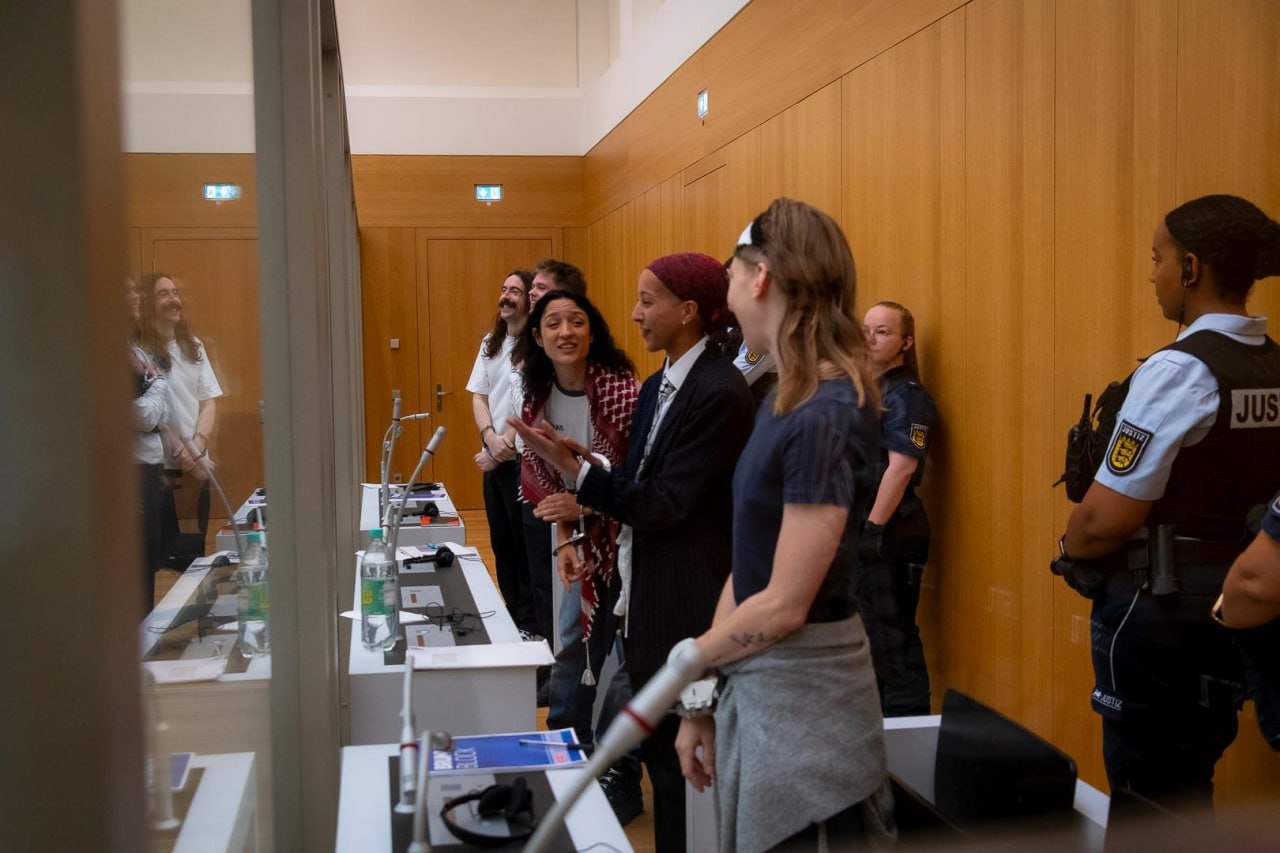
The fact that these activists are treated even before trial as dangerous criminals—brought from their jails in handcuffs and shackles, and led to their benches in handcuffs behind bulletproof glass that separates them from their attorneys—only further calls into question the impartiality of Presiding Judge Kathrin Lauchstädt, who has ordered all these measures.
The families and loved ones in attendance, as well as the entire audience, including several national and international MPs and MEPs, are also treated as a threat and are not allowed to take notes because pens could be used as “stabbing weapons”, even though they are monitored by security guards armed like riot police.
This has led the MPs and MEPs who have attended the trial to express their doubts as to whether this trial is being conducted in accordance with the German rule of law or the European Convention of Human Rights.
It has also been one year of so-called ceasefire—a year in which Israel has killed over 1300 Palestinians in Gaza and carried out genocide against the Lebanese people, along with violent attacks and murders in the West Bank.
Another year of record profits for arms manufacturers, including Elbit.
Another year in which the rights of German citizens are being curtailed and the war machine continues to see its budget increased. The German state, citing the need to defend itself and the Zionist state of Israel (Germany’s Staatsräson), is increasing surveillance and suspicion of its own citizens.
But it is also one year in which the courageous Vi, Leandra, Zo, Daniel and Crow have managed to achieve at least one of their goals. In the last few months, NGOs, MPs, legal observers, and national and international media that have attended the trial have questioned whether the rule of law applies equally in this country or whether, as it seems, it varies if your actions are directed against the war machine and its profiteers.
Germany’s long held status as a country that has atoned for its past is also on trial with every motion that the Ulm5’s lawyers present and every statement the Ulm5 make. For example, they specify that genocide and war crimes are in the company DNA of Elbit Systems Germany, which boasts of its previous 100-year history as the company Telefunken, thereby establishing its role in Germany´s genocide in Namibia and its dark Nazi history of forced and slave labor.
The Ulm5 have also used their voices to raise awareness about the appalling prison conditions people face in this country before ever having been to trial.
And most of all, they have once again shown how deeply complicit Germany is in the genocide, through weapons exports, diplomatic support, and suppressing dissidents and information, and how far this country will go, even against its own citizens, to protect the genocidal machine.
Mathes Breuer answered some questions for the Left Berlin about his client, Leandra Rollo, a Spanish and Argentine citizen.
Leandra is your client. How is she coping with the many months in pretrial detention and the irregular conditions of the trial she is facing?
She believes that the entire proceedings are a sign that the judge has already formed an opinion on the case and on the five of them, even before hearing anything about it. She finds this frustrating, although she wasn’t expecting much from the German state either. On the other hand, we have prepared numerous motions and pieces of evidence that the court will find difficult to ignore.
We have heard you and the rest of the legal team talk about the many difficulties you face in properly defending your clients. Have you ever experienced or heard of a trial in Germany being conducted in this way?
I cannot speak on behalf of all lawyers, but I have never seen a case in which the restrictions imposed on the defendants are so disproportionate in relation to the charges and the individuals accused. I have seen many restrictions, particularly in a political context, but this is on another level.
Judging by the way Judge Kathrin Lauchstädt is behaving and the way she is portraying the Ulm5, it seems as though a guilty verdict has already been reached. What are the next steps that can be taken to secure justice for the Ulm5?
I believe she has already made up her mind, but my experience tells me that a case is not lost until the verdict is handed down, so we will be presenting witness statements, appeals and evidence over the coming weeks and months in an attempt to change the outcome. It is important to keep talking about the trial and to keep the spotlight on it, as that influences how things unfold. Apart from that, justice would mean the five of them swapping seats in the courtroom with the CEO of Elbit Systems; but I suppose a lot of things need to change in Germany before we get to that point.
You can read the Ulm5 press release here.
Before the next Ulm5 court dates on September 23 and 25, the Nicaragua v. Germany trial for alleged complicity in the Gaza genocide takes place in the International Court of Justice (ICJ) on September 7–10.