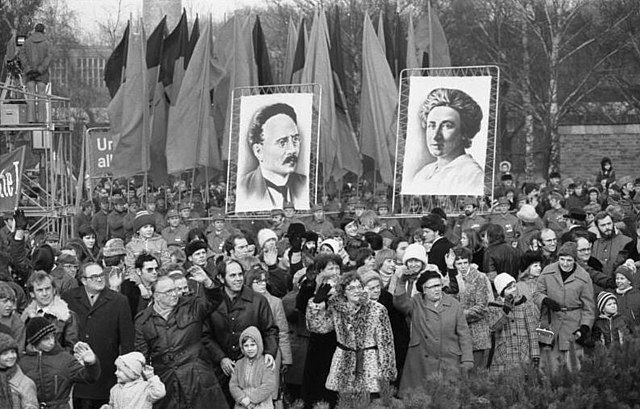
On the evening of January 15, 1919, revolutionary leaders Rosa Luxemburg and Karl Liebknecht were murdered. The trigger was pulled by members of the Freikorps, which later evolved into Hitler’s Nazi party, under the tacit order of the SPD’s Gustav Noske, the Minister of Defence and civilian commander-in-chief following Kaiser Wilhelm II’s abdication. Both Luxemburg and Liebknecht had recently been members of the SPD, with Liebknecht serving as an SPD MP.
Germany’s defeat in the First World War in 1918 sparked an uprising among disillusioned workers and soldiers, inspired by the Russian Revolution. On November 9, Liebknecht declared a free socialist republic, calling for “All power to the Soviets!” at the same time SPD leader Philipp Scheidemann proclaimed a bourgeois republic. This led to a period of dual power between the SPD-led parliament and workers’ councils, with Liebknecht and Luxemburg’s Spartakusbund playing an active role.
On Christmas Eve, sailors occupying the Kaiser’s palace were attacked by troops loyal to the parliament, followed by the dismissal of Emil Eichhorn, who served both as Chief of Police and a revolutionary. The Spartakus Uprising took place on January 5, the day after Eichhorn’s sacking, in a premature seizure of power made before the country was ready for revolution. The state seized this opportunity for revenge, allowing the Freikorps to run rampant.
Luxemburg and Liebknecht were captured by the Freikorps‘ GKSD cavalry guard division. Both were smashed in the head with rifle butts, Liebknecht was then driven to the Tiergarten. The car stopped and he was ordered to continue on foot. A soldier shot him in the back, claiming that he was trying to escape. Luxemburg was shot in her car by GKSD officer Hermann Souchon, a GKSD officer, who jumped onto the running board. Her body was tossed into the Landwehr Canal and not discovered for several months.
The German revolution was ultimately crushed, paving the way for the Nazis’ rise to power; even SPD leaders who had aided in suppressing the revolution later perished in concentration camps. Yet, the uprising and its two inspirational leaders continue to resonate. Luxemburg’s last words proclaimed: “Your ‘order’ is built on sand. Tomorrow the revolution will ‘rise up again, clashing its weapons,’ and to your horror it will proclaim with trumpets blazing: I was, I am, I shall be!”