Hi again, Hossam. Since the last time we spoke, you’ve become a doctor.
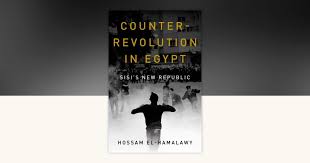
That’s true. I finished my dissertation, and now it will be published by Verso. I’m really honoured to have a book with them that will come out this May.
Maybe you can explain what the dissertation and book are about.
It’s based on research that I’ve conducted from 2018 till 2023, but in practice, it’s based on over two decades of my involvement in the dissident movement in Egypt – as a journalist, as a photographer, as a labour organizer, and also as a researcher who’s been interested in the repressive apparatus of the modern Egyptian state.
The main argument of this book is that, contrary to the general belief that a counter-revolution restores the old order, actually, the old order has failed. This is not a failure around governance and human rights and social equality and what have you. In the eyes of the counterrevolutionaries, the old regime has failed because it failed to repress the revolution. This is why the kind of regime that evolves out of a victorious counter-revolution is usually one that tries to avoid the mistakes of the past. It is even more repressive and more efficient at repression.
This is not uniquely an Egyptian phenomenon. When the German revolution failed, you didn’t get the Kaiser; you got Hitler. When the Italian revolution failed, you didn’t get a constitutional monarchy; you got Mussolini and Fascism. When the Egyptian revolution failed, we didn’t get Mubarak; we got Sisi.
Are you arguing that Sisi is objectively worse than Mubarak?
Objectively worse, but also different. And this is what’s more important. My book tries to explain how this regime is different from the previous regime. I mainly focus on a couple of things. One is how the security apparatus was organized before the coup, and how it is organized now.
The modern Egyptian repressive apparatus was born after the 1952 coup. It was fragmented by design. In 1952, we had a coup by a group of eclectic nationalist army officers who called themselves the Free Officers. They were led by Colonel Gamal Abdel Nasser, and they overthrew the British-backed monarchy, and declared a republic a year later.
There was a lieutenant colonel among the conspirators. His name was Zakaria Mohieddin, and he was dubbed as “Nasser’s Beria”, in reference to his role in restructuring the security establishment. He was Nasser’s right-hand man, like Beria under Stalin.
Mohieddin organized the Egyptian modern security apparatus, and he fragmented that apparatus by design, because the immediate concern of the officers at the time was simply a counter coup. This was very fashionable. There was a joke at the time in the Arab world, for example, that the officer who wakes up the earliest usually stages a coup. Coups were the order of the day at the time.
If your dominant perceived threat is a military coup, you fragment your apparatus. You create organizations with overlapping mandates in competition with one another. They hardly exchange information, and the communication channels are not horizontal. Only the ruler would have the bird’s-eye view.
When it comes to the security sector, the interaction between the components of the Egyptian repressive apparatus for decades, whether it’s under Nasser, Sadat, or Mubarak, shaped Egyptian politics. This formula basically continued up until 2011.
Someone would naturally ask, were the rulers only worried about a military coup? What about the people on the streets rising up? Now, it’s natural that any autocrats, if they want to stay in power, have to protect themselves from all sorts of dangers and threats. However, at the same time, there is always one dominant perceived threat. And they organise their apparatus according to that dominant perceived threat.
Up until 2011, the Egyptian ruling class never took us seriously. They knew that every now and then, you could have riots here, some protests there. But they never imagined, even in their worst nightmares, that a revolution like 2011 could take place. So now you had a revolution, and for two and a half years, the gallows haunted the dreams and the nightmares of the Egyptian ruling elites and generals, until the coup happened in 2013.
The generals who led the coup, together with el-Sisi, who was the minister of defense back then, regarded Mubarak as too weak, too lenient, someone who gave so much room for the press and NGOs to criticize him. If it wasn’t for his leniency, they said, we wouldn’t have had this catastrophe of 2011.
So they opted for a new model, which rested on two main things. One is that they unified the security apparatus for the first time since 1952. The components of that apparatus are mainly the military, the police, and the General Intelligence Service. For the first time, they were forced to coordinate and to unite these three components and to exchange information in order to face this existential threat of a revolution.
In the book, I trace how Sisi reorganized that apparatus. It wasn’t an easy job. This wasn’t just an automatic transition that the security services had opted for. There were those inside those organizations who resisted, and they had to be purged.
That is one thing. I argue that the other thing that distinguishes the Sisi regime is that while it is true that Mubarak was a dictator, he presided over a vibrant civil society, and this civil society acted as a buffer to protect society from the excessive intrusions of the executive state.
It also protected the state against a potential uprising. Let me give you a concrete example. If atrocities flared in Gaza, Mubarak was worried that this might trigger riots and mass protests in Egypt. But he had the Muslim Brotherhood, a mammoth organization that existed in almost every province in Egypt. They were reformists and were more than happy to play the game with the regime, and Mubarak would turn a blind eye and allow the Muslim Brotherhood to hold protests, which never chanted against Hosni Mubarak, never left the university campus to go into the streets, and never left the premises of the professional syndicates. These protesters never chanted against the police. They never clashed with the security forces. And if things got out of hand, Mubarak would send in the Central Security Forces, which is our version of the riot police.
If there were rising frustration in society over the deteriorating living conditions. Mubarak had a network of Salafi sheikhs who could use their Friday sermons to start blaming unveiled women, or Christians, or Shia, for the economic malaise. To divert attention, they could tell everyone it’s a moral crisis before it is an economic crisis.
If there were industrial actions flaring, Hosni Mubarak had the state-backed General Federation of Trade Unions, which was a pyramid-like structure dominated by state bureaucrats. They had a presence in almost every workplace.
Mubarak would strike a bargain with those bureaucrats, together with striking a bargain with the legal left-wing organization, the Tagammu, which was our die Linke more or less, or with the Egyptian Communist Party. These bargains defused the industrial militancy in exchange for some seats in parliament.
More importantly, there was something called the ruling National Democratic Party, a mammoth organization that existed in almost every neighbourhood in Egypt. These guys were not just thugs for the regime. They were bureaucrats who were the product of generations of experience from the Nasser time—the Arab Socialist Union days. This was the one party of the regime. And they all transformed themselves and metamorphosed into the National Democratic Party.
These guys had 20 or 30 or 40 years of bureaucratic experience. They knew how to wield power. So, if you had a problem in your neighbourhood with the police or with the authorities, before you go and set yourself on fire in front of the police station, you would go to your local NDP guy. You would talk to him, and in exchange for a small bribe, or even for free, he would act as a mediator between you and the state to solve the problem.
Now, Sisi and the generals saw this as one of the reasons for the “catastrophe” of 2011. So the kind of regime that they built after 2013 rested on unifying the security apparatus and completely destroying civil society. Egypt is now being ruled without a ruling party, without opposition, without NGOs, without independent trade unions, without even the old power structures that Hosni Mubarak had.
Instead, you have the state micro-managing society on a daily basis, without any buffer in the middle. You have the repressive arm of the state, meaning the military, the police, and the intelligence service, who are cannibalizing the civilian organizations of the state.
So, for example, many of the responsibilities of the various ministries and civil agencies were transferred to the military. It is true that since 1952 and especially under Mubarak, the regime used to pump in retired officers into the bureaucracy. This is not new, but what’s new here is, first, that it’s being done on steroids at this point. And secondly, officially, the military institutions are now replacing the civilian institutions.
If you want to know which military agency is running what sector in Egypt, simply go to the Facebook page of Sisi’s presidential spokesperson, where the guy posts daily pictures of whatever meetings Sisi is having. Look at any picture at any point of the day, and examine the attendees. Each civilian official would have a military counterpart. The latter has the upper hand.
For example, when he tells you that today, Sisi held a meeting to discuss the agricultural sector, on Sisi’s right will be the Minister of Agriculture and the Minister of Irrigation. On the other side will be Colonel Bahaa el-Ghannam, who is now running the Future of Egypt agency, which is the business arm of the Air Force. The Air Force is now in charge of our agricultural sector, believe it or not.
If Sisi is having a meeting to discuss education policy in Egypt, you would find the Minister of Education sitting on one side of the table. On the other side would be the director of the Egyptian Military Academy. So it’s the Egyptian Military Academy that is now running the education sector.
Starting from 2023, every single applicant for any civil service job has to be vetted by the Egyptian military academy. I’m talking here about every single civil service job, where, after you pass your exam, you go to the Egyptian Military Academy for six months, where you go through an ideological indoctrination boot camp.
You wake up in the morning, and you practice sports just like a conscript. You do physical training, and then you take courses and classes on national security, on the conspiracies to bring down the state, and what they’re calling “Fourth generation warfare” – a crackdown on internal dissidents who are serving foreign powers without even knowing.
You’ve talked a lot about how the state has restructured itself and tilted towards more naked repression. The history of Egypt and the history of the region show that naked repression of its own will not sustain itself indefinitely, that there will always be discontent. I presume there is discontent about Palestine and about living conditions. What’s the state of our side? You’ve explained well what their side is doing. Is there any organised attempt to counter this?
At the moment, the situation is bleak. I will not try to paint it as rosy. First, after the coup, Sisi started cracking down on the Islamist opposition, mainly the Muslim Brotherhood, but also the Salafis and the Jihadis. And then he started cracking down on the secular opposition, whether they are on the left, liberals, or youth groups. He dismantled all of them, killed scores of activists, and imprisoned tens of thousands of others.
From 2011 to 2021, 43 new prisons were built. The prison population is very difficult to estimate because there is no transparency whatsoever. Some figures ran as high as 60,000 political prisoners at some point. Now, I think that the number has gone down to anywhere between 10,000 and 20,000.
The Egyptian left, meaning our side, has been largely neutralised and destroyed. And this happened through mass arrests, through drying up the funding of these organisations, through security crackdowns. Then the regime also adopted this revolving door detention technique called Tadweer in Arabic, which means recycling.
They will arrest you today and hold you in pre-trial detention for, let’s say, a couple of years. on some bogus charges. Then, before you go on trial, they will release you on paper, but accuse you of the same things in a new case. So you stay in this revolving door forever. You have people who have been recycled for over seven years. No trial, just getting in and out on paper.
At the same time, this is not a reason to despair. I always say this, there is a saying: “The Darker the Night, the Brighter the Star”. We are Marxists who understand the dialectics. This means that even when there is the worst kind of repression, it’s laying the seeds for opposition.
What’s been the reaction of the Egyptian street to the ongoing attacks on Gaza?
It’s been largely muted compared to the previous decade. I am 48 years old. I got radicalised through the Palestinian cause. My political upbringing was always through solidarity with the Palestinians, and it’s through this solidarity that I got into radical leftist politics.
But what has happened is that under the sheer level of repression that the country has seen, most of the organisations have been destroyed, and there is also fear among the public. It would be suicidal to have a protest for Palestine.
Despite all of that, with the outbreak of the war on Gaza, spontaneous protests did take place on the campuses. These were probably the first protests that the campuses had seen in almost a decade since Sisi pacified them. There were also sporadic protests in mosques and public squares, but the state cracked down and arrested hundreds. As I’m talking to you today, there are at least 120 people who have been in prison in pre-trial detention since 2023.
At the same time, the regime was spreading through the media that Sisi was doing its best to disrupt the transfer scheme and the expulsion of the Palestinians into Sinai, and that we’re doing our best to help our Palestinian brothers, even though, at the end of the day, Sisi was completely complicit in this war.
That’s why it didn’t translate into mass protests in the streets, but it revived this sense slightly, and solidarity with the Palestinians was expressed through other forms, especially the boycott campaign, which spread like wildfire in Egypt.
What has been the reaction in Egypt to the recent developments in Iran?
It’s been mixed, depending on the kind of news they are receiving. There will definitely be a section of the Egyptian public who would buy into the propaganda that the whole thing is solely about Israelis bringing down a regime that’s anti-Israeli. But I would say that the majority of Egyptians would find parallels between themselves and the Iranian protesters.
What triggered this mass wave of protest in Iran is the deteriorating economic condition and sheer brutality of the state, which is something that the Egyptians know quite well. So I think Egyptians will be watching closely and also contemplating whether something similar could happen in Egypt.
Of course, you cannot predict the future, but what could happen next in Egypt?
I am hopeful for a very simple reason. Sometimes, a counter-revolution could diffuse the factors that led to the outbreak of the revolution in the first place. Some counter-revolutions are successful, not just because of repression, but because they also address those problems. This is not the case in Egypt.
To put this in clearer terms, the 2011 uprising did not happen simply because activists or opposition figures decided to mobilise. Individual action and political agitation matter, but they are never enough on their own. Revolutions emerge when broader structural conditions make society combustible, and when organised political forces are able to intervene at the right moment.
In Egypt, two such objective conditions came together. The first was pervasive political repression and routine police brutality. The second was social injustice, particularly the unequal distribution of wealth and the steady deterioration of living conditions. These factors created a society primed for explosion.
What was missing for long periods, and what briefly materialised in 2011, was what Marxists call subjective intervention. By this, I mean the presence of organised actors, networks, and movements capable of translating popular anger into sustained collective action. The counter-revolution did not resolve any of the underlying structural problems. On the contrary, repression intensified, and economic conditions worsened. This means the objective conditions remain firmly in place. What remains absent, for now, is that organised political intervention capable of turning discontent into a mass challenge to the regime.
Did the counter-revolution provide answers or solutions to these problems? No, they actually made it even worse. Today, when it comes to political repression, Hosni Mubarak is a human rights activist compared to Sisi. When it comes to the economic conditions, many people are yearning for the Mubarak days. I don’t blame them when they say: It wasn’t that bad under Mubarak.
The existence of these two factors means that there will always be an environment that’s fertile for resistance. What’s missing here is the subjective intervention. And over the past few years – and this got accelerated by the genocide in Gaza – there’s been a slight revival in left-wing activity. It’s still very confined to the margin. But this margin did not even exist a few years ago.
Simultaneously, there is an increased wave of industrial actions, not on the same level as the waves in 2006 or 2011, which was our winter of labour discontent that made the road to the revolution. But an incremental increase is happening. In 2025, at least 100 labour protests were recorded, and these are the ones that we know about. There will definitely be other wildcat strikes that we couldn’t know of.
These strikes are triggered by low salaries, and by the management refusing even to implement Sisi’s decrees of raising the national minimum wage. So, managements are not even sticking to that bar that the government is setting. Amid this industrial action, this creates an audience for people like you and I to start talking socialism again.
Does the fact that things are now worse than they were before 2011 mean that the Arab Spring was a failure?
I’m not a fan of dichotomies or of binaries, saying that something failed, or something didn’t. That wave of the Arab Spring, or whatever you want to call it, as some people don’t like that term, has been defeated; there is no question about that. But this is not the end of the story. I would disagree with the kind of narrative that sees defeat as the end. There are people who have seen this revolution, and they are still alive.
In the 1990s, when my comrades and I were starting in underground cells trying to talk about revolution against Mubarak, people treated us like lunatics, like extraterrestrial aliens. What are you talking about? We never had a revolution in this country, or the last time we had a revolution was in 1919, against the Brits.
Today, you can tell an 18-year-old to look at YouTube, in order to find footage of what happened. This makes the revolution an actuality, something concrete, and not just something abstract that you read about in books. You’ve seen it happening.
This is one of the positive things that came out of the Arab Spring. At least when we are talking about a new revolution, there is something concrete that we’re based on. But I would say that this first wave definitely got defeated. But let’s learn from it, build on it, and take the movement forward.
Is there anything that you haven’t said that you’d like to add?
One last thing is that comrades here in Germany have a role to play. You are in the belly of the beast. Sometimes people romanticise the global South. They say: “That’s where the repression is, so that’s where the revolutions will happen. We will never see it here in Germany”. That’s not true.
The entire capitalist system is getting into a crisis, and we’ve already started to see symptoms and signs of it, whether it’s here in Germany or in the industrialised West. People here in Germany and in Europe and in the West have a role to play. This role is number one: you reign in your own governments from supporting and endorsing our regime.
One of the main reasons why the counter-revolution prevailed in Egypt was that it was endorsed by regional and global allies, and that would include Germany. So you have a role to play in pressuring the local government here into stopping support for Sisi.
On the other hand, there will be a rise in social dissent here in Germany. There is no question about it. This is not because Germans are left-wing or right-wing, but because the economic situation is deteriorating. If you are not organised enough, people will start looking to the far right for answers if the radical left is not ready with those answers.
Any local fight that you engage in here in Germany is helping us in Egypt. It’s not just about protesting in front of the Egyptian embassy. If you win a fight against the privatisation of the S-Bahn, you are helping the Egyptian revolution. If you win a fight here against the cuts in social spending, you’re helping the Egyptian revolution. If you bring a halt to this militarisation drive here in Germany, you’re helping the Egyptian revolution.
The entire capitalist system is like a matrix. You weaken it in one spot, and that helps all the other ones.
Your book is now available for pre- order. How can people order it? You can pre-order on the Verso website. You can also order via any book-selling platform, including Amazon, but I would prefer that you buy from Verso directly.