
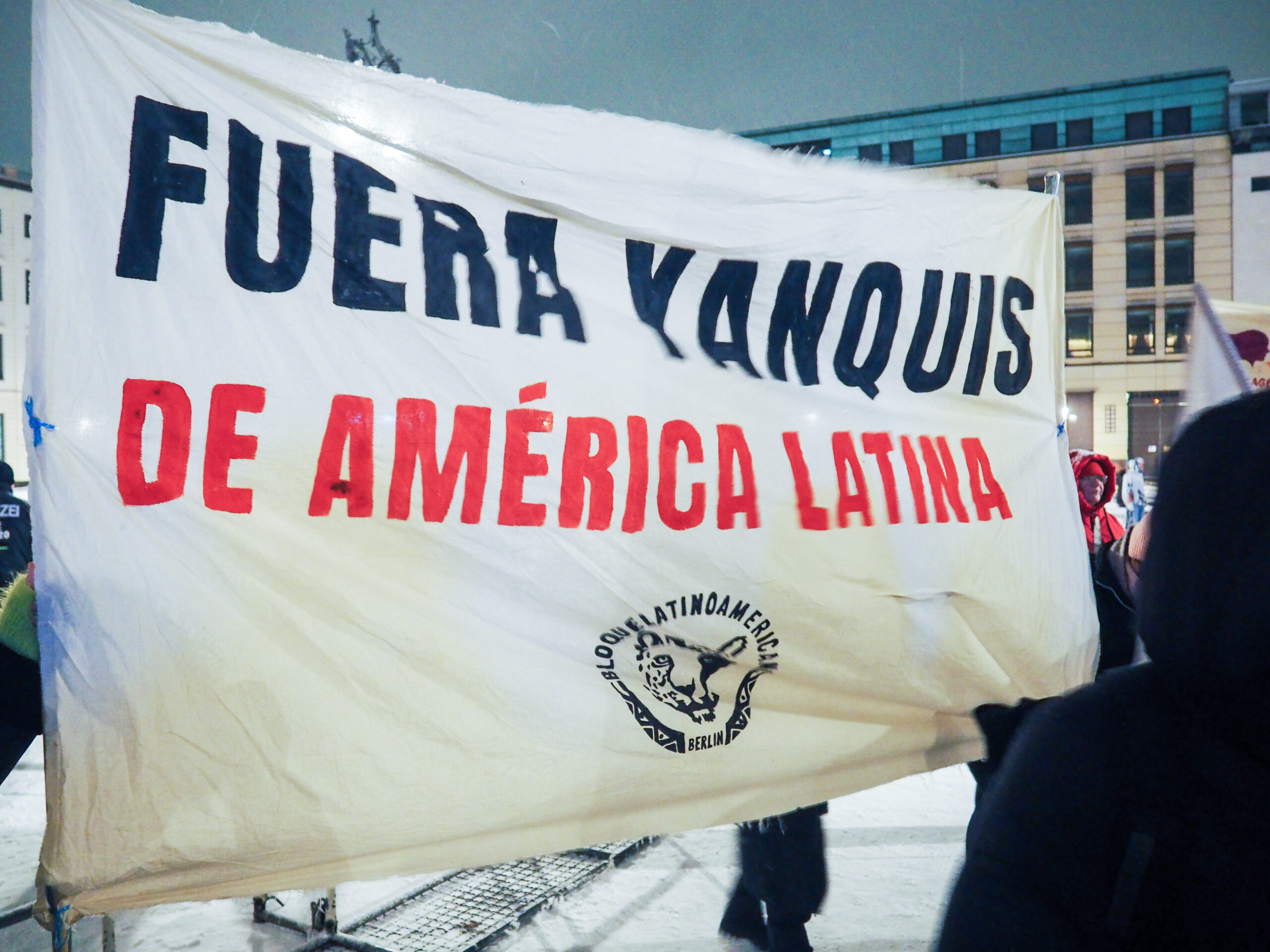
In the dawn of an ordinary day at the beginning of January 2026, the world awoke to shocking news: a brutal U.S. military aggression and the kidnapping of Venezuelan President Nicolás Maduro and his wife in a complex operation executed with supreme military and intelligence precision. Despite the direct military attack and intensive bombardment, the operation relied heavily on a massive employment of digital technology (as reported by Defense One, NBC News, and Just Security). Media coverage focused on political aspects without real attention to the pivotal role played by advanced technology. It was not just a traditional military intervention, but rather a comprehensive digital war that preceded the arrest by long months of planning and monitoring.
Before continuing, I would like to point out my reservation regarding the policies of the Maduro regime in suppressing dissenters, restricting freedoms, and tightening the grip on leftists and labor unions. Our critique of American capitalist intervention and the use of technology as a weapon for hegemony does not mean justifying the repressive practices of the Maduro regime against progressive forces and the labor movement. What we are highlighting here is the technological and strategic lesson that this incident provides to all leftist and progressive movements.
In this operation, the most advanced American satellite surveillance systems were used to track the movements of the Venezuelan leadership via satellites. Big data analysis extended to drawing accurate maps of government communication networks with all their complexities. The hacking of electronic systems was precisely planned to disable them at the decisive moment, making the Venezuelan leadership completely isolated from its bases. The employment of advanced digital techniques in analyzing millions of calls and messages was not just traditional espionage, but rather a complex operation to pinpoint the locations of leaders accurately and predict their next moves. The programmed manipulation of media and social media networks was an organized campaign to shape public opinion in favor of the intervention, and to portray the operation as “liberation”, not an aggression against the sovereignty of an independent state.
These are not scenarios from science fiction movies, but a documented reality we live today. The U.S. National Security Agency possesses the PRISM program, which was revealed by Edward Snowden and which monitors global communications without discrimination. Companies like Palantir Technologies provide highly advanced data analysis systems to the American intelligence establishment. The capitalist technological system today is capable of comprehensive surveillance and systematic tracking of political movements and political actors. The most dangerous thing is that there are many digital technologies and weapons that are still within secrecy, as was the case with the internet itself, which was not revealed to the public until years after its military and security use.
Technology as a Tool for Capitalist Control and Hegemony
What happened in Venezuela is not an isolated incident. It is an essential part of a comprehensive digital capitalist strategy that we have seen repeated in many places in the world. The clearest lesson from the incident of Maduro’s arrest is that capitalism in its current stage no longer relies only on traditional military force. It has developed a complex digital system capable of penetrating geographical borders, monitoring individuals and groups with amazing accuracy, and manipulating information and shaping public consciousness in ways that were not possible in any previous era. It is an invisible war, its battles take place in cyberspace and data servers, having proven more effective and less expensive than bombs and planes.
This reality poses a fateful question to the forces of the Left: how can liberation movements that still rely on traditional meetings, distributing paper leaflets, using unencrypted phones, and harnessing the internet in a primitive way, face a digital capitalist system with this level of development? The answer is clear and painful: it cannot, unless it decides to enter seriously and strategically into the technological field, not as passive consumers of capitalist technology, but as developers and innovators of independent digital alternatives that protect the struggle from penetration and suppression.
What we are witnessing today is a reproduction of historical class exploitation by more advanced and hidden means. This exploitation is no longer confined to factories or farms, it has extended to include the digital space itself. The algorithms of digital companies exploit manual and intellectual workers in ways more cruel than any human manager. These algorithms determine wages based on supply and demand at every moment, impose exhausting working hours without regard for health or family status, and issue automatic penalties without the possibility of appeal.
In the field of consciousness: the algorithms of giant platforms are used to shape the consciousness of billions of people. These algorithms systematically promote the ideology of capitalist consumption and the culture of individualism, while fighting leftist and progressive content through techniques of “reach reduction” and “shadow banning.” The consciousness of millions of young generations is shaped not through reading and critical thinking, but through algorithms that decide what they see and what they do not see.
In the field of surveillance and control: digital technologies are used today to deepen political and social control in ways that were not previously possible. Recognition and analysis systems allow tracking political activists and monitoring their behavior and networks with high accuracy. These technologies are exported to authoritarian regimes, transforming digital and public space into a permanent field of surveillance.
The Historical Stake for the Left, Toward a Liberatory Digital Revolution
The technological factor is no longer just a secondary addition in the Left’s battle against capitalism. It has become an essential condition for survival, effectiveness, and influence. Facing this reality cannot be limited to criticism, but requires specific positions and policies, transcending the exposure of capitalist hegemony to working on dismantling it and redirecting technology toward serving the general masses. Developing leftist capabilities in the technical field is a vital necessity no less important than developing political and organizational capabilities. Just as the forces of the Left cannot rely on capitalist media and seek to build their independent media, they must also work on building their independent technological alternatives, whether in social networks or digital tools and others.
What the current digital revolution reveals is that we live in a historical moment in which the contradictions between the massive development of the productive forces and capitalist social relations, which are no longer capable of containing this development, become clear. The struggle in digital space must transform into an organic extension of the socialist struggle on the ground, and not just a separate arena. Linking the technological struggle and the class struggle is essential, because digital hegemony is just an extension of the hegemony of capital.
The possible solution now is to develop open-source, transparent systems, managed democratically with societal controls, in addition to pushing toward enacting international laws that regulate the work of digital technology and ensure its service to society as a whole. But this is not enough. The radical solution is building real leftist technological alternatives with progressive orientations and societal ownership, through which this technology is snatched from the grip of the market, and employed in dismantling relations of exploitation, and contributing to building a new, more just and humane society.
The Left’s use of current digital technology must be accurate, deliberate, and cautious. Applications developed within a capitalist environment cannot be trusted without deep critical awareness. Extreme caution must be taken when dealing with sensitive data and information, for the unstudied exploitation of these tools may lead to a security breach or information leak that exposes leftist organizations to danger. Therefore, it is necessary to develop advanced digital security protocols, adopt more independent open-source applications, and train members on digital security practices.
The Decisive Historical Moment for the Left
While what happened with Maduro is not a singular event, it is a sharp warning to all progressive regimes and leftist movements in the world. It is a practical announcement that the digital battle has turned into a central arena of class struggle. What happened in Venezuela reveals that digital capitalism has come to rely on technical vulnerabilities that grant it the possibility of influencing the stability of progressive regimes, attempting to paralyze their leaderships, and betting on engineering the consciousness of their societies digitally. The danger does not affect Venezuela alone, but it could extend to threaten every leftist and progressive experience. We are in front of a new stage of class struggle, in which technology and artificial intelligence are used as a strategic weapon to strike leftist movements in their cradle. The global socialist struggle today is directly targeted by digital penetration, comprehensive surveillance, and the prior drying up of any potential revolutionary act.
The basic question: Are we, as leftist and progressive forces, really ready to fight this digital war? Do we have the courage to rebuild the Left intellectually, organizationally, and technically? Are we ready to overcome fragmentation and division, and understand that the fate of every progressive experience has become linked with the fate of others? The historical moment does not forgive, and digital capitalism does not wait for our hesitation. Either we engage with awareness and struggle in this battle, and reformulate an alternative socialist project capable of facing the digital age, or we are left on the margins of history. Accepting the latter fate is inevitable extinction. The true historical stake for the liberation project is that it transforms into a digital project with awareness and organization.
Digital technical knowledge must become an integral part of contemporary leftist culture, and here the vital role of youth emerges as a vanguard for this transformation. We must build leftist technical cadres, investing the energies of young generations in developing alternative digital tools, and social networks that are not subject to the algorithms of capital. We must understand the programming code as we understand the political text.
This effort requires coordination and common action globally through building digital internationals and alliances whose goal is to develop the digital struggle of the Left in the whole world. Building these independent technological alternatives is fraught with dilemmas: the dilemma of depending on knowledge developed in the bosom of the capitalist system itself, the dilemma of the massive resources required, and the dilemma of coordination between feuding leftist forces. Therefore, this project must be a strategic tactic that starts from the critical use of available tools, building technical solidarity networks, and striving to develop an alternative core in the spaces provided by open-source technology, with the recognition that it is a long-term cumulative project.
The Left that had the noted role in promoting freedoms, equality, and justice can overcome this current state. Let this digital battle be a moment of new birth for an electronic digital Left merged with field struggle, more daring and radical and scientific. The battle for control over digital technology is not a technical battle only, but a battle for the future of humanity itself. Digital socialism, in this sense, is not a choice among choices. It is the existential condition for the survival of the socialist project itself in the twenty-first century.