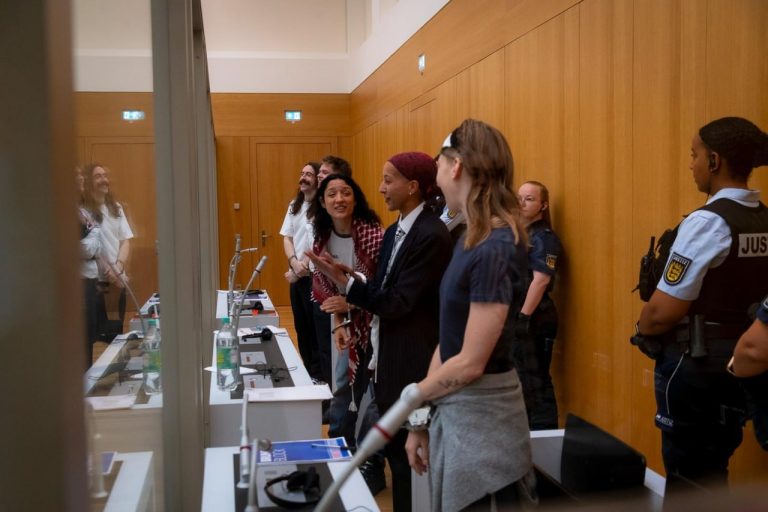

Editor’s Note: On 12th December 2025, The Left Berlin published a report by Roser Garí Pérez about the harsh pre-trial conditions of the Ulm 5, facing trial for a non-violent action against arms manufacturer Elbit Systems, which is complicit in genocide in Gaza. On 26th January, the Ulm 5 filed an appeal. Here we publish a statement by their lawyers, preceded by a summary by Roser of their current condition.
The pro-Palestine movement in Germany has been brutally repressed and persecuted for decades, but since October 2023 the state’s physical, psychological, and legal violence has intensified.
Invoking Germany’s Staatsräson—the unwavering defense of Israel, a state currently on trial at the International Court of Justice (ICJ) for committing a textbook genocide in Gaza—German police have arrested thousands of people, with hundreds of cases now moving through criminal courts across the country. In Berlin alone, police claim to have initiated more than 11,000 proceedings.
People prosecuted for minor offenses such as trespassing, chants, or symbols are treated as dangerous criminals, with cases often heard in high-security courtrooms.
While state violence is largely ignored, or even encouraged, by the political elite and significant parts of the population, activists opposing its most extreme expression—Germany’s complicity in the genocide of the Palestinian people—are criminalized and dragged through lengthy, exhausting legal procedures. Few cases illustrate this political persecution more clearly than that of the Ulm 5.
Further restrictions
Despite the nonviolent and highly targeted nature of their action—which posed no threat to public safety—the German state appears determined to make an example of the Ulm 5 and has denied them bail.
Since their incarceration, they have been subjected to disproportionately harsh treatment. Beyond the abuses documented in my previous report, the Ulm 5 have faced severe restrictions on communication and contact, as well as inhumane detention conditions, including the following:
- One individual is completely denied phone contact with lawyers, family, or friends.
- Others are permitted phone calls only with legal counsel, with all communication with family and friends prohibited.
- In-person visits are severely restricted: one person is allowed two one-hour visits per month, while another is permitted only one hour per month, divided into two 30-minute sessions.
- Video visits are rendered largely ineffective due to poor internet quality, reducing a scheduled one-hour visit to as little as 20 minutes. Some visits take place behind floor-to-ceiling glass, with all physical contact prohibited.
- All visits by family and friends are monitored by police and a translator.
- There is a systemic failure to properly communicate visit and phone-call arrangements to both prisoners and their families, resulting in missed connections and significant distress.
- Incoming mail is poorly photocopied, often rendering letters difficult or impossible to read.
- One individual was initially placed in a shared cell they felt was unsafe and was later moved.
- In another case, an incident occurred in a nearby prison corridor in which a person took their own life.
- Prisoners report inadequate food, with individuals stating they often feel hungry.
- Heating and clothing provisions are insufficient; warm clothing sent by families arrives extremely slowly or is turned away entirely.
- During holiday periods, individuals were at times confined to their cells for entire days due to staff shortages.
They also suffer arbitrary restrictions on personal items and information:
- One individual has been restricted to ordering only three books in the four and a half months since their arrest, with no books permitted to be sent from outside.
- Access to newspapers and general information about the prison system is withheld, while explanations provided by staff are often sarcastic or unhelpful.
- Individuals are prohibited from discussing their case with family members during visits, including relaying updates from their lawyer.
- All visits are surveilled by police representatives and a translator.
- All written correspondence is monitored by the prosecutor or presiding judge.
The activists also face inadequate access to legal counsel and basic procedural rights. Phone calls and meetings with their lawyers—legally unrestricted—have been repeatedly cut short by prison staff, in apparent violation of the law.
Some individuals report being denied adequate healthcare despite having potentially serious medical conditions.
The trial dates currently offered by the court span nearly three months, from late April to late July. As a result, pre-trial detention may extend to as long as 11 months, exceeding the standard six-month maximum without adequate justification. The court has scheduled hearings non-consecutively over several months, creating significant logistical and financial barriers for lawyers, families, and supporters attempting to attend.
The disproportionately punitive treatment these activists are facing appears designed to punish and isolate them before their trial has even begun—while also serving as a warning to others in Germany who might consider challenging the state’s Staatsräson.
By preemptively punishing those who seek to uphold international law and prevent genocide, Germany adds yet another chapter to its complicity in Israel’s genocide of the Palestinian people.
Press release: 26 January 2026
Dear Sir or Madam,
We, the defence lawyers for the ‘Ulm 5’, have today lodged an appeal against their detention. Our clients must be released from pre-trial detention immediately.
The clients have now been in pre-trial detention for almost five months without interruption. The stricter conditions continue to apply. This includes strict control of telephone calls, visits and letters, confinement to their cells for up to 23 hours a day, and restricted access to books and communal events.
The enforcement of pre-trial detention was disproportionate from the outset. The act was clearly aimed at a legitimate goal, namely, to end the killing of civilians in Gaza. Only material damage was caused in this context; no people were injured. Elbit Systems Deutschland GmbH & Co KG is a wholly owned subsidiary of the Israeli company Elbit Systems Ltd. The latter profits considerably from the war in Gaza and supplies a large proportion of the drones used there. However, no investigation was conducted into this line of defence based on justifiable emergency assistance, and a corresponding request by the defence was ignored by the Attorney General’s Office. The investigating authorities are obviously primarily concerned with making an example of our clients, who are committed to fighting occupation and genocide.
On top of that, now that charges have been brought, the Stuttgart Regional Court is violating the principle of expeditious proceedings, which must be given special consideration in detention cases (Art. 5(3) sentence 2 ECHR; Sections/§§ 121, 122 StPO). The main hearing is not scheduled to begin until the end of April 2026 and is expected to last until at least the end of July. The Regional Court is legally required to begin the trial by the beginning of March 2026 at the latest. The unlawful detention of our clients is thus being prolonged indefinitely, which constitutes a significant violation of their fundamental right to liberty.
All defence lawyers have therefore lodged an appeal against detention with the Higher Regional Court of Stuttgart today.
The signatories are available to answer any questions.
Yours sincerely,
Solicitor Dr Maja Beisenherz, Munich, Info@beisenherz.eu, 0177 / 70 95 812
Solicitor Mathes Breuer, Munich, breuer@kanzlei-abe.de, 0175 / 52 46 963
Solicitor Benjamin Düsberg, Berlin, mail@rechtsanwalt-duesberg.de, 0157 / 30 30 8383
Solicitor Rosa Mayer-Eschenbach, Munich, eschenbach@kanzlei-abe.de, 0176 / 65 35 9443
Solicitor Christina Mucha, Memmingen, info@kanzlei-mucha.de, 08331 / 69 08 136
Solicitor Nina Onèr, Berlin, kanzlei@ninaoner.de, 01520 97 33 278
Solicitor Matthias Schuster, Berlin, mail@anwalt-schuster.de, 0176 / 24 75 8230
Solicitor Martina Sulzberger, Augsburg, kanzlei@anwaeltin-sulzberger.de; 0821 / 50 87 3850
(This press release was written in German. Translation: Ana Ferreira. Reproduced with permission)