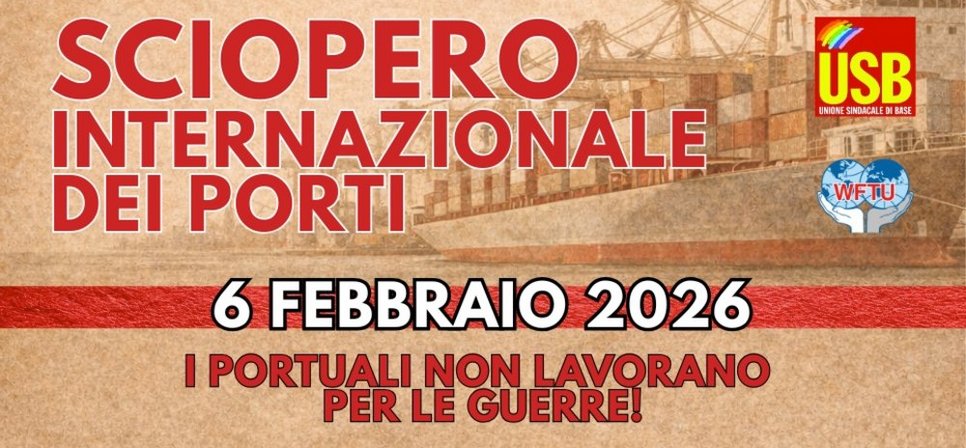
On the 6th of February 2026, dockworkers in twenty-one ports across the Mediterranean, stretching from Tangier, Morocco to Mersin, Turkey, will go on strike. They are striking under the slogan: “The Ports do not work for War”. The strike is led by the Italian-based Unione Sindacale di Base (USB) and is affiliated with the World Federation of Trade Unions (WFTU)—their parent organisation.
Their demands are spelled out in unequivocal terms on the USB website. Here are their demands:
- Guarantee that European and Mediterranean ports are places of peace and free from any involvement in the war
- Oppose the effects of the war economy on our wages, pensions, rights, and health and safety conditions
- Block all arms shipments from our ports towards genocide in Palestine and any other war zone, and to demand a trade embargo on Israel from governments and local institutions
- Oppose the EU’s rearmament plan and to stop the forthcoming EU and European governments’ plan to militarise strategic ports and infrastructure
- Reject rearmament as an alibi to introduce further privatisation and automation of ports
In an increasingly belligerent Europe, defense spending has consistently increased year after year. This trend has persisted for the last decade. In 2025, EU member states have spent more than 2% of their GDP on defense. This is a ~63% increase in defense spending compared to 2020 .
On the other hand, the population at risk of poverty hovers close to 20% in Italy, and even higher in other EU states. The statement by the Italian union makes it clear that these imperialist wars and militarisation are not in the interest of workers, and never will be.
As Fabian Lehr points out in this incisive analysis, a war economy based on imperialism, cannot be in the interest of workers. It will only benefit large corporations, like Rheinmetall, who will make windfall profits by charging the State whatever they can get away with. This is already reflected in the stock markets—good harbingers of what to expect—where Rheinmetall’s shares have more than doubled over the last year. The problem with a war economy is, that once you turn metal into tanks, bombs, and guns, there are only two possibilities: either they sit around as inventory, or you find a way to sell or use them.
Over the last two years as Israel commits genocide in Gaza, Germany has actively exported arms to the Israeli military. Germany happily ranks as their second largest supplier worldwide. With this re-armament drive, it seems like Germany will have to look for even more warring parties to sell to, or perhaps invent a war of its own.
German trade unions
While the dockworkers strike is a clear sign that the WFTU holds a principled, class-oriented, anti-war stance, the trade union discourse in Germany is far more concerning. At its annual press conference on January 26th, IG Metall—Germany’s (and one of the world’s) largest trade unions comprised of 2.2 million members—released its Initiative for Jobs and Economic Recovery. It says:
“The situation is objectively difficult, but by no means hopeless. Now it’s about setting the right course. Because there are stable industries undergoing transformation and promising fields of the future. These are described in the “High-Tech Agenda Germany” and outlined by the IG Metall “Opportunities Map”: Besides products for the mobility and energy transition, aerospace, AI and quantum computing, defense and security, medical technology, and robotics. We must now seize these opportunities boldly and decisively.”
The Union takes a conciliatory tone towards state policy, and towards big businesses. One gets the feeling that the German worker is expected to be thankful to the Union for getting them “opportunities in fields like aerospace, defense and security”, but is not supposed to question the foundation on which this edifice is built!
Why is there such a stark difference between the response of Italian and German unions? One possible reason is that the right to strike in Italy is an individual right; there is no obligation for a strike to be called by a union. Alternatively, in Germany there are far stricter rules around who can call for a strike (only trade unions), and for what reasons (quite restrictive).
This interview with Mohammed Alattar, a Palestinian dock worker from Hamburg, shines a light on the nature of the problem. Responding to a question about the difference between unions in Italy and Germany he says:
“Unlike Germany, the unions in Italy are combative and pursue much more the interests of workers than those of the government. Union executives, trustees, and other workers have marched together on the big demo. I have even witnessed how workers, by occupying a terminal, prevented the loading of a ZIM ship with armaments for Israel. Here, on the other hand, the DGB has nothing better to do than to repeat the pro-Zionist propaganda narratives of the German government and to support the militarisation of Germany.”
It is not all gloom and doom though. Initiatives like Rheinmetall Entwaffnen have been organising at local and national levels to try and shut the weapons industry down. A group of trade unionists called Gewerkschafter 4 Gaza have been trying to get the trade unions in Germany to change course.
Forcing structural change in Germany will be a huge challenge, but perhaps the Mediterranean dockworkers strike can inspire workers in Germany to reclaim their power from Union bosses—and lead an illegal strike or two, so that one day we no longer have to take to the streets and say: “Deutsche Waffen, Deutsches Geld, morden mit in aller Welt!”