On May 10, 1940, Nazi Germany invaded the Netherlands despite its declaration of neutrality. The unprepared Dutch army fought for four days before the government surrendered on May 15, following the bombing of Rotterdam.
The new leader, Austrian-born Arthur Seyss-Inquart, recognized that National Socialism had little support in the Netherlands. The Dutch National Socialist Party (NSB), led by Anton Mussert, was widely despised, and the population rejected Nazi ideology. Seyss-Inquart’s initial strategy relied on a softer occupation: he pursued gradual Nazification through collaboration with local authorities and avoided antagonizing the Dutch people, hoping to convince them that a new Nazi-led Europe represented their future.
Yet despite this gentler political approach, the persecution of Jewish people remained a priority. The Nazis quickly imposed signs banning Jews from public spaces, and NSB members regularly harassed and assaulted residents in Amsterdam’s Jewish neighborhoods. This escalated in February 1941 when an NSB gang clashed with Communist resistance fighters, resulting in an NSB member’s death. The Nazis exploited this incident to launch mass arrests: on February 22 and 23, they arrested 400 Jewish men in Amsterdam and deported them to camps in Eastern Europe. The raids shocked many non-Jewish Amsterdam citizen and sparked the February Strike.
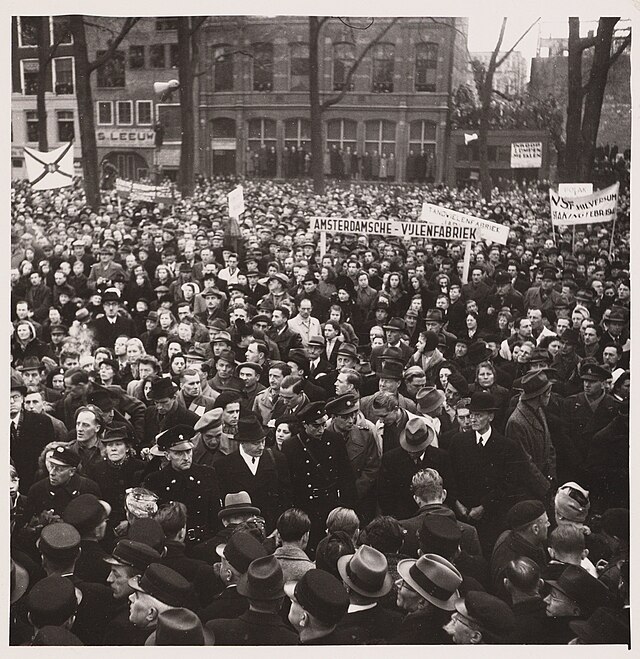
The February Strike occurred on February 25 and 26, the same week as the arrests. Called by the then-banned Dutch Communist Party (CPN) with the motto “STRIKE!!! STRIKE!!! STRIKE!!!,” the action began in Amsterdam when tram workers stopped work, followed by citywide participation. It quickly spread to Haarlem, Velsen, Zaandam, Hilversum, Bussum, Weesp, Muiden, and Utrecht.
Lasting two days, the strike was the only open mass protest against Jewish persecution in occupied Europe. The German response was swift and violent: nine people were killed and many imprisoned. The broader consequences proved even more severe. The Nazis swiftly cracked down on the CPN, executing four communist strikers and fifteen resistance members within days. Twenty-two men who organized the strike were deported to forced labor in Germany, where two died. The strike demonstrated that the soft occupation strategy would not succeed, forcing the Germans to quickly change course.
Though the strike represented Dutch resistance to Jewish persecution, collaboration with Nazi Germany remained widespread. Of the 140,000 Jews living in the Netherlands before the war, 107,000 were deported to camps. Approximately 25,000 Dutch people joined the SS. While the strike highlighted the Communist Party’s role in the resistance movement, this legacy was largely forgotten after the war. Communist organizers were barred from annual memorials for years, and Dutch police and military disrupted tributes to Communist resistance fighter Hannie Schaft. Only after the Cold War’s end did the Dutch Communists receive proper recognition for their fight against Nazi occupation.