
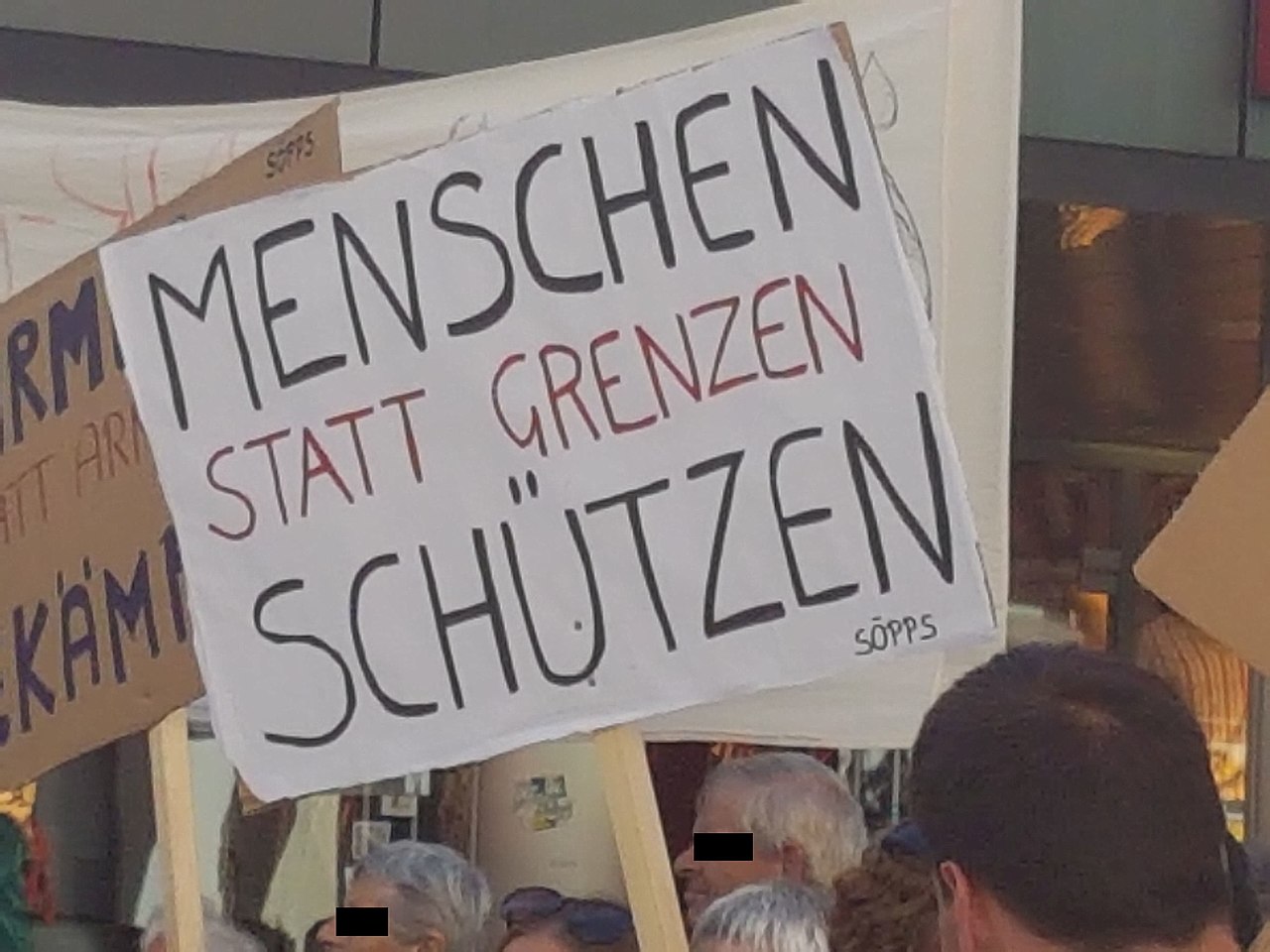
Amidst these days’ horrifying news, the German parliament was able to pass the most severe tightening of asylum legislation in Germany since 1993 almost unnoticed. The adoption of several pieces of legislation which implemented the New Pact for Migration Asylum passed on February 27th with the votes of the CDU/CSU and SPD, except for one. This brought the EU-level reform of the Common European Asylum System (CEAS) into German law. While most of the EU legislation can be directly applied, each EU state reserves some level of discretion when implementing the reform. This article seeks to highlight some of the main consequences for people on the move in Germany that will follow the adoption of the Pact into German law.
The EU Pact, to put it simply, exacerbates the use of mass detention, deportations, surveillance, and externalisation in order to make it as hard as possible for people who arrive as asylum seekers to actually receive asylum, as I have analysed more thoroughly here. The German implementation, as the following analysis will show, furthers this process by moving the very deterrence and control strategies deployed at the EU borders to Germany.
Background: The New Pact on Migration and Asylum
The reform process of the common European rules on migration and asylum was initiated in 2016 by the Commission after the previous rules had proven dysfunctional and led to the catastrophic reception conditions that people on the move face in places like the Greek islands. After a lengthy negotiation process, the Commission, European Parliament, and the Council of the EU adopted the new legislation in April and May 2024.
The Pact was officially framed as a historic step to render the European asylum system more efficient and fair, as illustrated Commission president Ursula von der Leyen in April 2024:
“It will be making a real difference for all Europeans. First, more secure European borders. […] Second, faster, more efficient procedures for asylum and return. This means that those with no right to asylum will not be allowed to enter in the European Union, while those escaping war or persecution can count on the protection they need. […] And third, more solidarity with the Member States at our external borders. Because they manage the pressure from illegal migration.”
Following the Pact’s adoption on EU level in May 2024, member states had two years to develop implementation plans and transpose the reform into national law. Germany published its plan in December 2024, followed by last week’s vote on the legislation.
What is in the laws adopted by the German parliament on February 27th?
“Our goal remains clear: to regulate migration, limit secondary migration, and strengthen confidence in the rule of law’s ability to act,” comments Günter Krings, Vice Chairman of the CDU/CSU fraction in the parliament, on the CEAS reform passed on February 27th.
That day, the Parliament adopted two pieces of legislation: The ‘GEAS-Anpassungsgesetz’ (‘CEAS-adaptation law’) and the ‘Änderung des Ausländerzentralregistergesetzes in Folge der GEAS-Anpassung (AZRG)’ (a change to the central foreigners register), 200 pages of text that put together a list of changes that will be implemented in the already existing German legislation, especially the asylum and residence law.
Even more ‘Lager’
At the new legislation’s centre is the introduction of so-called Sekundärmigrationszentren (‘secondary migration centres’). These are used to house people who apply for asylum in Germany but have already applied for asylum elsewhere according to the so-called Dublin procedure, or have been granted asylum in another EU state. As those individuals are deemed unlikely to receive asylum in Germany, their deportation shall be facilitated through concentrating them in one place. Germany is not even legally required by the EU to introduce these centres, but is pursuing its own migration policy priority to curb so-called secondary migration towards its territory. Those affected will be obliged to live in these centres until their asylum application is being decided or they are being deported, the default timeframe being 24 months and 12 months for families.
If one wonders what a place like this will look like in practice, one can have a look at the already-existing centres (called “Lager” by many of those subjected to its violence) in Germany – desolate places in isolated, remote areas, lacking basic living standards. The Lager in Eisenhüttenstadt illustrates this, as it was built as a Dublin deportation centre solely to house those subject to deportation to another EU country. There, people report dire inhumane conditions such as a lack of food and psychological violence by the authorities. These conditions regularly spark resistance by the residents.
Widespread detention disguised as mobility restrictions
Moreover, Germany attempts to expand its control over asylum seekers through the widespread, systematic, and default use of detention. Both during the normal asylum procedure and for those residing in secondary migration centres facing deportation to other EU countries, the authorities can impose a ban on leaving the facility for up to 12 months. An exception is given for families and children who can only be required to stay inside between 10pm and 6am. Requirements are few – the ban needs to be proportionate and a risk of escape needs to be given. However, the law states that the risk of absconding will be assumed by default and the respective person needs to prove there is no risk (“Die Fluchtgefahr ist widerleglich vermutet”) through their ‘personal circumstances and social relations in Germany’ – what this means in practice remains unclear.
What is clear, however, is that it serves as a free pass for de facto detention for up to 12 months. Because even if the facility’s doors are technically open, the person is likely under strong psychological pressure to remain inside, especially given the possible sanctions for violating the ban. These sanctions include the decrease of benefits under the Asylum Seekers Benefits Act (Asylbewerberleistungsgesetz), with the possibility to cut all benefits altogether in certain cases, leaving the person effectively starving.
This phenomenon of applying detention through the backdoor is not new, but has been applied in the EU migration regime systematically for a long time, notably on the so-called hotspot islands in Greece and Italy. There, most asylum seekers are obliged to remain on the islands throughout their often years long procedures and moreover underlie a curfew limiting their possibilities to leave the isolated, dire closed camps. The detention character is exacerbated by the prison-like infrastructure including containers and fences with turnstiles, as well as the ever-increasing surveillance infrastructure of drones, 24/7 CCTV, body checks, biometric data checks, and AI-based motion analysis. The rationale of detaining migrants de facto is to effectively control and immobilise them without having to apply the safeguards and formalities that would arise if a deprivation of liberty is officially (de jure) imposed as detention, such as legal assistance and remedies. Many survivors of these practices at the EU borders have reported severe mental and physical health impacts resulting from the year-long combination of deprivation of liberty and dire living conditions.
Expanded asylum procedures at the borders in closed facilities
Germany will expand the application of asylum border procedures at its airports and seaports: therefore those places where Germany ‘borders’ so-called third world countries outside the EU. There, certain people, among others those whose country of origin has an overall acceptance rate of less than 20% will have to undergo their asylum procedure at Germany’s ports and airports. Because of the 20% criterion, a large share of applicants will probably have to undergo the border procedures. During the border procedure, asylum seekers will be considered outside EU territory. This so-called fiction of non entry is an often-used trick in EU migration management to reduce legal obligations towards asylum seekers.
While these border procedures are already being carried out in German airports (‘Flughafenverfahren’), they are going to be expanded and prolonged. In the future, more than 300 people can undergo the procedure at any time, and its maximum length will be prolonged from 19 days to 12 weeks. How exactly these facilities will look remains unclear – in its national implementation plan, Germany envisions to carry out a pilot project in Frankfurt, Berlin and Munich airports. The effects of this can, again, be seen in the EU’s migration policy laboratory, the external border zones. The current Greek hotspot approach including the asylum procedures and the closed camps’ infrastructure served as a blueprint for, and are codified by the reformed border procedures. These are characterised by an absence of legal safeguards and systematic pushbacks.
However, in one point the reformed border procedure even exceeds the severity of the EU external border practice: the new rules allow for migrants illegally staying in the country apprehended anywhere in the territory at any point of time to be subjected to a screening and subsequently a border procedure if they fulfill the conditions. This means that potentially, one can have spent months in Germany, only to be apprehended by the Police and brought to a closed facility to do an asylum procedure there under de facto detention.
The newly introduced Asylverfahrenshaft (asylum procedure detention) – also for children
Moreover, possibilities to detain people during the normal asylum procedure have been expanded (Asylverfahrenshaft). Detention is possible for up to two months, and the requirements are very low, for example if someone breaches the obligation to remain in a reception centre, as discussed earlier, or if a risk of absconding is being presumed. Even children can be detained under certain circumstances if it “protects” or “is in the best interest of” the minor. This provision lacks clarity on the grounds for detention, leaving plenty of room for arbitrary application.
Deportation detention
Deportations will be facilitated directly from the border for those who have undergone an asylum border procedure and received a rejection through the newly-introduced Return Border Procedure. This direct link between the asylum and the return procedure codifies what EU officials have been envisioning on the hotspot islands by the EU Türkiye Statement. EU states may now detain rejected asylum seekers for a period up to 12 weeks. Hence, someone rejected during an asylum border procedure and subsequently subjected to a return border procedure may undergo a period of six months of de facto detention in a closed facility at Germany’s border for the sole reason of having asked for asylum.
All of this will be accompanied by more restricted access to asylum counselling and legal support, as well as increased surveillance and data storage further hampering the possibilities to escape the system’s violence.
How have the new laws been received in Germany?
While the ruling parties CDU/CSU and SPD celebrate the new laws as a milestone, all opposition parties have voted against. While the AFD unsurprisingly argues that the reforms do not go far enough to control migration, Lukas Benner (Alliance 90/The Greens) commented that the coalition had used every discretionary power “to make this law even harsher.”, and Clara Bünger (The Left) calls the reform a “European isolation regime” entailing “detention, camps, and disenfranchisement” in Germany. The criticism from the Greens seems somewhat cynical, given that it was the coalition of the SPD, Greens, and FDP that, after unsuccessfully advocating for some improvements in the treatment of minors, agreed to the reform proposals in 2023.
Among NGOs working on migration, both the Pact and the German implementation have sparked vast criticism. The two largest groups, ProAsyl and Amnesty International, called on the Parliament to stop the adoption. They argue for a human-rights conform reworking of the draft, including the removal of mobility restrictions, asylum procedure detention, and the reduction of possibilities for border procedures.
What’s next?
Most elements of the reform will enter into force on June 12 2026 – only three months from now. Once it’s implemented, the system’s current loopholes that sometimes allow people to slip through will get increasingly closed off through. Therefore, activists should resist the normalisation of violence, and closely monitor and fight against the ever-increasing crackdown on people on the move that very practically impacts the lives of thousands of people here in Germany. Alliances such as the O-Platz Berlin Refugee Movement, the Welcome United Network and other self-organised and solidarity structures fight every day against the living conditions in the Lager and to provide alternative housing and support structures. They should receive more support before repression gets even stronger.