In February 2025, after a five-minute court hearing, the case against a young Palestinian-American student was dropped: a case that had entangled her, as well as her Palestinian-German partner in a month-long campaign of targeted state violence and persecution.
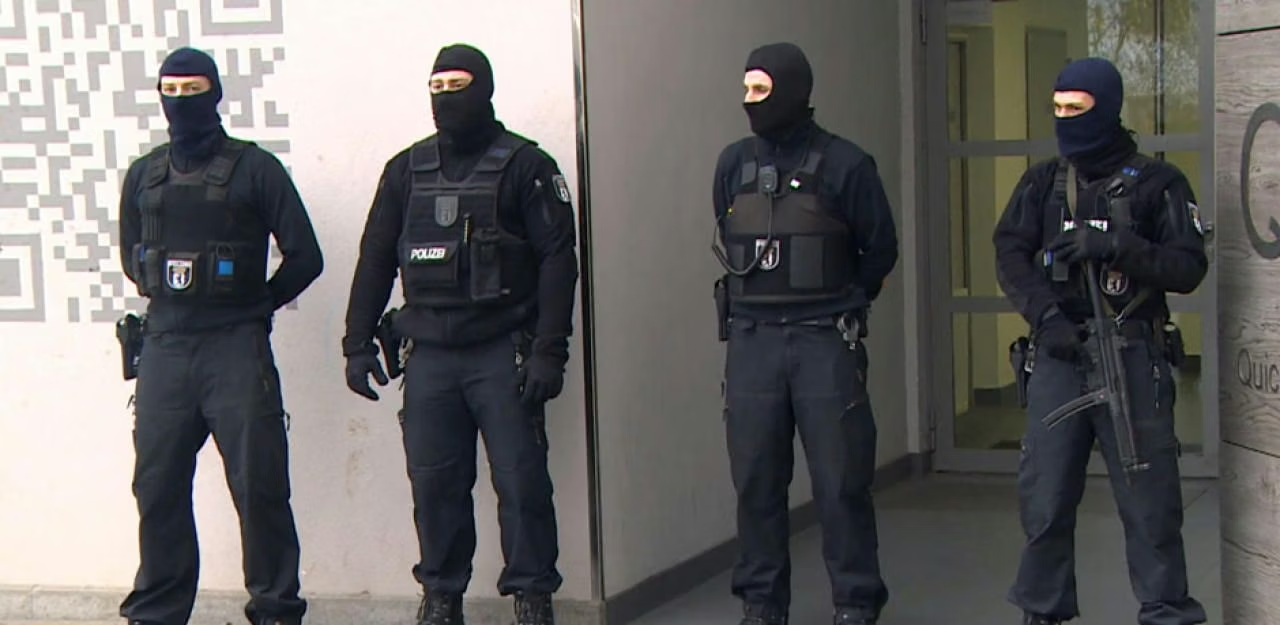
Ten months earlier, the home of the couple was stormed at 6am by a the State Criminal Police Office (LKA), as well as forces from the Special Operations Unit (SEK). While the official pretext for the raid and subsequent court case was a Facebook post that read “From the River to the Sea, Palestine Will Be Free”, the case illustrates that rather than merely criminalising a slogan, the German state attempts to terrorise and intimidate those who publicly express dissent to the genocidal “Staatsräson” paradigm.
The investigation was triggered when a person, likely a neighbour, scanned the student’s facebook profile and reported her to the anti-discrimination office in Hesse called “Hessen gegen Hetze” (Hesse Against Agitation). This office escalated the case to the Frankfurt Public Prosecutor’s Office, who then forwarded it to Berlin.
After the raid the couple learned that then a three-month long investigation followed, in which they were never addressed to respond to accusations, which they first heard off when charges were read to them during the raid.
Moreover, files accessed by their lawyer showed that enquiries were made about both to all kinds of authorities: from regular police, the state resident’s registration, to enquiries to the Office for the Protection of the Constitution (Verfassungsschutz).
The student described the raid, which left her in utter disbelief of the disproportionate measures taken by the cops:
On 16 May 2024, at around 6 am, my husband and I were woken by a knock at the door. My husband quickly got up to see what the commotion was about. When he opened the door, police officers stormed in. I got up quickly and tried to shut the door. As I did so, two female officers burst in – I was half-naked! I was ordered to get dressed so they could take me to the living room.
Her partner, who was later also charged for the same slogan, as well as the alleged use of banned organisations and trespassing, relayed:
While two female police officers were in the room with my wife, supervising her as she got dressed, my details were being checked and I was made to wait in my own living room. When my wife was ready, she was sat down next to me, and we were finally told what was happening.
As it turned out in hindsight, the raid itself had also been thoroughly prepared, in a bizarre display of state power. Two days prior to it, the police came to the building, photographed the outside, the nameplate on the doorbell, the front door, letterbox, and wrote a report on how many entrances and exits the building had, the window facade, and other details. The Palestinian-German engineer described the absurdity:
Later, we found out that the police had frantically rung all the neighbours’ doorbells to get into the building. While they were knocking at our door, they had covered our peephole with black tape. It’s all pretty excessive for such an allegation.
The actual reason a judge signed this search warrant was that the police couldn’t definitively identify my wife from the profile pictures on Facebook. So nowadays, the police can conduct house searches just to establish someone’s identity.
The case, which culminated in the suspension of proceedings illustrates that state repression does not always aim for eventual conviction in court, as cops are well aware of the frequent insubstantiality of accusations. Instead, raids and the terror and intimidation they are supposed to inflict appear to be a goal in themselves.
However, in this case, as in many others, the accused continued their activism for Palestine unafraid, as reflected in the students’ statement:
Anyone else facing repression needs to speak out about it! And make sure you get good lawyers. Most of these allegations have no legal basis that would hold up in court. Keep fighting, and Free Palestine, forever and ever!