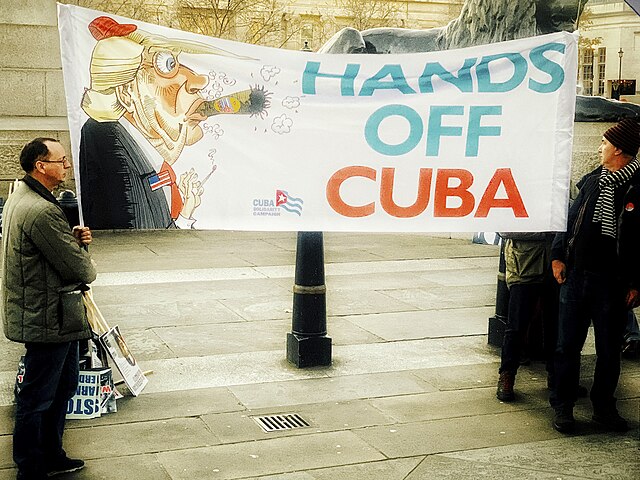
The United States has economically and diplomatically isolated communist Cuba for longer than any other country. Following Castro’s revolution in 1959, the Caribbean island has suffered a constant embargo, experiencing recurrent phases of deep crises, for instance during the “Special Period” that followed the collapse of the Soviet Union in 1991. During Obama’s administration, diplomatic and economic ties between the two countries were partially restored, in an effort from Washington to repair bilateral relations with Havana. The election of Trump and the death of Castro in 2016, however, marked a renewed deterioration in relations between the two countries. Trump began reversing Obama’s policies on Cuba, increasing travel and financial restrictions on the island. The situation did not change significantly with Biden, who corrected some of Trump’s measures without lifting the embargo.
The situation escalated significantly as on the 29th of January this year Trump signed an executive order that authorises tariffs on goods on countries that sell or provide oil to Cuba, imposing a de facto naval blockade. In fact, after the successful kidnapping of Maduro, Trump has now turned his attention to the government of Havana, whose supposed “malign influence” he is determined to counter. In an escalation of threats and hostile statements, Trump said last week that he’ll have “the honor of taking Cuba” soon and that he can “do whatever he wants” with the country. The president has not articulated what this would entail, but Washington appears likely to be planning its umpteenth regime change operation.
As we juggle with Trump’s — apparent — erraticism, let us now focus on the current naval blockade. In March, Cuba saw a total collapse of the supply of oil, food, and other goods, with no foreign tankers arriving in Cuba and only three container ships from China, India, and the Netherlands listing the island as their final destination. The temporary easing of sanctions on Russian oil by the Trump administration, aimed at increasing global oil supply amid skyrocketing prices due to Iran’s closure of the Strait of Hormuz, does not apply to Cuba. However, the country is now expecting two vessels — one sanctioned by the U.S. and carrying 730,000 barrels of fuel — to arrive in the coming days with Russian fuel. Additionally, 650 delegates from 33 countries and 120 organizations began arriving in Cuba on Friday, the 20th, aboard a flotilla called Nuestra América Convoy, carrying over 20 tons of food, medicine, solar panels, and other supplies.
While we hope to see more oil-carrying tankers reaching the country and humanitarian efforts increasing in the coming weeks, the naval blockade is, at the moment, tragically affecting every aspect of 11 million Cubans’ lives. The country, one of the most oil-dependent in the world for electricity generation, produces barely 40% of the oil it needs to meet its energy needs. Not having electricity means no water reaching homes, as many water systems depend on electricity to operate their pumps. Cubans also started relying on wood-burning stoves for cooking due to the absence of liquefied gas.
Cuba’s healthcare system, which, despite leading in medical innovation and international health solidarity, was already in a constant state of stress due to the embargo-induced lack of supplies and staff, is now on the brink of collapse. Without fuel, ambulances cannot respond to emergencies, and vital supplies do not reach the Island as airplanes are not able to refuel at its airports. For all the 5 million Cubans who live with chronic illnesses – including 16,000 cancer patients requiring radiotherapy and 12,400 needing chemotherapy – this means that their treatments will be severely affected. Another dramatic statistic underscores the gravity of the situation: until 2020, the survival rate for children with cancer was 76%; today, it has dropped to 60%. More than 32,880 pregnant women and their babies are similarly at risk: care for extremely severe maternal morbidity and critical neonates is lacking, children do not receive their vaccines on time, and home ventilation, mechanical aspiration, and air conditioning are critically lacking. This is just a small glimpse of the embargo’s impact on the country, which is also affecting the education system, one of Cuba’s most famous prides. Since January 3, schools have been operating on reduced schedules, while the university system has been reorganized, and science programs, which require supplies, equipment, and electricity, are now struggling to continue with their daily work.
This increasingly untenable situation has brought people to the streets to protest against the government, something which rarely occurs in Cuba. While these protests stem from the immediate hardship caused by the lack of essential goods, they appear to be taking on an increasingly political dimension. Last week, protesters attacked and tried to set the headquarters of the Cuban Communist Party in the municipality of Morón on fire. While it is true that some people are attributing the responsibility for the current situation to the government, especially among younger generations, others tie it to the current naval blockade, and many look at a possible US military intervention with fear and opposition. Be that as it may, authorities are slowly undertaking initiatives to ease the island’s economic dire straits. Cuba’s president Díaz-Canel has recently called for “the most urgent and necessary transformations to the economic and social model”, primarily regarding “business autonomy” and “the resizing of the state apparatus”. For instance, while residents were significantly limited from starting private businesses until 2021, the government is now planning to allow members of the Cuban diaspora, including those living in the U.S., to invest in the island.
Acknowledging the Cuban people’s resentment, or the current government’s willingness to partially reduce state control over the economy, does not imply that the country will accept whatever diktats Washington might impose on its political system. On Monday 16 the New York Times reported that talks appear to be underway between Washington and Havana aimed at removing the country’s elected president. However, on Friday, Cuba rejected the idea that its government, president, or institutions were up for negotiation. Contrary to the Trump administration’s assumptions, Cuba is not Venezuela; you can’t arrive overnight, kidnap the president, and expect everyone else to fall in line. The country’s revolutionary process has been ongoing for 77 years, profoundly transforming people’s consciousness and institutions. Without delegitimising the current protests, Cuba’s achievements in many sectors cannot be denied: Cuba’s education, healthcare, and civilian production systems have, for decades, and despite the hardships caused by the U.S. embargo, rivaled those of the world’s largest countries. President Díaz-Canel, in a social media post published in January, has made it perfectly clear that they will not give up their political and economic sovereignty to please Trump’s thirst for dominance: “Cuba is a free, independent, and sovereign state—nobody dictates what we do,” he said, further stating that “Cuba does not attack; we have been the victims of U.S. attacks for 66 years, and we will prepare ourselves to defend the homeland with our last drop of blood.”