
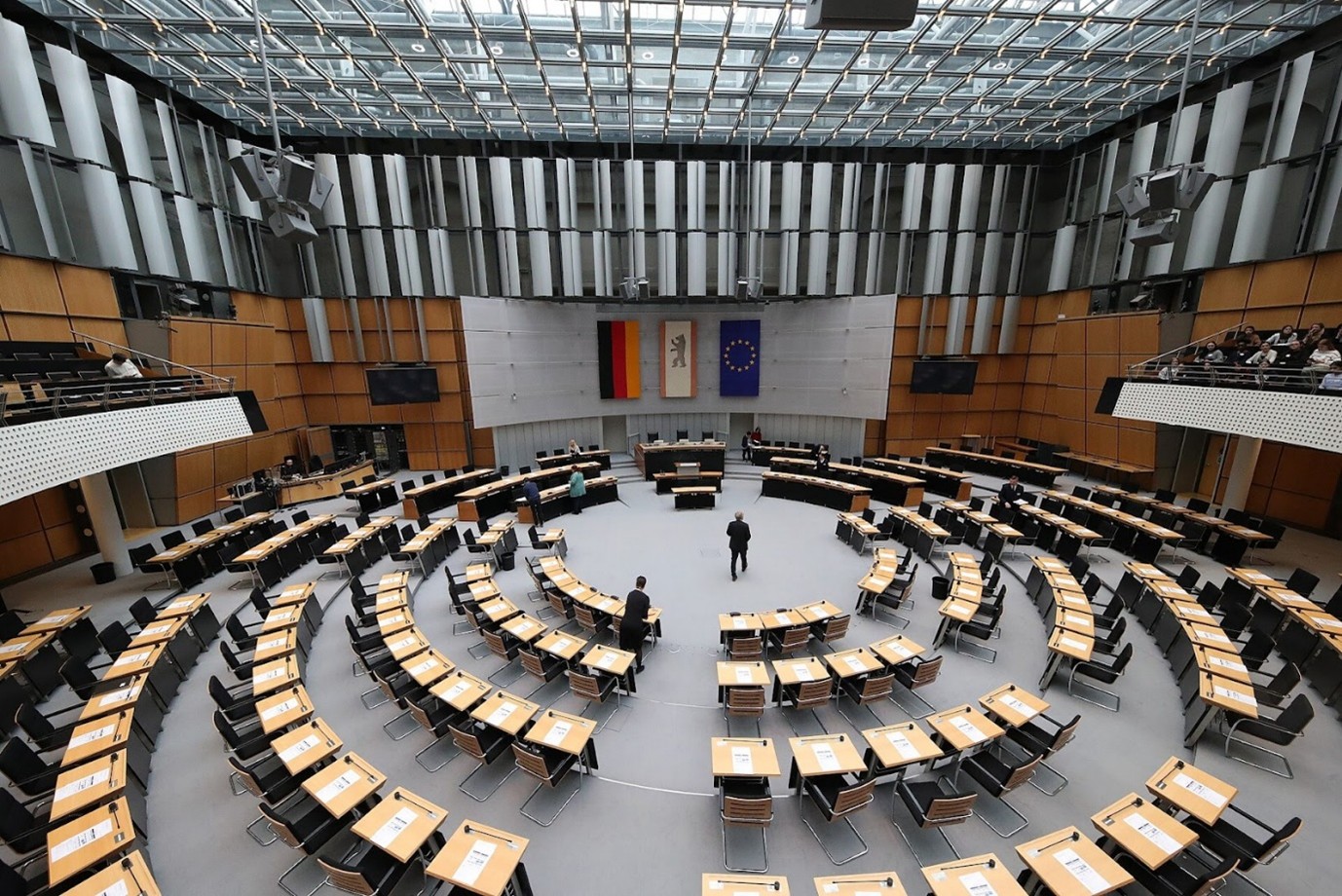
On March 26, the CDU/SPD-led Berlin parliament passed a law that significantly weakens the city’s Freedom of Information Act (IFG).
The amendments to the IFG were rushed through, despite criticism from journalists, transparency experts, and thousands of petitioners who warned that the changes would undermine government accountability and make it harder to expose political misconduct.
Under the new law, entire sectors—including public transportation, culture, and media—may be excluded from the scope of information requests.
Alongside cultural censorship, the ongoing suppression of pro-Palestinian activism, and the expansion of police surveillance, this rollback of transparency represents a new step in the erosion of democracy in Germany: another stage in the drift toward a militarized security state.
What is the Berlin Freedom of Information Act?
The Berlin Freedom of Information Act (IFG), in force since 1999, gives citizens the right to request information held by Berlin’s public authorities.
An IFG request can be used to obtain a wide range of information: government contracts, official correspondence, studies, and much more.
Considered one of the most transparent freedom of information laws in Germany, the IFG is a powerful democratic tool that helps journalists and activists monitor government actions and hold authorities accountable.
According to the law text itself, the purpose of the IFG is to “enable public scrutiny of government actions.”
The anti-antisemitism funding fiasco and the shadow of the Vulkan group
The Senate justifies the changes to the IFG on the grounds of civil protection (Katastrophenschutz). In particular, it points to the attack on Berlin’s power grid, framing it as evidence of a “changed security situation”.
As a reminder, the January 2026 arson attack on a cable bridge was claimed by the Vulkangruppe—a purported left-wing group that appears to have little recognition or support within Berlin’s broader left. Shortly after, a second statement denied that the “real” Vulkangruppe was behind the attacks.
Beyond the murky authorship of the attacks, experts have pointed out that the attackers did not obtain information about their target through an IFG request. They didn’t need to: the bridge was clearly visible for miles and had been barely secured for months.
Rather than a response to the power grid attack, the changes to the IFG appear to be part of a general rightward shift as well as a direct reaction to the so-called “CDU-Fördergeldaffäre”.
This “funding scandal” exposed that public money meant for projects combating antisemitism was funnelled towards friends of the CDU, many of which lack relevant expertise. CDU members of parliament, working together with Culture Senators Joe Chialo and his successor, Sarah Wedl-Wilson, channelled around €3 million to projects they had selected themselves, bypassing usual oversight. Most of this money ended up benefiting questionable projects such as The Nova Exhibition, which many critics have described as a form of trauma-exploiting genocide propaganda.
The transparency platform Frag Den Staat published thousands of documents related to the affair—all obtained through IFG requests.
These types of documents will likely no longer be available to journalists going forward.
Despite the fact that the changes to the IFG seem to be a response to the CDU’s public embarrassment for the funding scandal, they are framed as something else: a necessary precaution to fight left-wing terrorism. This has, by now, become a familiar pattern in Germany as well as in France or the US: using the spectre of the “radical left”—even when all serious studies show that the far-right is the only real threat—to justify passing laws that curtail the freedom of all.
A weakened transparency law
So, what has changed?
The amendments to the IFG introduce new reasons to reject information requests.
The law will no longer apply to requests about facilities that are deemed critical infrastructure according to the Berlin Disaster Protection Act. This includes facilities from the following sectors: energy, information technology and telecommunications, transport and traffic, waste management, health, water, food, media and culture, or finance and insurance.
Additionally, the law now excludes from public access any information about civilian infrastructure important for civil defence or with military relevance (e.g. bridges).
From public transport to hospitals (and, yes, cultural funding), many areas of public life could now fall under the scope of these exemptions—meaning citizens might no longer be able to request information about them through the IFG.
In effect, this shift could lead to sector-wide blanket refusals, making it much more difficult for journalists and activists to expose political misconduct and uncover scandals such as the so-called “Fördergeldaffäre”.
Grinding down democracy: criticism ignored while other states plan similar laws
The changes to the IFG were heavily criticised before the vote. A coalition of 38 civil society organizations (including Frag Den Staat, Amnesty International, Wikimedia and Chaos Computer Club) sent an open letter to Berlin’s governing parties, urging them to halt the reform.
They warned that the amendments would significantly restrict democratic oversight while being unnecessary since existing rules already allow authorities to withhold information for security reasons.
A petition launched by Frag Den Staat gathered nearly 20,000 signatures. Even the Berlin Commissioner for Data Protection and Freedom of Information, Meike Kamp, expressed concerns that the new law would mark a serious step backward for transparency and freedom of information in Berlin.
Despite these critics, the reform was pushed through without much regard for public consultation. Meanwhile, other states such as Thuringia and Mecklenburg-Vorpommern are already planning similar changes to their freedom of information acts.
Freedom of information requests are an important part of democratic life, as they give people a way to peek behind the curtains of power. This is how we can uncover how our infrastructure is built, which lobbies have a stake in a new law, and how the people we elect communicate among themselves.
The weakening of transparency laws means less state accountability and represents another blow to German democracy. Yet, from a rightwing perspective and the ‘Zeitenwende’ or ‘turning point’ narrative, they make perfect sense: becoming Europe’s strongest military superpower will be hard, shady deals will happen—better if we know nothing about them.