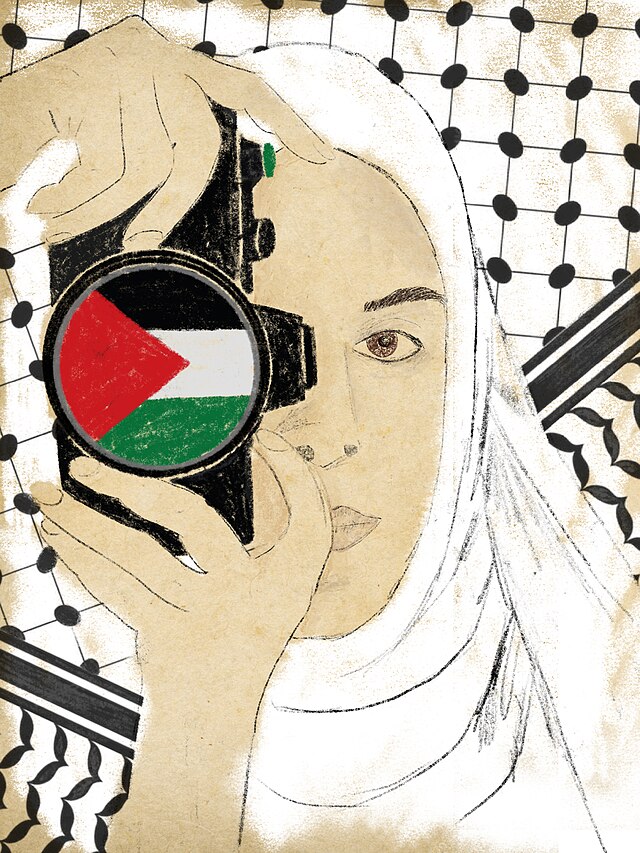
With Sepideh Farsi’s documentary about the young Gaza photojournalist Fatma Hassouna, Gaza crashed Cannes last year. The young woman’s assassination, the day after the film’s selection, loomed over the festival. In Put Your Soul on Your Hand and Walk, Farsi documents her friendship with Hassouna, as captured over 11-months of video calls – until the young woman was killed alongside her family in an Israeli air strike, the day after she heard their film was selected for the Cannes film festival.
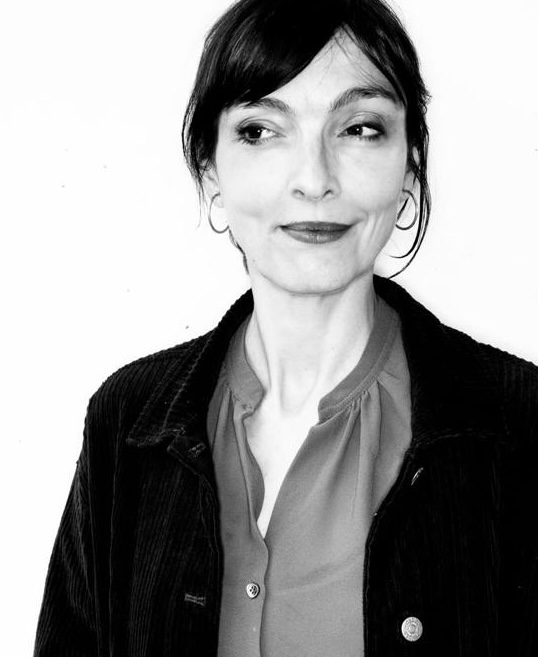
Iranian-born filmmaker Sepideh Farsi experienced revolution and imprisonment before fleeing Iran at 18. Now based in Paris, she has directed many films —including Tehran Without Permission, Red Rose, and The Siren.
Sepideh will be in Berlin this week, where Tehran Without Permission and Put your Soul on your Hand and Walk will be screened. Following’s Wednesday’s screening of Tehran Without Permission (Lichtblick, 8pm). Sepideh will be taking part in a talk moderated by journalist Nadja Vancauwenberghe. In preparation for these events, here is an unpublished interview between Nadja and Sepideh from June 2025.
In April 2024, French-Iranian filmmaker Sepideh Farsi set out to make the journey into Gaza, determined “to put faces” on the casualty numbers she read in the western media. She never made it past the Israeli blockade, but what she today calls a “miracle” did happen: in Cairo she made the e-acquaintance of Fatma Hassouna who would become her “eyes in Gaza” during an 11-month FaceTime friendship — an intimate connection abruptly severed when Israeli missiles killed Hassouna on April 16, 2025, just one day after the happy news of their film’s selection at Cannes film festival.
This didn’t prevent Fatma Hassouna from being present at Cannes last year: a poignant tribute by Juliette Binoche in her opening speech, and the standing ovation following a very emotional film premiere raised the young woman to world’s attention. Fatma’s huge smile on Farsi’s phone became the symbol of a whole people’s resilience in the face of annihilation.
One year and one shaky ceasefire down the road, Farsi’s doc hasn’t lost an inch of its poignancy, nor, sadly, of its topicality. It is a haunting tribute to a lost friend, to a bright, talented young woman – one of the over 72,000 Palestinians killed in Gaza since October 2023.
Put Your Soul on Your Hand and Walk testifies to the power of documentary film to bear witness when other media won’t : Hassouna’s wish to have her “death louder than bombs” has been fulfilled.
It’s April 2024, 6 months into the war, and you decide to take the journey into Gaza. Why?
It had to do with a personal need, an urgency, which grew over the months. Past the initial shock of the October 7th attacks, we were now realising the casualties were mainly the Palestinian civilians, women and children. And yet, the Palestinian voice was missing in media narratives. We had the European point of view, the Western, the American, and the Israeli point of views, and very rarely, almost never, the Palestinian point of view. This piece of the puzzle was missing, so I had the urge to go and find out for myself and then, maybe, respond as a filmmaker. In our big media, Palestinians were just casualty numbers — I wanted to put faces on them.
There were images from Gaza all over our social media, to the point people talked of the“first live-streamed genocide”…
Well, I did get images but I didn’t get the voice, the face – the individual stories were missing. And there’s also the distance, because when you see images of such brutality and violence, wherever in the world, after some time one gets numb as a viewer. That’s what happened with Syria, and again, up to a point, what has been happening with Ukraine. War becomes a banality, and this is really dangerous, and I wanted to fight this as best as I could with my own means as a filmmaker.
Did you really think you had a chance of getting in, considering Gaza had been under a media blockade since October? What were you hoping to do there?
I wasn’t sure of course but I wanted to try my luck — I thought: I’m a filmmaker, I have a French passport, perhaps I can get a laissez-passer from the French embassy – this was still fresh, in April 2024. I’d done this kind of urgency filmmaking, cinema d’urgence before, in Tehran Without Permission, also with my documentary Harat, and in the other film I shot in Afghanistan, Seven Veils. So I am used to working undercover and reacting to my surroundings. But the roads were blocked, and I was stranded in Cairo, so I started filming Palestinian refugees who’d just arrived from Gaza and collecting their stories.
It’s in Cairo you ‘met’ Fatma, right?
Yes, while there I befriended a young man from north Gaza who started to tell me about one of his friends who was still there, a very special, brilliant person, full of energy, and a talented photographer. And he said: “you have to meet her online and then you will see”. That’s how I got introduced to Fatem.
At which point did it become clear that Fatma was that “face” you were looking for? That your video calls would become a film, of which she would be your one and only protagonist?
There was a first phone call. We talked and I asked whether she’d be willing to do a video. She immediately said yes — she just needed a couple of hours to walk to a place where she could connect. On that very first video call, which is the beginning of the film, I immediately understood she was special, that something was happening, and that I had to film every bit of this. Something immediately clicked. I related to her. She was like a mirror to me. She reminded me of my young years in Iran, when I was blocked there, when I went to jail. You see in the film her own feeling of being locked up in Gaza which she describes as a small box in the big world, “a prison“.
From this point on, every moment was precious – especially because I never knew when we could talk again, when she’d be able to reconnect, if the connection would be good enough for a video, or even, you know, if she would be alive the next hour, or day, or night. We now have proof that those were, indeed, precarious moments. So, yes, it all happened very quickly. I was responding to the urgency of the situation
This urgency is reflected in the radical simplicity of your set up: she, you and your phones, as filmed by another phone, with very little intrusion from the outside world. Was this formal simplicity clear from the get-go?
Yes, I immediately knew it had to be filmed on a mobile, and with a mobile. The idea of using a second phone to film that phone, and be at that level, and filming the screen, for her and for me, was also a very quick spur-of-the-moment decision. You almost see that moment when I flip the phone, and I say: “I’m going to film this”, it was instant. I had the gut feeling this was the right thing to do, and I followed my instinct. Later I had to make drastic decisions because I had many hours of footage. While editing, I was aiming to make something very simple, formally, to achieve this radical simplicity that is a bridge between the emotion I wish to convey and the aesthetics I want.
You said many times that Fatma Hassouna became your eyes in Gaza. Can you tell us more about this idea of bearing witness in a situation of media blackout and how your collaboration could achieve that?
Fatem’s story is of course hers, but she’s also representing those 55,000 Palestinians who’ve been killed by now – in fact many more, as we know there are many people unaccounted for in official figures.
So yes, I think this film is bearing witness — all the way up to Fatem’s murder. I say “ murder”, because, since that investigation by Forensic Architecture, we now have evidence that her death was a targeted attack by precision-guided munitions, namely two missiles that were dropped by a drone on her house, crossed all the floors from the top and exploded on the second floor where she and her family were living. I wasn’t imagining that she could be targeted because of her photos, or because of a film, until the report became public, and I learned those horrible details. But of course she’s not the only one. That Israel can keep on killing Palestinian journalists — over 220 journalists in 23 months, is unbelievable. It’s outrageous.
What can a documentary like yours express that we don’t get otherwise?
The human truth of those who live there — the chance to meet someone at eye-level and to come as close as we possibly can to their reality, despite the physical distance imposed by the media blockade. I tried to make this leap, something that you do not get through the media, something that you do not get through films that are done with big means and long processes. My film gives a very intimate insight into the life of a young woman in Gaza, through long hours of conversation, with me trying to be as close as possible to her through our only means of exchange – a phone.
Fatem became a very special person in my life, she became a friend. I tried to shed light on her story and, through her, the hardship of the Palestinians in Gaza. I tried to make an honest film.
What would you answer to people dismissing your film as one-sided?
It’s an intimate film, a human gaze on a person’s story. It just so happens that this person is a young woman, Palestinian, born in Gaza, 25 years earlier, without ever being able to go out, and that she was a photojournalist, an artist, a writer, a great grand person. And that she was killed before we could ever see each other in person. It was a miracle that I met her. I had the honor of spending time with her. She will always be a part of my life. Now, if that’s one-sided, be it.
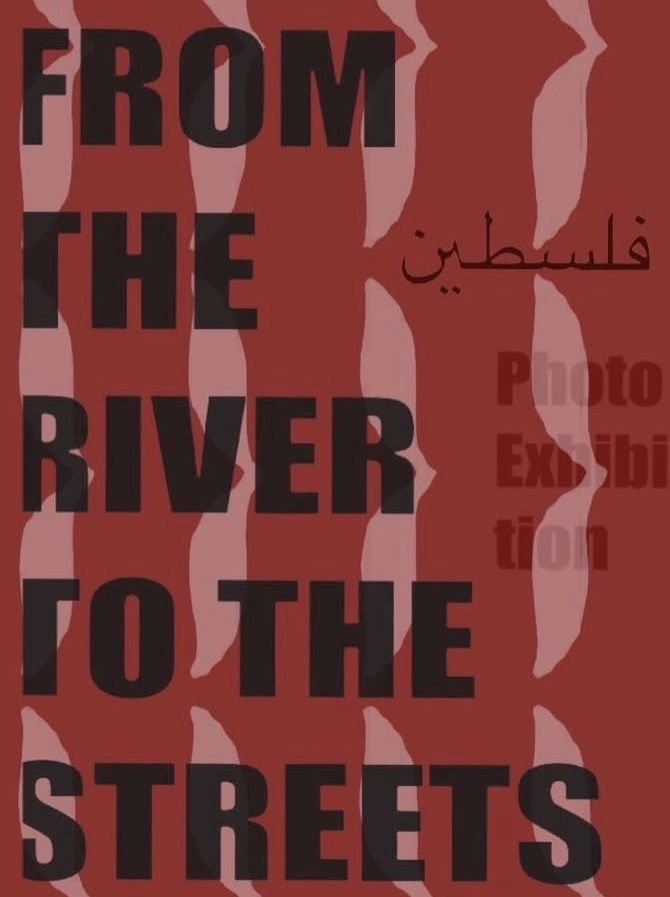
Wednesday, 15th April, 8pm: Tehran Without Permission followed by a talk with director Sepideh Farsi, moderated by journalist Nadja Vancauwenberghe. Lichtblick KinoThursday, 16th April, 6pm Put your Soul on your Hand and Walk, Sputnik Kino