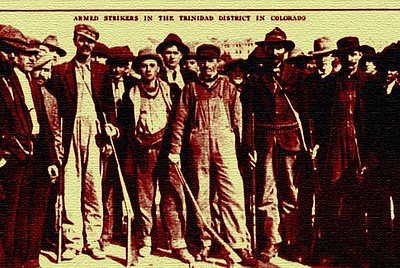
By 1914, Colorado’s mineral wealth had attracted waves of European settlers whose expansion cost the lives of the Ute, Arapaho, and Cheyenne Native Americans—massacred in the name of the same settler greed that would soon turn on the workers who replaced them. Industrialist John D. Rockefeller, also the lauded owner of Standard Oil, controlled most of the state’s mines, mills, and plants through his Colorado Fuel and Iron Company (CF&I). Workers faced low pay and abysmal conditions. In late summer 1913, roughly 10,000 miners—many of them Greek and Italian immigrants—organized with the United Mine Workers of America (UMWA) and went on strike. CF&I evicted them from company towns, so the strikers built tent colonies, the largest housing about 1,200 people in Ludlow.
CF&I called in the Colorado National Guard, led by Lt. Karl Linderfeldt, to intimidate the strikers. Rockefeller-hired detectives attacked strikers indiscriminately. By March 1914, the organizing efforts of Greek union leader Louis Tikas had calmed some of the violence, but tensions remained high. The National Guard burned the Forbes tent colony as retribution for allegedly “harboring murderers,” killing men, women, and children. Each side accused the other of provocations, and the situation was a powder keg.
On the morning of April 20, 1914, the day after Orthodox Easter Sunday, soldiers lured Tikas to the Ludlow train stop on the pretense that a woman wished to speak with her husband in the colony. Tikas urged his fellow Greek strikers to remain calm, but seeing machine guns positioned above the camp, they disobeyed and took cover in hastily dug fire positions. Fighting erupted and 177 militia and soldiers joined the assault. Gunfire raged from 9:30 AM past 5 PM as families huddled in cellars beneath their tents. Twelve-year-old Frank Snyder was killed leaving his shelter, and the colony was eventually set ablaze.
When the smoke cleared, Tikas and other strikers were found shot in the back. Eleven children and two women were found suffocated in a subterranean cellar. At least 18 on the union side lay dead—while the National Guard suffered only one confirmed casualty. During 1915 Congressional hearings, Rockefeller denied any knowledge of the militia’s animosity or responsibility for the massacre, despite accusations from activists including Margaret Sanger and widespread condemnation from the national media.
The Ludlow Massacre was a landmark moment in American labor relations, prompting Congress to investigate; the resulting 1915 report proved influential in promoting child labor laws and the eight-hour work day. Sanger attacked Rockefeller in her magazine The Woman Rebel, urging readers to remember the men, women, and children sacrificed so that Rockefeller might continue his “noble career of charity and philanthropy.” Labor organizer Mother Jones, who had rallied the miners with fiery speeches daring the men to rise up or step aside for women brave enough to fight in their place, saw the massacre vindicate her warnings about corporate brutality. Today, the Ludlow tent colony site is owned by the UMWA, who erected a granite monument in memory of those who died, and the site was designated a National Historic Landmark in 2009. From the Ute and Cheyenne to the miners of Ludlow, Colorado’s history shows that wherever there is extraction, there is exploitation—and wherever there is exploitation, there is resistance.