Yesterday the war in Sudan entered its fourth year. While the satellite images of the blood spilled during the El-Fasher massacre, that saw up to 10,000 people killed by the RSF, caused a momentary flurry of media attention, the world’s most devastating war was quick to be re-hidden among the chaos of things.
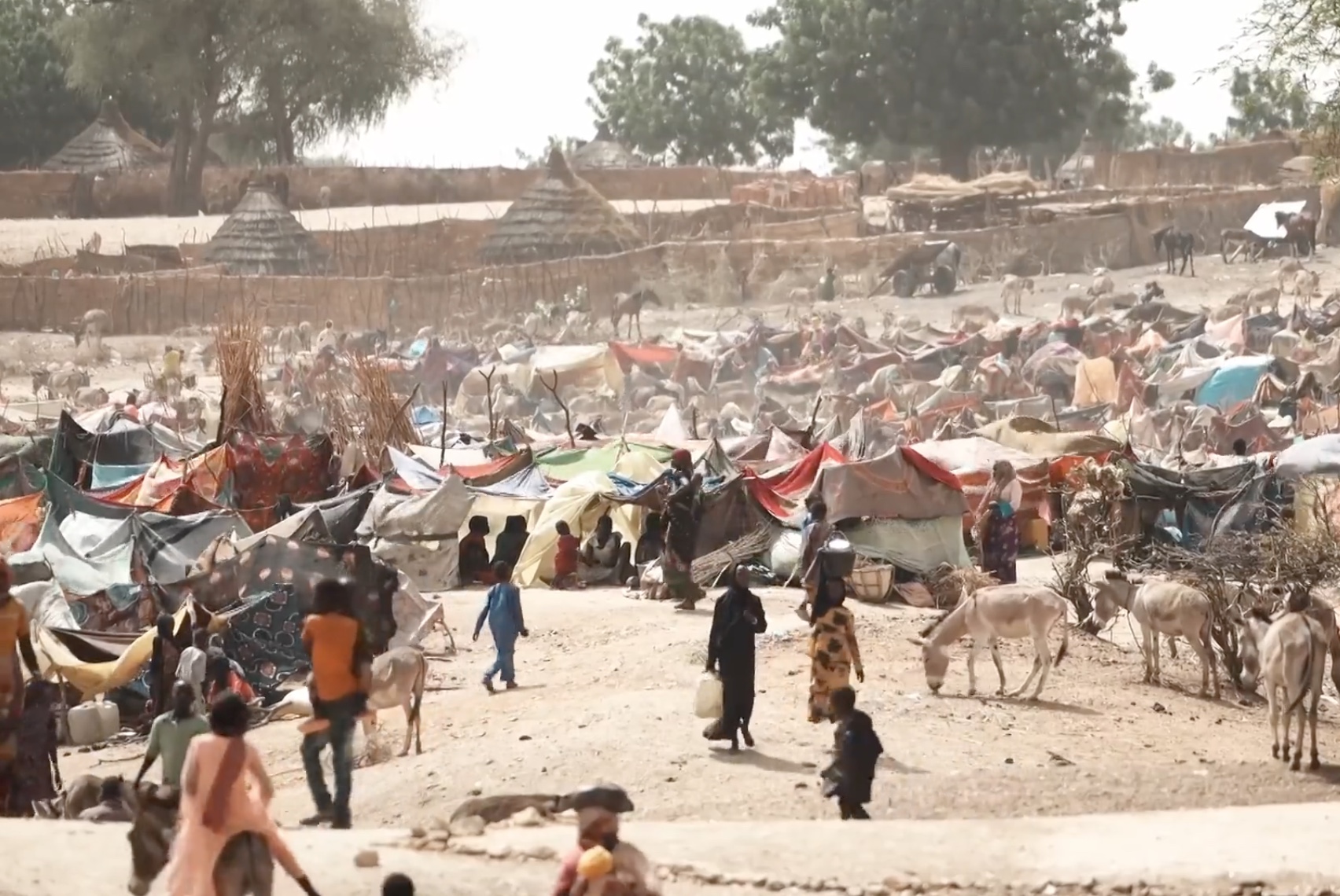
It is often termed the forgotten war, as though one could simply forget the at least 150,000 killed, 14 million displaced, 11,000 missing and 33 million people in need of assistance.
“Bloody unacceptable is what it is. Unacceptable that the world focuses on other crises and leans into it entirely to find solutions: why not here?” Denise Brown, United Nations Resident Coordinator in Sudan, decried the paltry international response to the deepening crisis.
Yesterday, on the anniversary of the start of the war, the Third International Sudan Conference, organised by Germany, France, the UK, the USA, the African Union and the European Union, took place in Berlin. So far the scale of the crisis has continued to be underrepresented in the media as well as in diplomatic efforts, while the inclusion of Sudanese voices in discussions has been largely neglected.
While the magnitude of the devastation in Sudan is unquestionable, the search for solutions for ending the war remain elusive. “How about focusing on finding a solution to end the war?” asks Denise Brown.
Following the international failure to seek and pursue concrete solutions to ending the war, Sudanese political analyst Kholood Khair and founding director of Confluence Advisory Hend Kheiralla were sceptical of the conference. Unless the war is reframed as an attack on civilians aimed at rolling back gains made during the 2019 revolution, rather than a war between two generals, the conference ‘will remain an exercise in optics and will not be a genuine pathway to peace.’
The Sudanese Armed Forces (SAF) led by General Abdel Fattah al-Burhan and the Rapid Support Forces (RSF) led by Hemedti aim to erase all hope of a civilian led government. Yet the Sudan conferences held in London and Paris in the last two years appeared to miss the point when they excluded all Sudanese representatives from the conference, from both the SAF and RSF, as well as civilian representatives. This resulted, unsurprisingly, in uninspiring diplomatic outcomes following disagreements between Egypt, Saudi Arabia and the United Arab Emirates; all of whom stake a claim in the region.
Frequently misrepresented as a civil war, the war in Sudan is rooted in colonialism and hinges on the expropriation of its natural resources by government elites and international actors. Sudan’s main exports amounted to $5.09bn in 2023 and include crude oil, gold, animal products, oilseeds and gum arabic.
Despite Sudan’s wealth in natural resources, the extreme inequality caused by the ousted Omar Al-Bashir, alongside crony capitalism and systemic corruption, kept entire regions in poverty, eventually leading to the 2019 revolution and Al-Bashir’s downfall. The subsequent international inaction failed to secure the civilian government Sudan so desperately needs.
Meanwhile, three years into the war that has cost millions of Sudanese civilians their lives and loved-ones, including many in the Mediterranean Sea or Greek prisons, inaction and hypocrisy has continued to dominate the international response to Sudan’s worsening prospects.
“The true scandal is not a failure of international peacemaking, but the sustaining and escalation of this war by outside interests,” writes the Guardian. Saudi Arabia and Egypt are the SAF’s key supporters, while it is widely claimed the UAE is funding the RSF, allegations the UAE denies. The Guardian further alleges indirect EU involvement through the supply of weapons, as well as funding meant to curb migration which ended up in the hands of the RSF.
Writing for The German Institute for International and Security affairs, Dr. Gerrit Kurtz bluntly dashes any hopes of any immediate sustainable steps towards peace: “It is important to note that this is not a peace conference. No one should raise their expectations too high. Even a humanitarian truce, which the United States wants to broker with its partners Egypt, Saudi Arabia, and the United Arab Emirates, is not currently in sight.”
Unlike the previous Sudan conferences in Paris and London, 40 Sudanese civilian representatives were invited to the conference with the aim of building a new civilian-led political order. This is much to the dismay of the Sudanese government who, along with the leaders of the RSF, were excluded from the talks.
Although a diplomatic breakthrough is unrealistic at this stage, it is hoped that the conference will mobilise awareness and aid for the nation devastated by war and substantially decreased aid pledges in recent years. Aid budget cuts by countries including the USA, the UK and Germany, led to only 40% of the humanitarian aid plan for Sudan being funded in 2025, a shortfall of €2.2 billion.
Humanitarian aid is desperately needed to fund the life-saving work of community kitchens, emergency response rooms and mutual aid groups. But humanitarian efforts are no substitute for holding those responsible for the atrocities accountable and pushing for a lasting peace.
Sudan researcher at Human Rights Watch, Mohamed Osman warned: “The conference in Berlin should not be another box-ticking exercise, but instead finally galvanize international momentum to deter further atrocities, advance justice, and protect civilians, including local aid workers. This conference should not have to be remembered as the first day of yet another year of atrocities against civilians in Sudan.”
While the €1.5bn in aid pledged at yesterday’s conference will go some way to fill the gap left by previous cuts, what stands out is the lacklustre approach to accountability, the abandonment of civil society, greed, and the self-serving role of international powers.