It’s hard to describe what it feels like to be Hungarian today. In the last 16 years there have been hundreds of political analysts diligently writing opinion pieces about the Hungarian hybrid system and its illiberal government. A lot of them have probably grasped some bits of the political realities of Orbán’s reign well, but I doubt any of them have really managed to flesh out the full context, because some of what has happened is simply not translatable or explainable to those not breathing the suffocating air of NER (Nemzeti Együttműködés Rendszere—System of National Cooperation). Yes, the world-class kleptocracy of the Orbán government—even as they pushed Hungary to be the poorest country in the EU—or the servitude towards both Putin and Trump were defining characteristics, but these were by far not the worst aspects of the decomposed democracy that left behind a traumatized society.
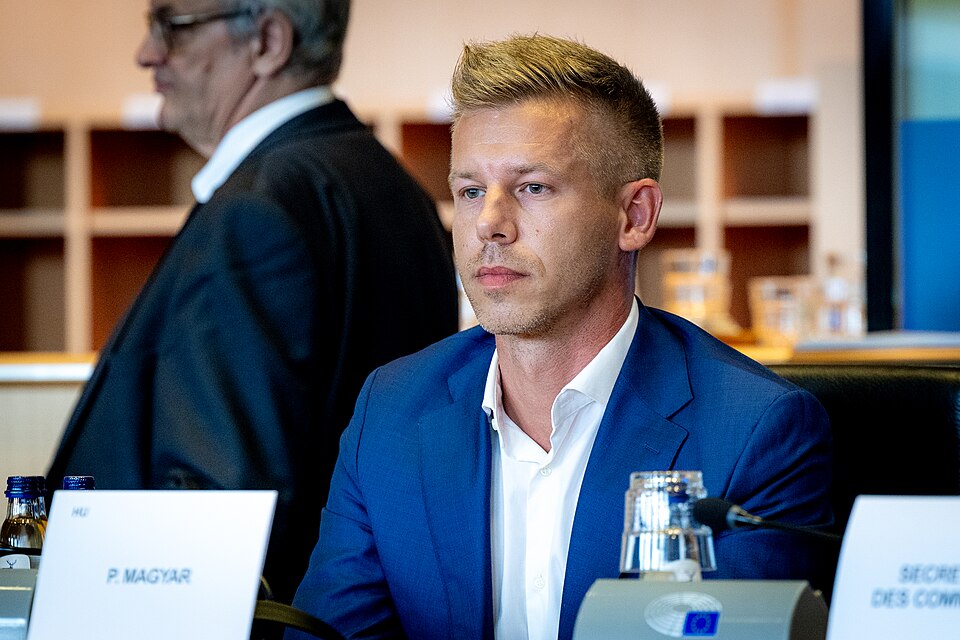
There will surely be many analyses, opinion pieces, and hopefully TV shows recounting the intricacies of the years, months, and weeks leading up to this election, describing how and why the Tisza party with Péter Magyar won in an extremely asymmetrical system, against a well-oiled propaganda machine and despite the explicit will of two superpowers.
The recently deceased great Marxist philosopher Tamás Gáspár Miklós described the situation we need to navigate in Hungary as anti-capitalists (and seeing the universal truth, with endless parallels across Europe, especially Germany) like this:
“Living in capitalism is not good. It’s not pleasant. It’s ugly. It’s a bad society. It poisons a person‘s relationships. And everyone knows this. To replace capitalism through parliamentary means, well, it’s a ridiculous thought. In order to improve our situation we are condemned to act according to a system, in which we do not believe. A huge number of people, especially those who don’t come out badly, accept capitalism and use its advantages, but they don’t like it. Facing the ultra-capitalist and autocratic and dictatorial system is an opposition that itself is ultra-capitalist[…]. But the fact that for a while it is not Orban in power, that in itself would do this country a great deal of good. In a psychological sense it would definitely do a great deal of good.“
Here, I won’t attempt to give even a superficial overview of what happened in the last few months. I’ll link a few resources that can be a good starting point, and hopefully help to understand how this was not only unpredictable, but close to impossible.
But there are a couple of takeaways for us on the (radical) left, that are worth pointing out.
For one, the thesis that only the extreme right can build populist movements in Europe in the 21st century, something we have conveniently accepted, is simply not true. Magyar considers himself a conservative, but his supporters have certainly a wide range of beliefs across the political spectrum. About the same proportion of the voter base says that they are left or very left leaning (40%) as centrist (38%), with the rest being right or far-right leaning. His party is, in the classical sense, a national front.
Magyar has brought back a classically left-wing analysis of the material conditions our people need to face. TISZA (the party behind Magyar) built up solidarity across the entire Hungarian society. Its movement has shown that voters don’t, and probably never have, moved on a classic left–right–liberal spectrum or decided on political offers based on that.
The analysis that we have heard about TISZA, that they tend towards technocracy—basically a FIDESZ without the stealing—is also wrong. Magyar and his party started from a deep hatred towards the system two years ago. As someone who used to be an insider, Magyar understood the Realpolitik aspect of Orbán’s conservatism, and probably for a long time he could reconcile it with his values. But the issue of the presidential pardoning of the paedophile enabler K. Endre in early 2024, and the collective handling of the scandal on the government’s side, broke not just his, but many Hungarians’ trust. Magyar recognized the moment and put himself forward to carry the political momentum.
To introduce himself to the people, having no significant money or political backing, he did something that probably only New York’s Zohran Mamdani did in recent history. While Orbán’s regime launched a black campaign against him across all platforms (the media landscape in Hungary is 80% owned by Orbán cronies), in the following weeks, months, and years Magyar went on what he called “Országjárás” or a “Walk Through the Country.” He truly saw the deprivation and the poverty in the country, spent weeks and months among the most vulnerable, and stopped and asked and learnt about their lives. This admittedly changed him and provided not just an incredibly powerful campaign tool but also shaped his worldview immensely. The second important lesson can be found in this: you cannot build politics and movements if you are not willing to spend time with the people. Building trust needs time and presence, and credibility that can only be produced if you are there, talking, listening, and not assuming what the people need. Magyar had a message from the beginning: it is possible to overcome this regime. But the positive offer of what Hungary after Orbán should look like, came from this painstakingly laborious step.
His inglorious departure from the system that had fed him could’ve pushed him to be more of an Edward Snowden–like figure, telling the truth and disappearing abroad. But exactly because he was so close to power, that simply didn’t occur to him. Magyar came from a political culture where not winning is simply not an option. This all-in (at TISZA they call it “All Out, Now or Never“) has initiated the third pillar of the success—and another lesson.
Because Magyar was so close to the people, and he visibly did sacrifice a lot, he could credibly represent his slogan: “Don’t be afraid.” This was not evident in a country where state propaganda kept a huge part of the population in constant fear of a never-ending line of boogeymen—from “migrants” to the latest being the Ukrainians—and where Orbán built a neo-feudal country in which the largest part of its population was dependent on his mercy. Orbán’s power was omnipotent, from artificially bloated conglomerates led by his family members or cronies (construction and manufacturing industries, agriculture, tourism), and direct oversight via the state apparatus (education, health care, police, state administration, etc.) to the undignified public work program, which is directly controlled by his party functionaries at the most local levels and is the lifeline for hundreds of thousands of Hungarians in the countryside. This system kept people in fear in the most material sense. People were never stupid; we all saw the incredible amount of money being embezzled, but dissent was simply so expensive that for individuals it became impossible to act against the system. Orbán has clearly demonstrated many times that he was willing to destroy lives and livelihoods through this system, blackmailing by withholding money, or in the most outrageous cases, even access to their children.
Magyar talked to these people and he visibly wasn’t afraid, and even among the most vulnerable, people started to stop being afraid of the oppression that permeated the most intimate parts of our lives, slowly choking us over the past 16 years.
As that happened, people could look around and start to believe that in the end THIS *waves hands around wildly* IS OURS. This land is ours, this air is ours, this school is ours, this media is ours, these castles are ours, this Balaton is ours.
This kind of courage, and inspiring others to be courageous, is absolutely needed to get people to follow you, and people did. TISZA started this election campaign with over 50,000 volunteers, each of them dedicated and delivering an incredible amount of work. This made it possible that the party, which had no conventional media presence, turned the country over. And when I write “no media presence,” it literally means that. As an example, if you recently visited Budapest as a foreigner and lived through the spontaneous street carnival on election night, you probably would’ve had no idea which party was celebrating. I talked to people from the Netherlands that night, and they were utterly confused. The whole city was full of election posters for FIDESZ or the controlled opposition, but close to none for TISZA. They had no idea who we were celebrating.
This last point, the realization that we, the people, can move together to change the system, is the reason why nobody I talked to in the past couple of days (even people much more on the left than TISZA) was worried about the possibility that Magyar will be the next Orbán. We now have the understanding that eventually we hold the power over these politicians. We know that there are a few main promises that we collectively will hold the new government accountable on: to bring back plural democracy, to rebuild the institutional framework of checks and balances, and to keep the people who were the pillars of NER (the oligarchs and the propagandists) accountable.
We are uncertain what the future holds for Hungary. As the new government is still in the process of being appointed, and the buzzing of the shredders, busy burying the evidence, fills the otherwise empty corridors of ministries, the people and the newly appointed government cannot be sure what awaits beneath the ruins. It is, however, certain that the government inherits an incredibly difficult economy, and that all services are in disrepair. Magyar and most of the politicians in TISZA are completely new; they have never before sat in the Hungarian parliament or held public office.
While we contemplate the question—what’s next—we are all still in collective awe and shock. NER has collapsed in a matter of days. While we still walk among the backdrop of it—with its hateful gigantic posters, the twisted national symbols like the National Theatre, the gigantic prestige real estate developments, the stadiums, the super-bloated occupied media, previously brainwashing 24/7, now like a deer in the headlights—all the actors have left. Some disappeared without a trace; others now try to pretend they were democratic and harmless, just doing their jobs. The blame game has kicked off in FIDESZ as well. But for the rest of us, it’s hard to understand why we were here for so long. We want to move on, but we are also afraid that we will forget and forgive too easily.
This is a time for self-reflection for all of us, to ask what our role was in keeping all this going. Because we need to face it: opposing Orbán was a very cohesive and easy identity. It created a readily accessible space for art and self-expression and community inside and outside of Hungary. A lot of us will need to start to dig deep into what our real values are, and how we can start living by them now that this is all gone.
And I think this is something others can also learn from this experience. Yes, we need communities of like-minded people, but this is not enough. The community needs to aim for political power, and to achieve this, it needs political imagination and it needs political courage.