As the Ulm 5 are facing prison time over a break-in at an Israeli weapons firm, it’s becoming harder to ignore how closely the same technologies we use daily are tied to companies and states embedded in the economy of war and genocide.
Just two weeks ago I read a story on my Apple iPhone, through a link on my Meta-owned Instagram account, about Volkswagen (VW), a car I learnt to drive in. The article concerned the German carmaker’s recent announcement that production at their Osnabrueck plant may soon shift from cars to missile defence systems for Israel.
Another German institution on the wrong side of history, surely not? You’d think that past context — see Volkswagen’s role in the Second World War — might encourage some kind of restraint, though at this point, why even bother finishing that thought.
What this announcement actually makes clear is that the boundaries between civilian production, consumer technology, and violent supply chains are far more porous than they appear. We’re already entangled in an oligopoly of unethical phone and social media companies whose business models depend on extraction and exploitation across the Global South. The IOF’s weaponisation of technology across Palestine — and now in Lebanon — has shown how quickly systems built for everyday life can be folded into infrastructures of genocide. And in the United States, ICE is increasingly integrating cloud and AI systems to further authoritarianism.
So when a car company like Volkswagen announces that it will shift production from vehicles to missile defence systems, it doesn’t read like a sudden turn. It reads more like a continuation of something already happening: the slow tightening of the relationship between a promise of the future and the machinery of war and oppression.
FANUC
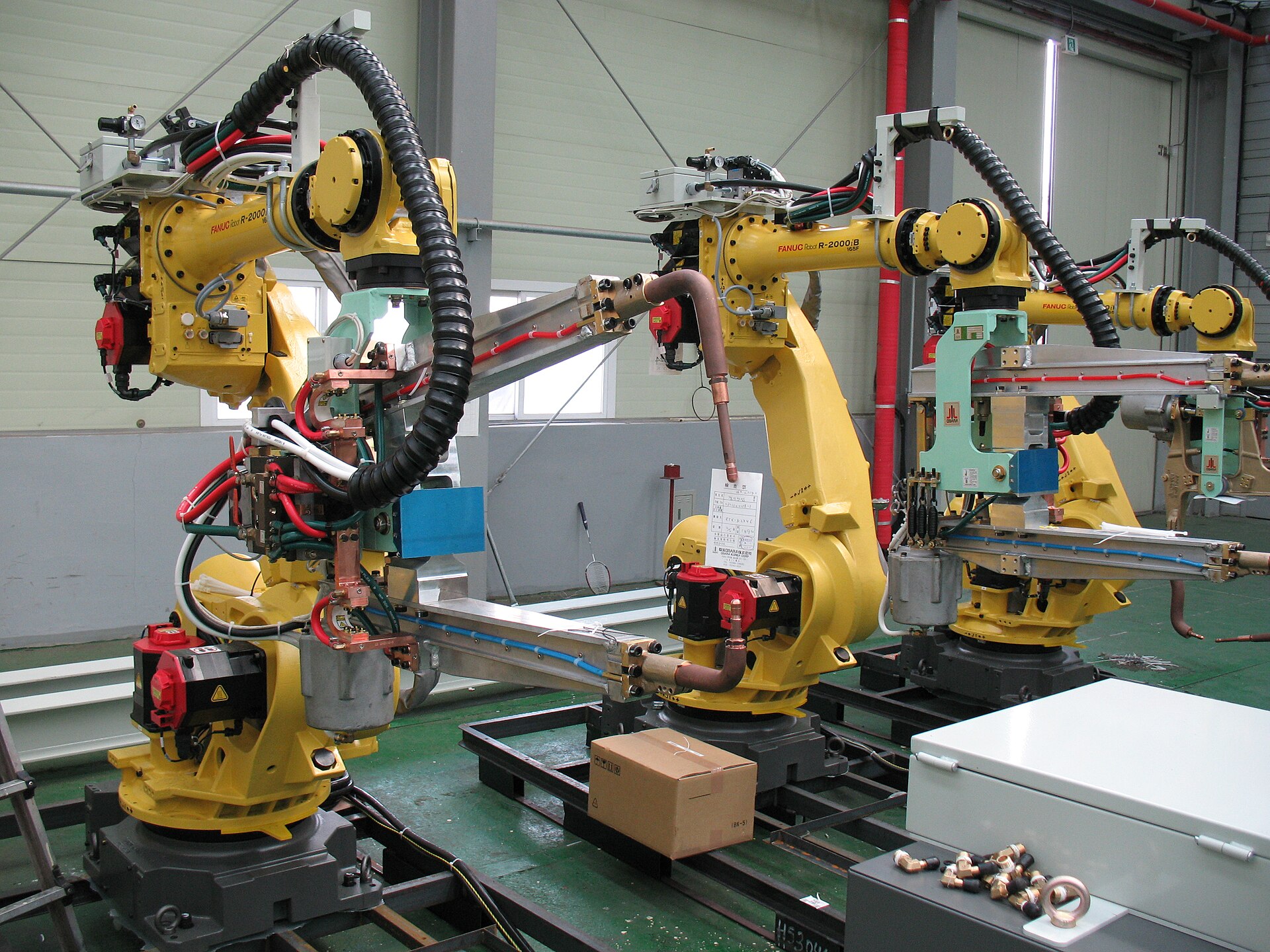
One company identified as being deeply embedded in the production of dual-use products (products that have both civilian and military applications) is FANUC, a Japanese robotics manufacturer you might not recognise by name, but whose systems sit quietly at the centre of global manufacturing.
Founded in the postwar period, FANUC operates across hundreds of facilities worldwide. It produces robotic arms and automation systems that underpin everything from automotive assembly lines to high-speed industrial production, with clients spanning the aerospace, pharmaceutical, and food and beverage industries. Describing themselves as a smart solution to boost efficiency, their machines make production faster, cleaner, and more precise.
In reality, the same robotic arms that assemble these everyday consumer goods are allegedly part of the same production infrastructures of military use now growing and expanding like never before. Unlike Volkswagen’s recent public announcement, however, this part of FANUC’s business isn’t openly declared. Layers of subcontracting, industrial supply chains and denial, make responsibility difficult to trace.
But this isn’t a speculative connection, it’s one already being documented. International observers, including BDS Japan and United Nations Special Rapporteur Francesca Albanese, have identified FANUC among the companies linked to Israel’s military operations in Gaza and its broader regime of occupation. In the report, From economy of occupation to economy of genocide, Albanese notes that robotic systems supplied by companies like FANUC are present in production environments connected to manufacturers such as Israel Aerospace Industries and Elbit Systems, as well as major defence contractors including Lockheed Martin.
UN human rights experts have also argued that, following the International Court of Justice’s 2024 ruling on the illegality of Israel’s occupation — which obliges states not to aid or assist it — governments should implement a full military embargo, including on dual-use technologies, and ensure that corporations within their jurisdictions comply.
Despite this pressure, the call for a military embargo has not only been ignored but recent findings point further in the opposite direction. In its report on nuclear weapons production and financing, the International Campaign to Abolish Nuclear Weapons (ICAN) found that the USA, Japan, and Germany are among the world’s top investors in companies involved in the production of nuclear weapons. It’s a scary prospect, but given the record-breaking profits being made in conventional weapons financial markets, it’s unsurprising that numerous companies who use automated production lines and robotics are players in both markets.
#StopFANUCNow and Engineers Against Apartheid
On the ground, campaigns such as #StopFANUCNow have emerged to challenge the use of dual-use industrial robotics in weapons production. Focusing on FANUC’s role in global supply chains, the campaign calls for greater accountability and the exclusion of industrial robots from military applications. In Japan, activists are also pressuring industry leaders and lawmakers, arguing that the robotics sector has both the capacity and responsibility to prevent its technologies from being integrated into military supply chains.
Engineers Against Apartheid (EAA) — a US-based network of engineers and workers, are also part of a wider wave of organising within the tech and engineering sector. Opposing the violence in Palestine and the role of corporate actors in sustaining it, their work focuses on US-based engineering, but the concrete realities of these infrastructures can be applied anywhere.
Across the USA, Germany, and Japan, the same industries that once promised prosperity and postwar stability are now part of automated production systems that move between consumer manufacturing and defence supply chains. We spoke with EAA about what it means to confront these systems from within, and how resistance becomes possible in industries still framed as neutral.
Hello, can you introduce yourselves?
Engineers Against Apartheid (EAA) is an organization made up of working class individuals in the engineering and manufacturing sectors of the greater Detroit area in Michigan. Michigan is one of the main hubs for automotive and defense design and manufacturing – making it a strategic exporter of technology throughout the USA and the rest of the world. EAA’s purpose is to raise awareness of complicit Michigan companies that have global impact, not only in the sale of products for genocide, but also the adoption of Israeli technology used and tested in the ongoing genocide in Palestine. EAA’s main goal is to discourage engineers from working in the defense industry and to raise awareness of how non-defense companies are involved in the ongoing genocide.
Can you talk about how you got involved with the #StopFANUCNow campaign?
EAA is one of the main organizations in Michigan researching company involvement and technology usage in the ongoing genocide in Palestine. Due to this, BDS international reached out to EAA after the UN report by the Special Rapporteur on the situation of human rights in the Palestinian territories occupied since 1967, From the Economy of Occupation to the Economy of Genocide, was published. The report presented FANUC Corporation as one of the key contributors to the genocide by manufacturing the robots that build bombs for companies with genocidal intent, such as Elbit Systems and Israel Aerospace Industries. After further research, it was revealed that FANUC Corporation has a subsidiary North American branch headquartered near the Detroit area, which is also surrounded by FANUC manufacturing and shipping facilities. EAA was presented with the opportunity to support and escalate the BDS call to demand that FANUC divest from genocide.
Why is the participation of engineers and tech workers in such campaigns crucial?
Many engineers and tech workers do not typically view themselves as contributors to war crimes because they are not the ones making the direct decisions to murder civilians nor do they ultimately pull the trigger. While the contribution of engineers and tech workers is not so obvious, there are many historical cases, such as South African or Nazi Germany, where engineers played a key role in the design, deployment, and maintenance of weapons that maintained the oppressive regimes. Even in today’s case of the USA, there is a mass movement of tech workers resigning over the use of AI to mass surveil civilians nationally and slaughter civilians internationally. Historically and currently, it has never been more apparent that the genocidal regimes are upheld by workers who believe they don’t have the power to make change. It is time for engineers to understand, step up, and fight back. They are on the front lines and they have some of the greatest power to make the world a safer place.
FANUC robots are marketed for civilian manufacturing, yet they’re used to make weapons deployed in genocide. Who is responsible — the company selling the machines, the buyers using them for war, or the engineers designing the systems?
The responsibility of stopping genocide must fall on all parties, the company, the buyer, the workers, and even the local communities to those companies. It’s why there are so many organizations directed at bringing in different types of groups. It’s important to have pressure points in every area directed at these corporations. Ultimately, the corporation will make the final decision to end their complicity But, in a capitalistic economy corporations tend to lean towards greed and building capital for the upper class. These days, those qualities are fulfilled by murdering civilians, starting wars, stealing resources, and stealing labor. Whether it comes to workers rights, communities protections or global impact, the average person – whether worker or community member – needs to understand that these companies must be taught how to operate ethically and morally. The only way that can be taught is by affecting what is most valuable to these companies – their money.
How do you see the broader tech and manufacturing industry enabling militarized violence through dual-use technologies?
The western world, especially the upper class in those societies, operate and maintain their superiority by building technologies that police the world, even their own civilians. At this time, there is nothing ethical about technology. From social media to home security to AI used in war zones, everything is being used to manipulate, train and pacify the global community. Even technology such as smartphones and automotive vehicles are built off the unethical treatment of people in the global south. If there is a seriousness in building a safer and more just future, these technologies must be ethical from their inception.
Dual-use technologies often move through several layers of suppliers and subcontractors. Do you think that complexity is accidental, or does it help companies avoid responsibility for how their technology is ultimately used?
This has been one of the difficulties in tracking how many companies are involved in the ongoing genocide in Palestine. One of these difficulties is found through the automotive industry for specific companies like Ford, Hyundai, or Toyota. There had been clear documentation of these companies vehicles being used as military vehicles for the Israeli Occupation Forces (IOF), but clear documentation/evidence of their contracts are difficult to find. For example, there is an Israeli weapons manufacturer named Plasan North America that retrofits Ford vehicles for the IOF. The difficulty in obtaining information is that Ford Motor Company is a publicly traded company while Plasan North America is privately traded company, which does not allow you to determine whether there is a contract between he two companies to obtain Ford vehicles or whether they are bought from Plasan off the lot. There are many avenues for companies to complicate information that should be easily accessible for the community and to the workers.
Do engineers and tech workers have the ability to resist complicity in systems of violence? How do you approach that tension?
Historically, there has been a level of manufactured superiority in the engineering field. Engineers are taught early on in their education that they are the more educated workers that aren’t subject to poorer or dirty working conditions that are more commonly associated with the poor, lower class individuals. Engineers in the automotive workers are also not typically unionized; they are taught to view unions as institutions workers use to avoid doing their job while still getting paid. Corporations have done a great job in separating and villainizing workers who demand ethical practices, and many engineers have accepted these accusations as the norm. It is important that we as engineers continue to challenge these views and being working with each other across roles. The only people who benefit from our separation are executive boards of the corporations we work for.
What tactics have been most effective in challenging companies complicit in armed conflicts, and what lessons can other activists take from your work?
The most dangerous thing we can do in a system that benefits of hyper-individualism is build community with each other and fight back. Many corporations deploy tactics that separate workers, communities, families, but its important that we continue to build with each other and take care of each other in times of hardships. This will grant people more confidence in their ability to fight back. In the end, corporations are for-profit; their goal is to make more money no matter what. Everyone should understand that their livelihoods are at risk and we should fight back while we still have the opportunity.
What can the public do right now to stop this complicity?
Keep speaking up. Keep fighting back. If you know that your company is complicit, inform your coworkers. We need more direct actions. Workers need to strike, the public needs to build pressure, communities need to purge these corporations from their cities. The global majority needs to rise in actions because everyone is at risk.
You can support the #StopFANUCNow campaign and sign the petition here. And you support the Ulm 5 here.