On 26 September, 2025 one of Berlin’s longest sagas came to an end. After 15 years, 4 years over schedule, the renovation of Karl-Marx-Strasse finally ended. City hall opened its doors, the district mayor gave a speech—the authorities even put up an open-air exhibition—and all of Neukölln let out a collective sigh of relief: the ever-wandering construction site blocking the district’s central artery was gone.
One little snag: the district was also busy putting up barricades at the southern end of Karl-Marx-Strasse next to Karl-Marx-Platz. The reason? A year-long renovation of the square including renewing canals on Karl-Marx-Strasse itself.
A Berlin adage could be: when one construction project ends another one starts at the exact same spot.
But unending construction projects are not the only things fraying the nerves of Berliners these days. Hardly a day goes by where I don’t experience a total collapse on the U-Bahn network. Appointments for public services sell like hot cakes on the black market; trash piles up in side streets and illegal dumping litter our parks; waitlists for childcare spots are longer than ever; doctors’ waiting rooms are overfilled. The list goes on and on.
Many have reached their breaking point. Last year a record 161,000 people left the city. Many of them have simply been priced out of a gentrifying city. Many are families buying houses in the suburbs. Many are doubtlessly tired of feeling like they’re colliding repeatedly with a grimy wall—what I sometimes think it feels like to live in Berlin when the next U-Bahn train is in 15 minutes.
But it’s up to us socialists to fight that feeling. Not every broken escalator is a metaphor for the downfall of Western society. Conservatives underfund and undermine public services until the private sector can step in and profit. They want to stunt the horizon of collective agency by naturalizing dysfunction. And people are going along with it—just 17 percent of Germans trust political parties, reflecting a wider disgust for politics in general.
An antidote to this cynicism contains small, material changes that improve the quality of people’s lives. That’s been Zohran Mamdani’s strategy over the first few months of his tenure as mayor of New York City—and approach he’s dubbing pothole politics. It’s a play on the sewer socialism term, an originally derogative term that describes the policies of municipal socialists in Milwaukee, Wisconsin.
The parallel is intentional: “This is pothole politics — our 2026 answer to sewer socialism — where the government is not too busy, not too self-important, not too mired in paperwork to fix the problems of this city, no matter their size,” Mamdani said.
The strategy appears to be working. Despite an onslaught of negative coverage from conservative tabloids, recent polling shows that 55% of New Yorkers view him favorably. Some are asking: “Where’s the revolution?” And while Mamdani hasn’t been perfect—he’s walked back from some of his more radical proposals—you’d be hard pressed to find anyone credibly claiming that he’s not already improving New Yorker’s lives.
Ultimately, the revolution is not going to happen tomorrow. Socialists can also become their own worst enemies by spending more time debating the finer points of theory than actually organizing. So it’s wrongheaded to maintain that municipalism is a waste of time for socialists who do indeed need to practice socialism in actuality—which under capitalism directly manifests itself as showing up and helping people. When you do that, you’re also fertilizing the soil for support for bigger, more socialistic changes.
Die Linke would be wise to take a page from the Mamdani playbook and adopt their own brand of sewer socialism. For many years, Die Linke has earned voters’ ire with its constant internal conflicts—a party that’s too busy with itself can’t be trusted to represent your interests, after all. The party’s best chances at success lie in its ability to become a working-class institution that builds bottom-up power. What better way to do that than prioritizing these material improvements?
So what could sewer socialism look like in Berlin? Let’s muse on 3 quick ideas.
A central planning authority
The chief cause of interminable construction sites in Berlin are the overlapping competencies when it comes to planning and execution. It’s truly death by coordination between a big tangle of agencies. The perpetual blockage of Karl-Marx-Strasse continues because the water utility didn’t coordinate its sewerage renovations with the district authority. The city desperately needs a central planning authority empowered to ensure plans line up before construction starts.
The senate’s newfangled, voluntary “construction site coordinator” position, introduced in April, falls laughably short of that. Crank up the fines and hand the keys to a fully-staffed and funded office instead.
Free bulky waste pickup
Costs for the disposal of illegal dumping are at an all time high, soaring past €13 million in 2025, a marked increase from the €9.7 million in 2023. Those dirty Berliners, huh?
Time to get even tougher on crime according to the CDU-run senate. The problem? Not enough staff to enforce fines. Thus a €250 fine for an illegally-disposed cigarette butt exists almost exclusively in the conceptual realm. Even as a concept, punitive approaches rarely work when it comes to “fixing” socially deleterious behavior. These types of fines always hit the poor hardest and create perverse enforcement incentives where police or authorities attempt to cover budget shortfalls with quotas in poor areas (Phil A. Neel devotes an entire section of Hinterland: America’s New Landscape of Class and Conflict to this dynamic). Fines also don’t stop commercial dumpers who will just write the cost off as part of doing business.
Instead, the city should offer free weekly bulky waste pick up. Pick a day of the week for each neighborhood, everyone puts their waste on the curb. You could fund it with a scheme similar to London’s lane tax that charges private utility companies that block roads for construction. Two for one!
A district attorney’s office for prosecuting rent price gouging
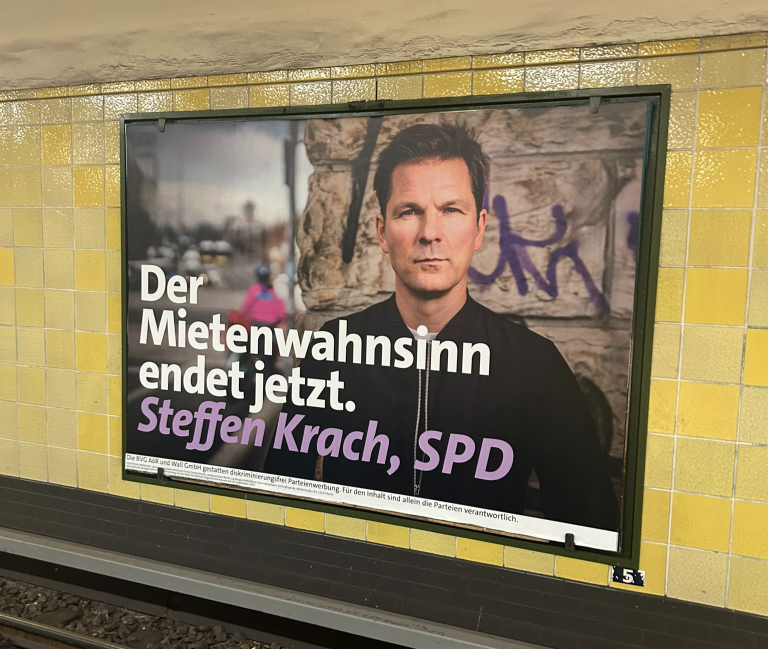
Most rents in Berlin are illegally high. But suing to get your rent reduced is a long, arduous, and expensive affair. That should change. Die Linke Berlin wants to create an “Mietwucher” (rent price gouging) taskforce that will go after extortionate landlords directly, suing them on behalf of residents. The lack of such a proactive advocate for renters puts the onus on renters to bear the risks for enforcing the law. Not only would such an authority actively help renters realize their rights, but it would produce knock-on effects that should make landlords think twice about whether jacking up the rent is worth a big, fat fine.
September is a historic chance for Berlin to turn red
Polling shows that it’s a three-way race for control of the city hall in September between the CDU, the Greens, and Die Linke. It’s clear that business as usual isn’t going to cut it for Berlin voters who feel more and more squeezed, hindered, and tired of all the dysfunction.
Die Linke seems to be taking the charge seriously—my social media feeds are full of trash clean-up events, legal support for renters, and red-vested activists pounding the pavement and knocking on doors. The party can ensure long-term success by getting out there on Day One and immediately starting to make a difference in people’s everyday lives. The basis for quick action and change is being built—I can only hope that if they turn the city hall truly red, they also learn to spice up these often mundane topics with some humor, like Mamdani has.
It’s not sexy talking about bulky waste pickups, but tackling these little nuts and bolts topics shows people politics don’t have to be the place where your tax money goes to die. The revolution won’t come in September, but a population of securer and more supported workers will be better equipped to fight for a socialism that makes public life work for everyone.