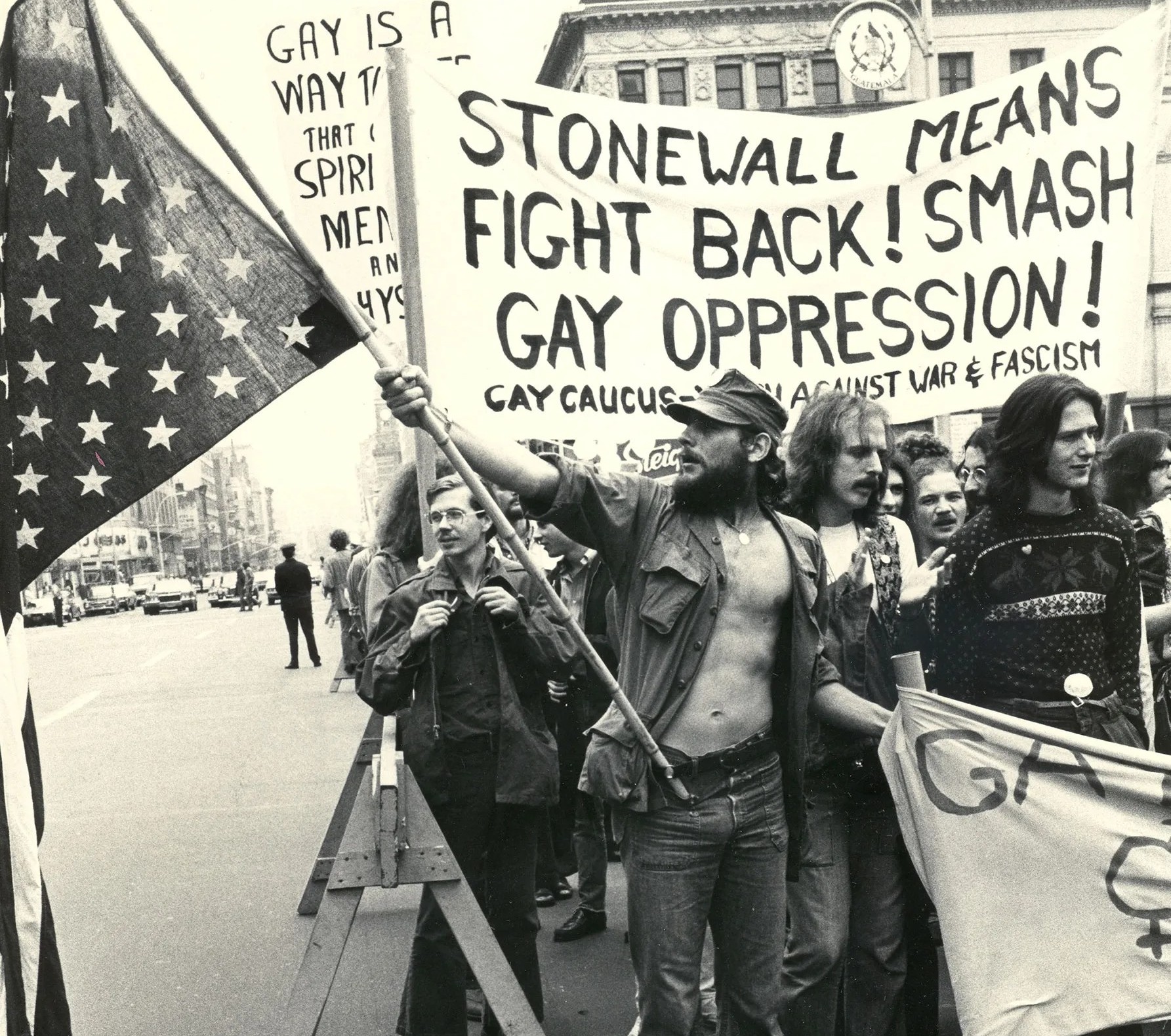
On June 28, 1969, riots broke out spontaneously at the Stonewall Inn in Greenwich Village, New York City (NYC), USA in response to yet another police raid. The bar was at the time the only place in NYC where gay people were allowed to dance and was popular amongst the very marginalized in the gay community: drag queens, trans folk and homeless youth. The riots and the eventual international pride movement it sparked were the cornerstone of the 1960s counterculture movement and have served as organisational pillars for queer activism ever since.
Raids or “sweeping” of establishments–bars, beaches, streets and neighborhoods–frequented by the gay community were not new and were par for the course at the time. These places, such as the Mafia-owned Stonewall Inn, survived by trying to avoid heavy post-raid consequences or bribes. Organisations like the Mattachine Society for instance lobbied discretely for liquor licenses and the abolition of police entrapment. The Stonewall raid on the night of June 28 thus was no different. As the police carried out their standard routine checks–unsurprisingly sexually assaulting several who were then detained–the situation started to turn. A woman, Stormé DeLarverie by many accounts, was handcuffed and hit on the head by a police baton and shouted “Why don’t you guys do something?”. The crowd that erstwhile heckled and jeered the police now turned violent.
Riots erupted and continued well into the night. Stonewall Inn was set on fire, police cars were blocked and overturned and kick lines broke out in the crowd, cheering in defiance. Women and transmasculine prisoners at a women’s prison down the street were heard cheering on from their windows “Gay rights! Gay rights!” and the riots went on for another night. This time around there was significant press attention and an overwhelming sense of agency prevailed–the burden of discretion had for a moment vanished. The aftermath of the Stonewall uprising is far too detailed to cover here, the reader is advised to look up several books and writings that have spurred since.
One curious consequence was the anniversary of the riots, organised on the same day in 1970 in NYC as Christopher Street Liberation Day bearing the name of the street where Stonewall Inn existed. Readers from Berlin will recollect that this is also the name of the annual pride parade (Christopher Street Day, or CSD) in Berlin, which first happened on June 30, 1979, ten years on from the Stonewall riots. They marched under two slogans – “Mach dein Schwulsein öffentlich!” (make your gayness public) and “Lesben erhebt euch und die Welt erlebt euch” (Lesbians, stand up and let the world see you). CSD in the 80s was marked by a strong emphasis on the AIDS crisis that was a systemic devastation of the gay community worldwide. Now, CSD happens in most major German cities and at different times of the year, mostly in July.
Even in the 2020’s, the state and large portions of the public are not comfortable with demonstrations and numerous events that mark CSD festivities. For instance last year, the queer Regenbogennetzwerk von Parlamentsbeschäftigten (rainbow network of parliamentarians) was disallowed from participating in the CSD by the German federal leadership. In smaller areas of Germany, AfD-driven neo-Nazi counter demonstrations are on the rise, some in a participant ratio of 2 counter demonstrators to every 3 CSD participants, further threatening marginalised communities there. In recent years however, CSD is culpable of pinkwashing by state and capitalist enterprises alike, platforming Zionist voices, queerphobic corporations and actively blocking out any conversation about the genocide in Palestine.
Since 2021, the Internationalist Queer Pride (IQP) in Berlin has emerged as an alternative to the very familiar anti-Palestinian sentiment espoused by CSD. Their first march had over 10,000 people participating and was held under the slogan “none of us are free until all of us are free” and now proceeds usually from Sudstern to Kottbusser Tor via Hermannplatz, making it the biggest pride march in Neukolln. As opposed to floats from Allianz and Commerzbank at CSD, the floats at IQP are occupied by several migrant activist groups working in the city. As the CSD this year will be across two days for the first time (July 24, 25), IQP dates are unclear at the time of writing.
The vein running through Stonewall all the way to IQP through CSD is perhaps best understood by observing how major struggles of the time, from Vietnam and anti-draft movements to Palestine and fighting the far-right are connected to the emancipation of the self via a collective liberation movement and that the state must never be allowed to police our lives. And to recognise that it all spurred from a detained protester who shouted, “Why don’t you guys do something?”.