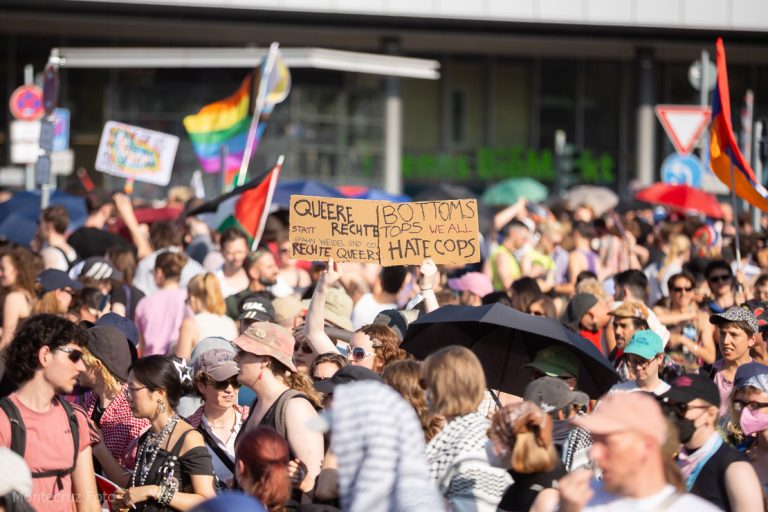

The German army, the Bundeswehr, is chronically short on staff. But the government, led by Chancellor Friedrich Merz (CDU) and the Social Democratic Party (SPD), has committed to rearmament: Germany must once again become ‘war-ready’ (“Kriegstüchtig”), as Merz put it. However, despite years of recruitment campaigns featuring adverts in city centres, on public transport, online and even thousands of recruitment events in secondary schools, very few young people want to join the army. On 1 January this year, the German parliament tightened the conscription law and introduced compulsory medical examinations for young men. Since then, tens of thousands of school students have been organising school strikes in cities across the country.
The militarisation of Germany is in full swing. Since the Russian invasion of Ukraine, politicians from the CDU, SPD and the Greens have been portraying Russia as a direct military threat to Germany and the entire EU. Not only is the political class exaggerating Russia’s real imperialist ambitions and military capabilities, but its rhetoric creates the dangerous impression that Germany is already fighting in this war. ‘We are no longer at peace,’ said Merz, for example, in September last year, adding that Russia was waging war against ‘our democracy’ and ‘our freedom’. Through years of image-building and framing, they have been quite successful in creating public support for rearmament and restoring the prestige of the German army. The Bundeswehr’s reputation had been severely tarnished by numerous scandals involving far-right networks and corruption in public procurement. Several opinion polls now show that a majority supports the reintroduction of conscription; amongst people aged 69 and over, as many as 77 per cent support universal conscription.
A general conscription has, in fact, been in force since 1956. Conscientious objectors were allowed the option of a voluntary year of ‘Zivildienst’, community service in hospitals or care homes for the elderly. Only in 2011 was this peacetime conscription suspended, meaning that every man aged 37 or over has already completed a year of military or social service. Older people, who tend to be more conservative, and the CDU and AfD, whipped up by the culture war, now expect the same ‘sacrifice’ from the younger generation. They also see the reintroduction as a means of instilling the necessary discipline and order in young people.
Nationalism and a shift to the right
Another factor is the disappearance of the post-war taboo on nationalism and militarism. At the very latest since the 2006 World Cup on home soil, it has once again become acceptable to be a ‘proud German’. The magazine Der Spiegel hoped that this newfound ‘relaxed, open-minded patriotism’ would be here to stay. What followed, however, was a form of nationalism that became increasingly chauvinistic and racist.
During the Euro crisis of 2008 and the ensuing years, the ‘lazy’ Greeks, Italians and Spaniards were compared to the ‘sensible’, ‘thrifty’ peoples of the North. Since the influx of refugees from West Asia and North Africa accelerated in 2015, German nationalism has become even more grim. At protests against asylum centres, which the far-right AfD has been able to latch on to and co-opt, German flags are ubiquitous. And with the current lurch to the right in society come calls for a heavy-handed state and a strong army at the borders.
The trouble is that young people are not taking the bait. According to several polls, 60 per cent of young adults aged 18 to 29 are against conscription, and only 14 per cent are themselves willing to enlist. Of the 300.000 adolescents who returned their questionnaire this year, only 530 responded that they are prepared to enlist.
Merz has also completely alienated young people with his support for Donald Trump and Benjamin Netanyahu and his own blatant imperialist stance. According to the latest polls, 95 per cent of 18- to 29-year-olds are dissatisfied with the government, compared with 85 per cent of the general population.
The new conscription law
That is why the government did not dare to reintroduce conscription straight away. On 1 January this year, the conscription law was amended to facilitate mobilisation. For instance, the medical assessment is being reintroduced: all men and women born in 2008 or later will receive a questionnaire from the army in their postbox. Recruiters then follow up on these surveys and Men are obliged to return it – the fine for failure to do so can be as high as 1,000 Euros. Furthermore, the Bundestag can now, by means of a simplified resolution, order the compulsory mobilisation of men liable for military service.
The new law also enables the German armed forces to stop men aged between 17 and 45 from leaving the country for more than three months, even in peacetime. The requirement to obtain a permit, which until now had only applied to longer stays abroad during wartime, is now permanently in force. Defence Minister Boris Pistorius (SPD) appeared to backtrack in April by promising that all permits would be issued as unbureaucratically as possible and would only be refused if military service was ‘specifically planned’. Nevertheless, the permit requirement remains legally valid and the government can change its application at any time.
German-European imperialism
Despite the doomsday scenarios about impending Russian attacks on Germany, the motives behind the armament and mobilisation are not just defensive. On various platforms, Merz has reiterated the message that Europe and Germany must be able to assert their economic interests in raw materials and supply chains even without US assistance, including, for example, by being able to intervene in the Strait of Hormuz. To this end, money should be no issue: ‘Whatever it takes,’ as Merz famously stated.
Ironically, Merz had just won the election having chastised the SPD and the Greens for reckless spending whilst himself promising to keep the budget balanced. Nevertheless, two months later, Merz’ majority in parliament decided to spend hundreds of billions of Euros outside the normal budget – including 100 billion on the armed forces. This allows the government to keep up the pretenses of a budget deficit while raising defence spending to no less than 108 billion Euros this year, double the figure for 2021.
In the medium term, the government has agreed to a further doubling to more than 215 billion per year in line with NATO’s ‘Trump standard’ of 5 per cent of GDP, to be achieved by 2035 – more than 40 per cent of the current federal budget.
At the same time, the German government is implementing far-reaching cuts to social security and intends to abolish the right to sick pay, further raise the retirement age and introduce a 48-hour working week. ‘Today’s welfare state is no longer affordable,’ according to Merz.
Counter-movement
Unfortunately, it is currently the AfD that is benefiting most from the widespread discontent with the government. In state elections, the fascists are celebrating one victory after another. But there is also resistance. Over the past six months, tens of thousands of young people have protested against compulsory military service on three separate occasions through school strikes. In 150 towns and cities, school pupils gathered at rallies and demonstrations inspired by the success of earlier school strike actions like the mass climate mobilisations organised by Fridays for Future.
Here, too, the state is displaying authoritarian tendencies. For instance, during the first school strike, the police dragged an 18-year-old schoolboy from Berlin off the street whilst he was holding a placard reading: ‘Merz Leck Eier’ (‘Merz lick balls’). He was charged with defamation and is now awaiting further action from the state security services. The slogan can now be heard everywhere. Since March, other pupils in Munich and Gießen have also been facing the prospect of legal proceedings for holding up similar signs. Pupils from Kiel recounted on Instagram how officers from the secret service and the criminal investigation department approached them on the street to question them about their strike.
But the young people who have been active in the movements in recent years are facing soaring costs and an increasingly bleak job market. They are deeply concerned about climate change, imperialism and, above all, the rapid rise of the AfD. The gap between official politics and their own lived experience is widening. And it is not just school students taking action. In May, for instance, students in Berlin occupied the Technical University in protest against cuts, whilst hospital service staff have been on strike for many weeks now, demanding a proper collective agreement. The solidarity movement for Palestine is also growing slowly but steadily.
So far, however, no overarching form of protest has emerged to channel this discontent and draw the link between militarisation and the attack on the welfare state. The trade unions and the socialist Die Linke party, too, have not done enough to support local resistance against cuts and taking the social struggle to a higher level. But things are changing. The national party conference of Die Linke this weekend’s slogan is “Enough! Stop the cuts, tax the billionaires, stop the arms race!”. And the trades union federation DGB has organised many local demonstrations, in Berlin on Saturday, 27th of June. One thing is certain, though: the sooner the activist left succeeds in deepening the struggle, the better equipped we will be to push back the AfD.