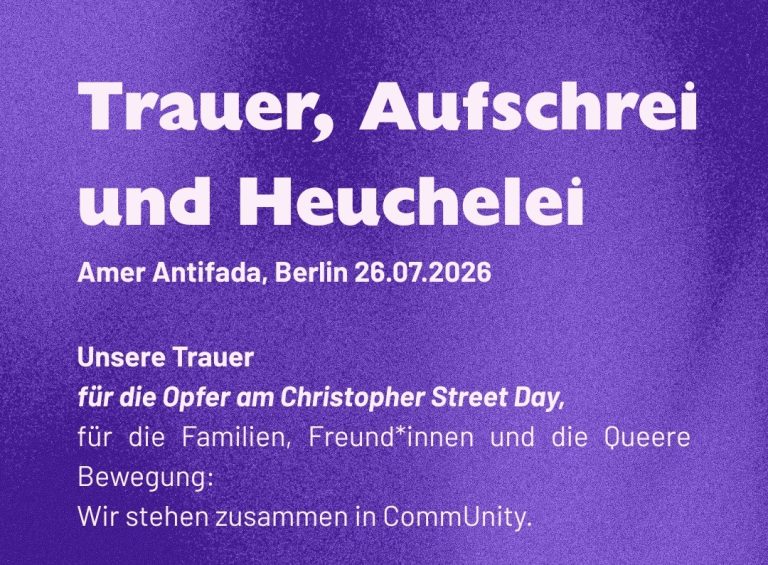
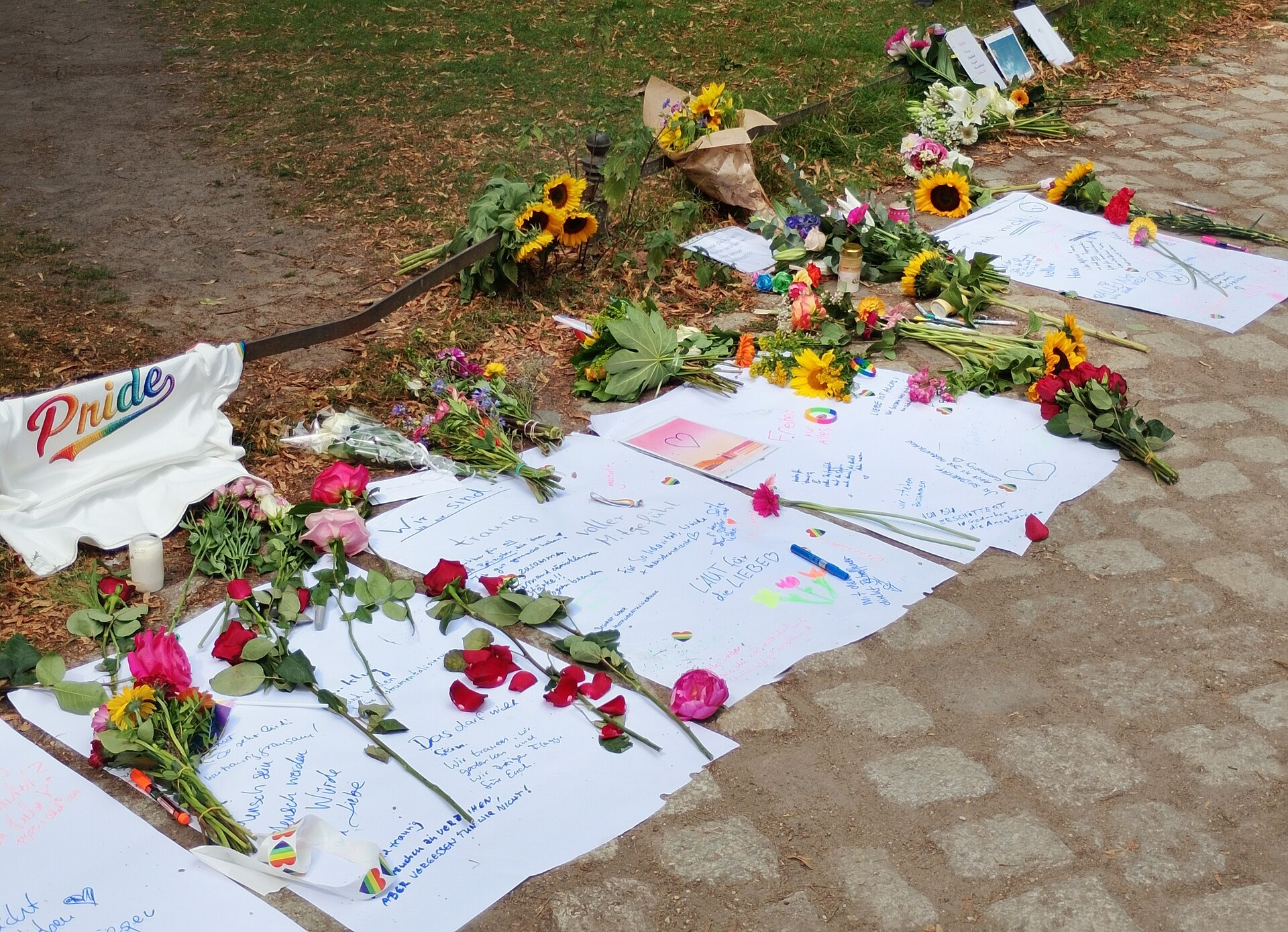
On Saturday 25 July, an attack occurred in the city of Berlin during the well-known Christopher Street Day (CSD), better known as the “LGBTQIA+ Pride march”.
A car drove into a crowd of people, leaving at least one person dead and several others injured. Very quickly, several media outlets pointed to a suspect and began promoting the idea that he was an “extremist linked to Islamic communities”.
Germany’s current chancellor, Friedrich Merz, described the incident as a “horrific act”, while the mainstream media has focused on the investigation of the suspect, individualising the action and constructing a racialised profile of the alleged perpetrator.
Identifying those responsible is essential. However, it is equally urgent to denounce that this was not simply a “horrific act”. What happened was a hate attack directed against a specific population: the LGBTQIA+ community, and it is a direct consequence of the rise in political violence and anti-LGBTQIA+ rhetoric promoted by the far right, led by the AfD and reinforced by the Christian Democratic Union (CDU), which today governs numerous local administrations and, in the CDU’s case, the federal government.
The leaders of the Christian Democrats are attempting to individualise what happened and frame it through a racialised profile to distance themselves from the political responsibility they bear as the governing party. In Berlin, that responsibility lies with Kai Wegner, the city’s current mayor, whose administration invests increasing amounts of public funds in police forces that are intensifying repression against social protest and solidarity with Palestine, rather than preventing hate attacks against our community. The same institution that claims to provide security instead seeks to discipline racialised, migrant, and queer people. It is also the same police force that on Saturday, at the Internationalist Queer Pride Berlin—an internationalist, anti-imperialist Pride demonstration in which the Latin American Bloc has historically participated—violently arrested at least seven demonstrators.
This political responsibility extends to the broader policies that are pushing German society toward an increasingly normalised climate of violence. On the one hand, these policies dismantle the rights of working people: hospitals are increasingly overwhelmed, workers face ever more precarious conditions, wages no longer cover the cost of living, and access to social services has been systematically underfunded. On the other hand, these same policies attempt to construct an internal enemy to blame for these problems: migrants and LGBTQIA+ people.
At the same time, the far-right AfD fuels hate speech that has even manifested itself in the burning of LGBTQIA+ flags. It also seeks to turn migrants, and especially queer migrants, into scapegoats for the hardships of the working class, even though it is the far right itself that promotes and supports the austerity policies that create those conditions.
The politics of hatred embedded in public discourse, combined with the systematic precarity imposed by the current government and the dismantling of prevention and support policies addressing violence against women, migrants, and queer people in Germany, contribute to a growing level of street violence directed against us.
In this context, where mainstream politics instrumentalises us whenever “diversity” gives political capital, and where the government does not prioritise our protection, we are left to care for one another ourselves. Building independent social movements therefore becomes a strategic necessity.
We must not forget that what was taking place in the streets on Saturday was a political demonstration demanding the rights, freedom, and sexual autonomy of the LGBTQIA+ community, and the fact that the chancellor could not even bring himself to name us as a community reflects a clear lack of political will to develop public policies capable of preventing these attacks. The absence of preventive measures, together with the complete omission of our community from the chancellor’s discourse, points to one thing: they seek to use an attack against our community to install a climate of fear and chaos that serves to justify their repressive and persecutory policies.
It is no surprise that, with the left (Die Linke) gaining ground in the polls in Berlin, both the current government and mainstream media are attempting to use a hate crime to promote a racialised narrative about the alleged perpetrator while advancing their own political interests.
We will only overcome these attacks through struggle and collective organisation, by putting our bodies on the line to prevent the CDU, the AfD, and all neoliberal parties from continuing to govern Germany.
Our solidarity goes out to the victims and to our community.
Our call is to organise and prevent those who oppress us from governing.
We answer fear with pride, struggle, and organisation.
The time is now.
Not in our name!
This article originally appeared in Spanish on the Bloque Latinoamericano Berlin homepage. Translation: Inês Colaço. Reproduced with permission