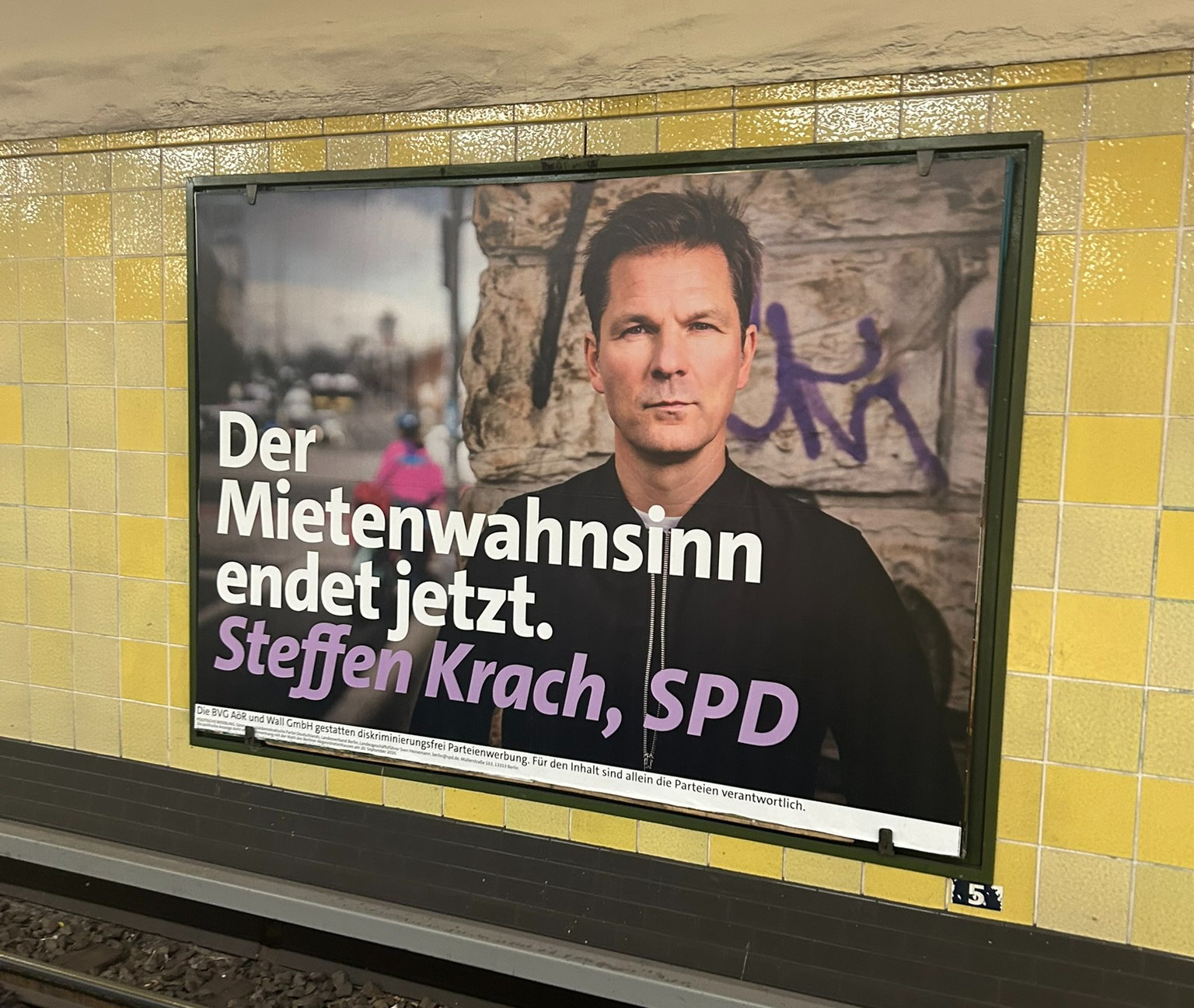
The SPD’s mayor candidate, Steffen Krach, wants to end Berlin’s “rent madness”. His bold posters promise action, but little in terms of substance. Worse, his words reveal confusion over his own party’s policies and a hefty amount of cynicism.
So how exactly do you propose to fulfill this promise, Steffen Krach?
Well, it’s clear he doesn’t think expropriation is the way. In an interview with Thilo Jung, Krach claims that since Berliners voted in 2021 to socialize corporate landlords, new instruments have been developed. Krach’s flagship policy is the rent cadaster, passed by Berlin in June. Landlords face fines of up to €10,000 for refusing to disclose required data.
Krach goes on to claim that landlords will voluntarily begin to sink the rent if forced to provide data on their possibly illegal rent contracts. “That helps much better, much more. It’s cheaper and generates money because the fines will be tough.”
The issue? The rent registry is nothing more than an exercise in transparency. Renters still need to actively check their contracts and sue to lower their rent. About a year ago, the city’s government also created “die Mietpreisprüfstelle” (Rent Review Office) to check for such cases. However, since its creation only four fines for more than 4,300 proceedings have been imposed, namely because the authority doesn’t have the authority to issue fines for high rents. That happens in court.
Berlin’s government also touts its “rent scan”, which analyzed more than 7,700 rental listings to detect violations. The exercise resulted in nothing but warning letters to landlords. No fines, no relief for renters.
If the SPD believes that landlords will actively recognize the errors of their illegal ways and lower rents, there is zero evidence to support that belief.
So how could the SPD actively regulate the rental market? Well, how about another rent cap? Krach claims the SPD is pushing a federal law to enable state-level rent caps. For those who might have forgotten, the German Constitutional Court struck down Berlin’s 2021 cap, ruling that the federal rent break takes precedence. Thousands of renters were forced to repay savings from lowered rents.
But Krach is apparently not versed in his party’s own policies since the Berlin SPD have also proposed implementing a rent cap that doesn’t rely on legislative competency. Instead, they argue Berlin can regulate rent by using Article 15 of the constitution—the socialization article. This article provided the legal basis for the 2021 referendum to socialize corporate landlords. “Land, natural resources, and means of production may be transferred to public ownership or other forms of the public sector (Gemeinwirtschaft) for the purpose of socialization.”
The SPD argues that introducing a form of non-profit rent management at the state level constitutes a form of “public sector”. This semantic sleight of hand stretches the definition of “Gemeinwirtschaft” (social or co-operative ownership) to its breaking point and demonstrates the SPD’s deep cynicism on this topic. Public ownership is nothing more than a vague policy buzzword here.
This cynical exercise in semantics allows the SPD to plaster the words “rent cap” everywhere without admitting they have no power to pass one.
Krach’s rejection of socialization directly contradicts his own party’s policies. In 2023, the Berlin SPD passed a resolution to implement the socialization referendum after their expert commission found it constitutional. The resolution even cites the commission’s report, arguing for below-market-value compensation. When pressed by Jung, Krach waffles—seemingly arguing that the SPD’s election program takes precedence. Berlin’s rent crisis has only worsened in these three years.
Krach’s confusion exposes the SPD’s political exhaustion: the internal contradiction of trying to represent both renter and real estate interests has left them without a coherent path forward. Once a champion of socialization, the SPD now clings to legal loopholes and landlord goodwill. Both of these are hollow substitutes for radical change.
Ultimately, the party will pay the price for this confusion. Polling shows their support at an all-time low, a paltry 12%. Perhaps a historic defeat can finally silence the careerist rhetoric of SPD politicians—for good. I won’t hold my breath, though.