Thanks for talking to us. Can you start by introducing yourself?
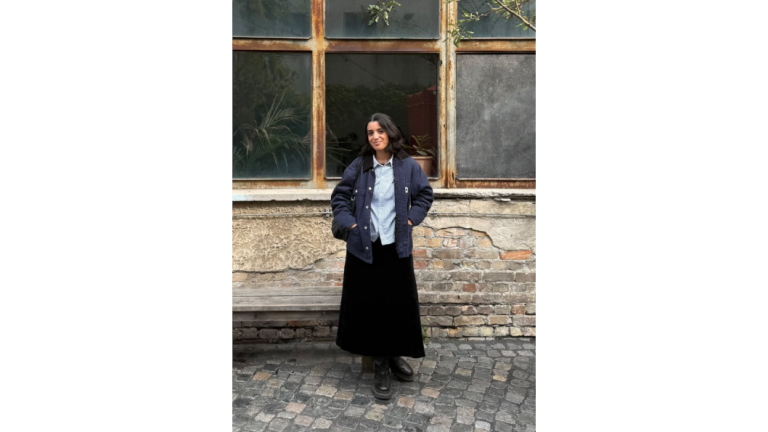
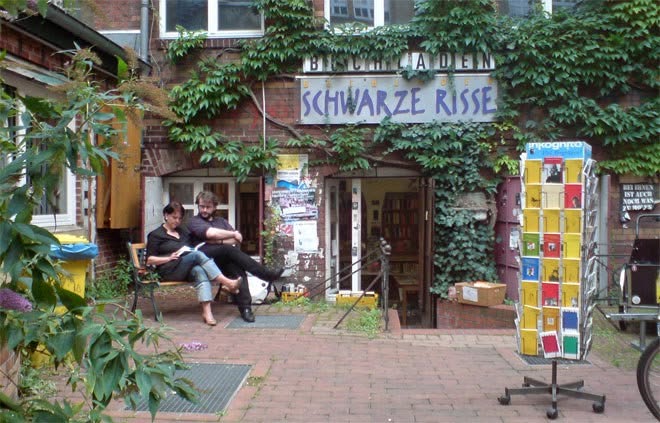
My name is Gabriel. I work here at the bookstore Schwarze Risse. I’m quite new, actually. It’s been a collective bookstore in existence since 1984. Some people who used to work here before me were here for something in the realm of 30 years.
Right now, we’re establishing a new collective of people who are working here, and there are some big personnel changes. Things are moving around, including the way that we are paying ourselves. It’s based on horizontalism, so we don’t have a boss or anything like that.
What’s special about the Schwarze Risse?
We have a really big offer of several books. We specialise in left-wing politics. We have a well-sorted section on left wing movements in Germany—everything from armed struggle to movement history. We have a big section on the history of National Socialism—the Nazi crimes, and what happened afterwards.
Our books are mainly from a radical left point of view, but we try to be quite broad. We also have a growing English section, and many nice novels.
You have always had a serious section on the Middle East, including Palestine. That’s not the case in all left-wing workshops in Berlin.
That’s true.
It’s also more than just a bookshop. It’s also a pick-up point for flyers and posters for social movements.
Yes, exactly. We try to support the movement in any way that we can. As a bookshop, we have the advantage that we are open the whole week. If people are trying to distribute flyers or posters, or sell bus tickets for demonstrations, they can contact us. We can either sell the tickets in their name, or just distribute anything that we support and try to show solidarity towards a left movement in Berlin in any way, shape, or form that we can.
And you have a rack of all sorts of different left-wing papers and magazines as well.
Yes, we do. We try to have most left-wing newspapers available.
You don’t just sell books. You’ve got films, DVDs and other things.
Yes, we have films and DVDs, but obviously DVDs are an outdated medium. We do sell merchandise for the movement. We also have posters and postcards, from which we benefit to some degree. But the t-shirts and tote bags that we sell are all to support some cause.
There’s the Free Palestine posters and T-shirts that we have, and there’s the Love Books, Hate Fascism products. There’s also antifa stuff, which goes to people facing repression for anti-fascist activity.
Could you explain a little more about ‘Love Books, Hate Fascism’?
This is the result of an initiative that formed after the Kulturstaatsminister [Minister of State for Culture] Wolfram Weimer took some bookstores that had applied for the German Buchhandlungspreis [German Bookstore Prize] from the list of eligible bookshops, because the Verfassungsschutz, which is basically Germany’s secret service, had information about them.
There’s something called the Haber-Verfahren in which a procedure in which federal ministries can request information on publicly funded projects from the secret service. This is a backdoor law that gives the state access to secret service information without really having any. Wolfram Weimer used this on all the bookshops that had applied for the price and took them off the list, calling them “political extremists”. This included The Golden Bookshop in Bremen, Rote Straße Bookshop, and Zur schwankenden Weltkugel, which used to be part of the Schwarze Risse Collective until a couple of years ago.
We at Schwarze Risse were first mentioned in an article about it, although we hadn’t applied for the prize. But it’s very likely that we would have also been cancelled. So we saw it in our best interest to support the bookshops that were mentioned in this. One thing that we did was organize an event during the Linke Buchtage, the Left book days, which take place every year in Mehringhof.
We organized a panel discussion about how this is connected to the rising wave of fascism and racism, and how cultural institutions have been pressured by the state in the last couple of years in the context of so-called anti-fascism, and how the pro-Palestine movement has been dealing with the brunt of this kind of repression. And of course what can be done about it.
‘Love Books Hate Fascism’ is a little initiative trying to spread awareness about this whole case. We also sell their merch to spread the news.
Do people still buy books anyway? How’s business?
The bookshop industry is struggling, although our business hasn’t been so bad. The financial situation is precarious but somewhat stable. For the long-term survival of the bookstore, we’re going to need to grow and sell more books.
We have the advantage that in Germany there’s something called Buchpreisbindung [fixed book prices], which means that all books cost the same in all outlets. Bookshops are not competing in the toxic capitalist way that they may be doing in other countries. For example, in English-speaking countries, books just are sold for whatever you can get for them.
But it’s a quite precarious situation. We are lucky to be here in Mehringhof, which is a really big place that also tries to support us. We don’t have to pay too much rent. But as with most bookshops, especially left-wing bookshops, it’s difficult.
Do you have a strategy with how you’re going to sell more books?
One of the things that we are trying to do is to sell more English books. We have broadened our English section, which is probably interesting for your readers. We also have many books that aren’t necessarily available in every bookshop, and not even in every left-wing bookshop.
We have some really old books. The other day we sold a book that has been in this shop for nearly 40 years. Someone saw it, liked it and bought it. It was a biography about Flora Tristan, a French-Peruvian feminist. If people are looking for particular books, especially about the left-wing movement, there’s quite a big chance that we’ll find it here.
I’ve noticed that at quite a few recent public meetings, the Schwarze Risse have had book stalls there.
Yes. We always try to set up stalls at political events to present authors’ books and promote people’s access to books that we think are worthy of reading.
What sort of people visit the Schwarze Risse? Do you have regular customers, or is it more random people who come once and never again?
We have many regulars, but it’s also quite broad. I was a customer for a long time before I started working, and I always assumed that it was more focused on the left-wing radical anarchist movement. That’s actually not the case.
Many people come only for our Marxist theory. Some people who you might think of being stereotypical Marxist theorists also like to come here and buy books. There’s also many people who come for another section. We have a well-served feminist section, for which we have regular customers.
Our customers are a mixture of super regulars who buy all the books here, and people who are trying to look for very particular books who come here maybe once or twice a month. Since we’re in the second backyard, it’s quite obvious that people kind of have to know about us to just stop by. So people rarely come here randomly.
At least you have the advantage of being opposite Mehringhof, where many meetings take place.
Yes, many people who go to Mehringhof obviously also come here. There’s also the theater here, so sometimes people do just walk in.
There’s been a recent tendency for increasing numbers of people to buy books online or from Amazon. Why should people use real bookshops?
Amazon is obviously the enemy, but apart from Amazon being evil, it can actually be quite convenient here. Because of the Buchpreisbindung that I mentioned, all German books cost the same, no matter where you buy them. If you buy a book from us for 10 Euros, you are donating three Euros or something to us, a nice collective bookshop. If you buy from Amazon, Jeff Bezos gets to have a bigger wedding.
We can order almost every book for the next day. Also, if you have a book and you don’t know how to get it, we can always help and try to look for it. It’s part of our bread and butter to find books, including those that are shown as sold out. If you make an order with us, the book will be here the next day.
How can people support the Schwarze Risse? Obviously, they should buy more books.
It’s a mutual support. We try to show solidarity, and we hope that people show solidarity with us by just making it public that our books still exist. If you have friends who are looking for books, you can send them here. Just make recommendations. This word-of-mouth marketing is really crucial to us.
A very easy and convenient way to support us is to follow us on Instagram. We’re not trying to demand support or anything. But if people want to support us, making a little bit of publicity for us is always nice.
Do you have a relationship with other leftist bookshops? Obviously, they’re not the enemy like Jeff Bezos, but they are competition.
We know each other and we know our colleagues. We try to support each other. We wish only the best for them. There are a lot of fascinating bookshops, most being somewhat specialized in a particular topic or genre, like we are on radical left titles.
I guess you get a sense of the movement by seeing what people are reading. Which books are selling best at the moment?
It’s true. I actually noticed how the discourse is also shaped by people buying books. Right now, there’s lots of interest in the analysis of fascism. Many books are being published on the issue of digital fascism—the phenomenon of Elon Musk and how AI is beginning to shape the digital world right now.
Obviously, feminist literature is more popular with the case of Pelicot in France. Apart from this, we have always sold lots of anarchist literature because it’s hard to get in other places. And the struggle for Palestine is very present obviously.
Is there a book that you would recommend that you don’t think that not enough people are reading.
I could point to many books. It depends on who’s asking I guess. This is part of being a bookseller.
Today I had a book that I read like a couple of weeks ago, which is called Der Lehrling und sein Meister. It’s by a Ishay Landa, a researcher of fascism, and it’s about the connections between liberalism and fascism—the ideological continuities between liberal and fascist thinking that have been disregarded by a lot of the analysis of fascism published in the press.
I personally found it quite revealing because it goes through all the different ideologues of fascism and how they were connected to liberal ideologues and how people like Hitler personally were—on an economic level—liberals. He never had the idea of abandoning private property, and was supported by many figures from the German economy.
I feel that this is underrepresented in the way that people are talking about fascism. But it’s just something that I’ve been thinking about today because recently the AfD has won many elections.
Another book that is for me sort of representative for the kind of books one might stumble upon in our store is Revolte gegen die Vernichtung by Reuben Ainsztein about the Warsaw Ghetto uprising. It was actually published by Schwarze Risse in 1993. I didn’t even know that our bookstore used to be a publisher until I randomly found this book on our shelves.
I don’t think that you can find books like this anywhere else. I believe that Schwarze Risse is probably one of the best places to go to for people who are interested in the history of the radical left in Germany.
You’re showing one of the reasons why proper bookshops are better than Amazon. That someone can just come in and say, “I am interested in this area. What have you got?”
True. This is also something that we try to do every day. Our experience is that it’s always nice to have someone recommend something to you and to talk about the books that you’re looking for, more than just browsing on the internet. It’s something that we do every day. I like these talks with people very much.
People also recommend books to us, which is always really nice and it’s broadened my horizon quite a lot.
Where do people find Schwarze Risse, and when are you open?
We’re open from Monday to Friday from 10 am until 7pm and on Saturdays from 11 until 4pm. And we are located here at Gneisenaustraße 2a in the Mehringhof.
You’re in a Hinterhof, so it’s not so easy to find you.
Yes, but people are really nice here. You can just ask around and find us.
How can people find you by telephone and social media?.
Our number is 030 6928779, our e-mail address is schwarze_risse@posteo.de, and our Instagram address is www.instagram.com/schwarzerisse/.