“Not everything that is faced can be changed, but nothing can be changed until it is faced.” – James Baldwin
Almost 10 years ago, Hollywood and then the entire world were shaken by numerous testimonials from female professionals accusing Harvey Weinstein of sexual assault, the first being Ashley Judd and Rose McGowan. The MeToo movement began in 2006 when a black woman and activist, Tarana Burke, coined the term and sparked an international protest against sexual violence, and it seemed for a while that the system was changing. In 2018, the actress Asia Argento took the main stage of the closing ceremony of the 71st Cannes Film Festival and gave a powerful speech in which she openly talked about the crawling-in-the-shadows criminals sitting in the audience: “You know who you are—we know who you are.” Of course, the festivals in Cannes, Venice and Berlin cannot change the industry, but, as the biggest Western European platforms of selection, they can show its tendencies.
This year, out of twenty-one movies featured in the main competition of the Venice Film Festival, only one was made by a female director—the Danish drama Woman Unknown by May el-Toukhy. The main programme curator, Alberto Barbera, who has been in charge since 2011, was heavily criticised for his choices in favour of men in the competition line-up—to which, in an interview with the magazine Variety, he answered: “We were hoping to find more female-directed films for competition, but fewer were submitted. Women-directed fiction films accounted for 24% of submissions this year, compared with 30% last year. Unfortunately, we also found them to be of lower quality, so we weren’t able to include more in competition. That’s a great disappointment, but there should be no suspicion of any bias on our part.” It is interesting to see how men who have been accused of sexual violence or misconduct were invited to the Venice Film Festival: Casey Affleck, Paul Schrader and Luc Besson. But the loudest scandal swirled around the figure of Ilya Khrzhanovsky and his project DAU.
Before the film festival opened, Alberto Barbera made a statement on his Instagram, defending his selection of the piece: “DAU is not a Russian film; it is not pro-Putin propaganda. It is a film that denounces totalitarian regimes and their intrusion into citizens’ lives to restrict their freedom.” This was Barbera’s reaction to the backlash from the different Ukrainian institutions, whose main concerns were political ones, not ethical. But for many journalists, DAU was above all evidence of abuse of power.
A two-decade-long project with funding from a Russian oligarch
The production of DAU started 20 years ago. At first, Ilya Khrzhanovsky wanted to realise a screenplay by the Russian writer Vladimir Sorokin. After he almost finished the shooting, he changed his mind and started to work on DAU, basing it on the memoir of Kora Landau-Drobantseva, the wife of the Soviet physician Lev Landau. Khrzhanovsky received funding from the Ukrainian and Russian Ministries of Culture (the Russian Ministry later requested the return of funds), European funds, the European Cinema Support Fund Eurimages and, most significantly, the Russian millionaire Sergey Adonyev, who is now under US sanctions. The money was used to create DAU, which was filmed from 2008 to 2011 in Kharkiv, Ukraine, in the “Institute” built for filming purposes. Three years of shooting produced more than 700 hours of material, 15 movies—and many claims of misconduct.
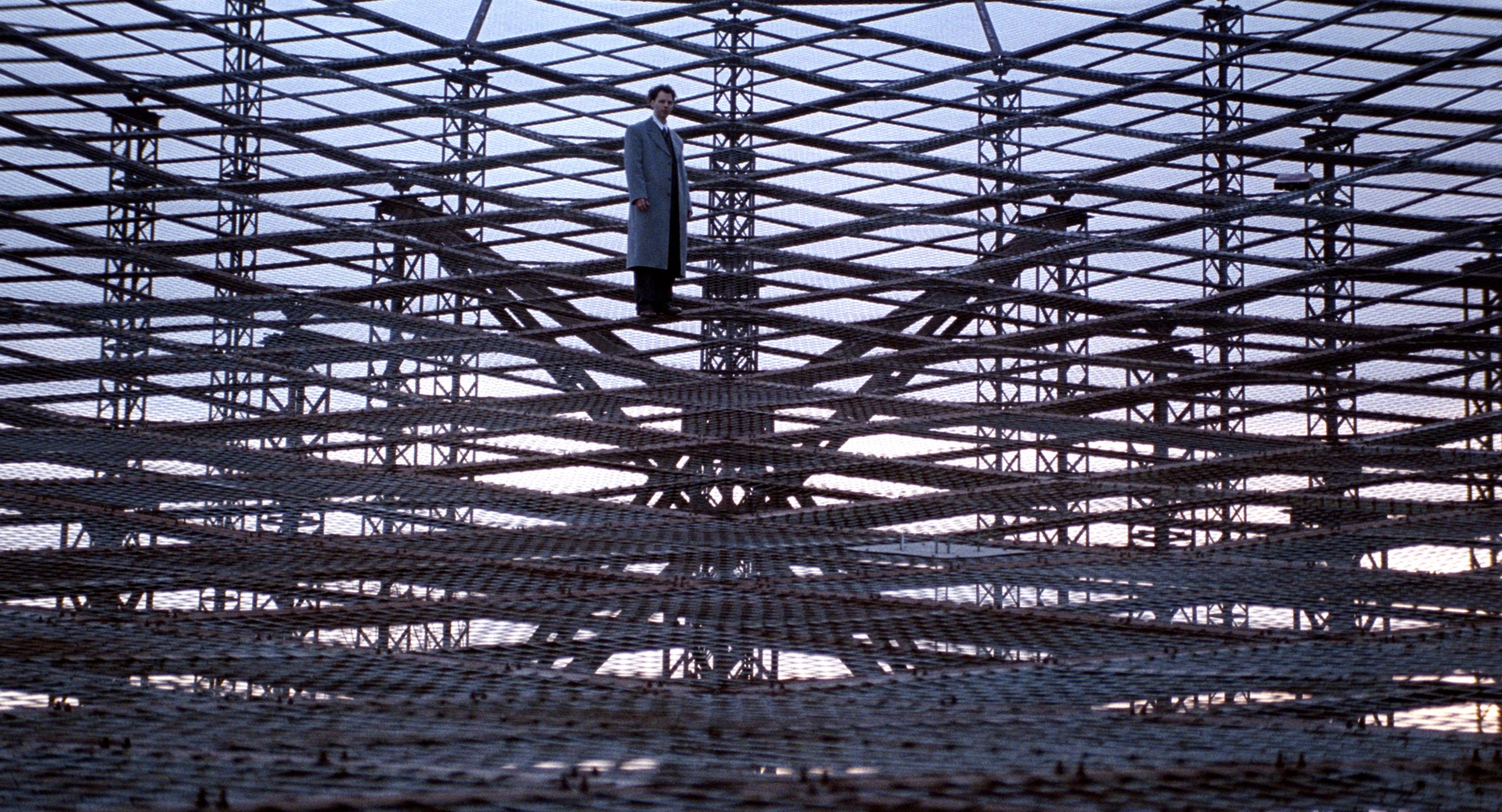
At the director’s idea, more than 400 people lived full- or part-time inside the Institute and tried to recreate the environment of the Soviet research facility, depicting its grace in the ‘30s and its slowly sinking to full decay in the late ‘60s. “No script but a real-life imitation”—this is how DAU was marketed to the public. Inside, everyone was supposed to live in the universe of the Stalin era—they had to dress and eat appropriately for that time, weren’t supposed to use modern language and also got paid with a special currency. It is said that, in reality, most of the actors, journalists and guests were free to enter and leave the place (although here the evidence differs), but inside the Institute they had to play by the rules. To this day, it is unclear to what degree the space was controlled, which actions were manufactured and which were actually an improvisation.
It is difficult to figure out what actually took place during the shooting of the DAU project, but an article from 2011, in which Journalist Michael Idov visited the set and wrote about his experience, may help us understand. He described Khrzhanovsky acting like a king, demanding that people fully obey him, and wrote that people who use modern words or forget to keep the character were punished financially. Idov quickly realised that what he witnessed was not simply a theatre play, but rather a real simulation: “No shooting, only documentation. And there is certainly no director. Instead, Ilya Khrzhanovsky, the man responsible for this madness, is to be referred to as the Head of the Institute or simply the Boss.” Idov also wrote about a woman, Yulia, who recently graduated from university. She was supposed to be the filmmaker’s assistant and was interrogated until 3 am with questions about sex. Idov’s conclusion was a horrid one: “The director wouldn’t make an actual move—that wasn’t his style—but clearly expected her to throw herself at him.” In the morning, Yulia “started uncontrollably shaking with disgust” and was removed immediately from the set—she was one of the “many dozens”, observed Idov.
This breach between fiction and non-fiction, as well as the PR strategy of the reality-show-like project, led to future scandals and accusations. The storm began when DAU was shown in December 2019 in Paris across three venues. One of the best pieces of coverage was published by the French newspaper Le Monde: they described the scope of the project and then questioned the ethics of its creation process. The article expresses concern that people were drinking alcohol on set, that sex workers were sexually abused on camera, and that Neo-nazi Maxim Marzinkewitsch (who killed people in real life) butchered a pig and harassed and called the American performer Andrew Ondrejcak an f-slur on set.
Some of those allegations were addressed: Le Monde was accused by Ilya Khrzhanovsky of changing his words, and then, after the movie’s premiere in Berlin, the actress Natalia Berezhnaya gave an interview to the Russian media Iskusstvo Kino in which she said that the rape scene was planned and she always had a chance to stop the filming at any moment. It is important to note that the author of that article, Egor Belikov, was himself accused by many people of sexual, physical and psychological violence. In the same interview, Berezhnaya shared that the porn scene was filmed without active consent. She and Luc Bigé, who played the role of the French scientist, were drunk and didn’t know in the beginning that there was a cameraperson in the room. Alcohol, as Berezhnaya said, played a huge role in the filming process. And she was not the only witness to non-consensual acts on the set—for example, the media manager Demian Kudryavtsev, who played the role of the scientist Zlatogorov, said in an interview that he was beaten but didn’t feel offended or harmed by it.
One of the most important testimonies is made by the photographer Anna Cladonia, who played the role of maid Anna in DAU. In her diary, which she wrote in the summer of 2024, she described how the casting and shooting process went, and what happened outside of the shoot. In the diary, she confirms the information about the consumption of alcohol and also shares details about sexual abuse on set by Alexey Trifonov, who harassed her and another actress Anastasia, who played the role of his secretary. Anna felt humiliated countless times during the period of being on set and developed an alcohol addiction. At the end of the diary, she shared that this experience affected her relationships with people for many years.
DAU didn’t break the wheel; it took a ride on it
Since the premiere of the DAU project at the Berlinale Film Festival 2020, where two chapters, “Natasha” and “Degeneration”, were shown, controversies have continued to arise, and a criminal case was filed against the director due to the film showing scientists conducting “experiments” on infants. The last “mother” movie, simply called “DAU”, finally got its premiere at this year’s Venice Film Festival, where it was awarded the prize for best directing.
The DAU project broke the Russian critic community in half and, to this day, its effect is present. What stands out to me, as someone who started their career as a critic shortly after the Berlinale 2020, is how the industry reacted. Many professionals believed that the MeToo movement meant more than words—as a result of many testimonials, some auteurs lost their standing in the industry. One of them, Abdellatif Kechiche, had even won the most prestigious award in the world of cinema: the Palme D’Or. Mostly known for his male-gaze lesbian drama Blue Is the Warmest Colour, Kechiche had been pursuing the project Mektoub, My Love, the first chapter of which, Mektoub, My Love: Canto Uno (2017) received mixed reviews and the second of which buried the director’s career for years. Mektoub, My Love: Intermezzo (2019) premiered in Cannes in a rough cut and immediately became the centre of the scandal. Kechiche was accused of pushing actors to perform non-simulated oral sex on camera and of using alcohol as a lever.
It would be expected to be the end of Kechiche’s career in cinema, and for some time it really came to its conclusion. Kechiche’s production company went into insolvency; the second chapter of Mektoub, My Love was never shown in cinemas; and the future of the third and final chapter was unclear. But a year ago, the Locarno Film Festival decided to show Mektoub, My Love: Canto Due (2025) in the official competition.
I am mentioning Kechiche’s case as an example of how someone can come back to the industry despite all allegations. He is not the only, and most probably not the last, controversial figure who will get pardoned by the heads of industry. (Japanese director Naomi Kawase was “cancelled” due to physical violence toward an actor on stage but also returned with the new work to Locarno the same year.) Both projects, Mektoub, My Love and DAU, have the same fastening material, which is alcohol and the idea of the absence of consent. Both directors wanted to create something real and achieved it, just in different environments—one put actors through one night of intensive dance, and the other created a three-year-long immersive theatre performance.
For me, it is salient how Kechiche and Khrzhanovsky preserved violence in their movies. They started them before the MeToo movement, before intimacy coordinators became a must on set. The abuse of power has existed in the industry for a long time, so it would be naive to believe that neither Khrzhanovsky nor Kechiche knew the rules of the game. They had full control over the material and still decided not to hide but to show real violence on the screen, which was a result of their actions. Even if they didn’t do something with their own hands, they became accomplices by allowing it to take place.
Some people defended DAU, saying that the director allows the viewer to experience the humiliating and degrading process of living inside Soviet society, in which people snitch on each other and are always observed by the special agents of the KGB. But I don’t believe in art that, in an attempt to comment on a problem, simultaneously reproduces it. You can’t criticise authoritarianism by creating a piece of art using authoritarian methods—it is hypocrisy. While the danger of retraumatisation in the context of sexual violence is clear for most people, many close their eyes to other types of violence and perceive it as spectacle. It can be observed in the popularity of wartime features that please the viewer with adrenaline-boosting scenes. In this sense, DAU does the name—it reproduces violence, damages people around it, and leaves marks on the spectators and non-professional actors.
Art owes nothing to anyone—it is not supposed to be safe or morally pleasing; it can have no meaning or be barely interpretable. These basic ideas are cited by DAU advocates, but what they don’t understand is that the critique of DAU arises not due to disagreement with its ideas, but instead with how these ideas are realised. These advocates forget that people supported the fascists’ ideas that something can be more important than a human’s life.
Human dignity was not centred in the Western European debates around DAU. The main concern was not the people, who testified about their experiences, and not the methods, which pushed people to act in a specific way on camera, but the personal position of the director about the Russian invasion in Ukraine and the source of funding. The film critic of the magazine The Guardian, Peter Bradshaw, gave five stars to the movie, comparing Khrzhanovsky with Christopher Nolan and savouring the grandiose idea of the director. Bradshaw didn’t mention any controversies around DAU. It seems that he, as well as other journalists, set aside the ethical issues and moved on—but DAU as a fully realised concept did not change in its core; only the political and cultural environment shifted.
The popularity of DAU among Western critics can be explained through a colonial lens. Firstly, Western critics don’t even see the ethical problem in the fact that the Russian director used the money of a Russian oligarch to employ many citizens of the Ukrainian city as non-professional actors. Maybe in the last decade, the colonial background of the DAU’s production was not clear, but now people should question the disbalance of power. Secondly, Europe and the USA have a stereotypical image of Russian artists with their tormented souls. Ilya Khrzhanovsky can be easily perceived as a genius who is oppressed by the Russian government (he got the repressive status of foreign agent), but he is not. He is more a European than Russian director because he left Russia in 2006 and rarely came back.
The funny thing about DAU is that some critics compared it to the blockbuster Oppenheimer by Christopher Nolan, with their same grand scope and story centred around a nuclear physicist who suffers from the government’s oppression. While praising Oppenheimer, those journalists forgot about the victims of the nuclear testing, who were indigenous people of North America. It is clear that, in the same way, they were blinded by the atomic radiation of DAU, which did not create something new but rather entropy—the simulacrum that eats everything around itself.