Author’s note: A crowdfunding campaign for the affected organisations can be found here.
This past Sunday, 18 October, the Berliner Polizei conducted a raid on Casa Kuà, a community-led organisation which provides public health-related information and services to a largely transgender demographic. The warrant was granted on suspicion of ‘illegal dealing in prescription-only medication’, per the Berliner Polizei’s press release. According to sitting LGBTQ+ Equality Commissioner Alfonso Pantisano (SPD), this followed two anonymous tips earlier this year.
The raid took place during ‘The Dolls’, a weekly tea-social for trans women and transfeminine individuals to enjoy ‘talking and hanging out’. A spontaneous protest outside the venue on the evening of the raid had police requesting backup after some 140 participants chanted ‘expressions of disapproval toward officers’.
Accessible public health and outstanding community organising
Casa Kuà lends its space to efforts that extend beyond the queer community, compensating for state negligence. A sex worker and community organiser, who prefers to remain anonymous, says while speaking to The Left Berlin, ‘I participated in training for marginalised communities to provide rapid HIV, STI and COVID testing to our peers.’ She says the training was in cooperation with the Deutsche Aidshilfe, an organisation with experience in sexual and public health education dating back to the height of the HIV/AIDS crisis.
She further commends Deutsche Aidshilfe for recognising the importance of meeting vulnerable individuals where they feel comfortable. In her eyes, Casa Kuà is just that, calling the centre, ‘a warm, accessible and welcoming space, and a really supportive environment for learning and exchange[…] a loving and imaginative answer to the question of what our care services and spaces could look like.’
When asked what she thought of the raid, she called it ‘frightening and heartbreaking,’ and emphasised that such actions ‘cannot be understood in terms of protection. By targeting Casa Kuà, police are actively working against public health efforts, at a time when government funding for health care and support are in rapid decline.’
Susan, a 45-year-old trans woman, recalls The Dolls fondly. ‘We cooked for each other, we shared experiences and expertise, we exchanged clothes and could use the LPL hair removal machine for free, as many of us don’t have access to continued hair removal treatment.’ LPL machines are available to the public for purchase, but cost around 200-400 euros. Though she no longer lives in Berlin, concerning the raids she feels, ‘Like Germany is, again, full Nazi.’
In addition to meetups and workshops, Casa Kuà serves the community through counselling for individuals, youth and families from peers and trained providers, alongside traditional and alternative therapies and a library. Services are free or provided on a sliding scale.
Twice a month, an internist and a trainee GP volunteer their time to offer free advice on sexual health and harm reduction, guidance on finding pathways to medical transition within the established medical system and information on hormone therapy. The two doctors explicitly disclose that in a practice-external setting, they are unable to provide ‘medication, bloodwork or other diagnostics.’
Discrepancies in healthcare access
Synthetic hormones are considered harmless enough to be approved for distribution via online prescription or pharmacy services. Patients fill out a form declaring symptoms and give a brief medical history. Answers are reviewed by a doctor who then writes an electronic prescription for testosterone gel, estrogen patches or androgen blockers, on one condition: that the patient is cisgender.
Barring the steep price some of these medications carry—one month’s supply of Testogel, a generic testosterone replacement medication, can cost 115 euros—trans patients are faced with additional obstacles to accessing them through insurance.
Despite being perceived as a global queer capital, Berlin has few doctors competent and willing to treat trans patients with the same medication they readily prescribe to cisgender ones. Those that do can be difficult to find without the knowledge and experience offered by peer-led organisations such as Casa Kuà and groups like The Dolls which connect trans people over the common experience of navigating the German medical system. While a visit to an endocrinologist, gynecologist or urologist can yield a prescription for hormones covered by insurance for a cisgender person seeking HRT, the same professionals will only treat transgender patients if they are backed by a psychological indication.
Obtaining an indication letter typically requires 6 months or a minimum of 12 sessions of psychotherapy. The waiting time for direct billing therapists (Kassenpsychotherapeuten) is estimated to be five to six months and expected to increase as a result of budgetary caps put on psychotherapeutic care by Merz’s governing coalition. Private sessions with licensed therapists cost around 150 euros each, meaning that trans patients could pay 1800 euros or more and wait over 12 months for the same medication as their cisgender counterparts—assuming they land with a psychotherapist sympathetic to and knowledgeable on transgender healthcare.
Reactions from the community and politicians
Mine Pleasure Bouvar, a political educator on socialism, trans/queer liberation and fascism studies, has given workshops at Casa Kuà and was a frequent visitor to the Dolls. When she heard about the raid, she was commuting to another city to give a seminar. She describes having to hold back tears as she desperately contacted friends for more information,
‘Having about forty police inside the place where I and my friends and sisters regularly share intimate exchanges, a place of safety and compassion, was just heartbreaking and indescribably painful.’
Of her experience with The Dolls, she says, ‘Nothing compares to the feeling on entering this room where trans women were in charge and centering transfeminine needs. The workshops range from political discussions, to empowerment and exchange on information about topics that deeply affect our lives like violence prevention, bureaucratic challenges (for example asylum system related), or advice on trans health to substitute the often lacking understanding of cis normative doctors. Further it’s a place of political organization. Participation in demos and other political events as trans women grew out of The Dolls.’
In a joint statement, Dielinke.queer’s national speakers Daniel Bache and Maja Tegeler condemn the actions of the Berliner Polizei. ‘This repression is unacceptable, especially on the background of the precarious state of [trans] healthcare,’ calling police raids of queer spaces an ‘unspeakable tradition,’ no doubt a historical allusion to early Nazi-era bookburnings.
They call the raid the latest in a series of blows to trans healthcare, referring to the ongoing disorder and confusion surrounding a 2023 court decision on a non-binary person’s right to have their top surgery covered by insurance. The case resulted in a scourge of denied and delayed claims for similar procedures. An amended law has not been passed.
Demonstration Saturday and support for recovery
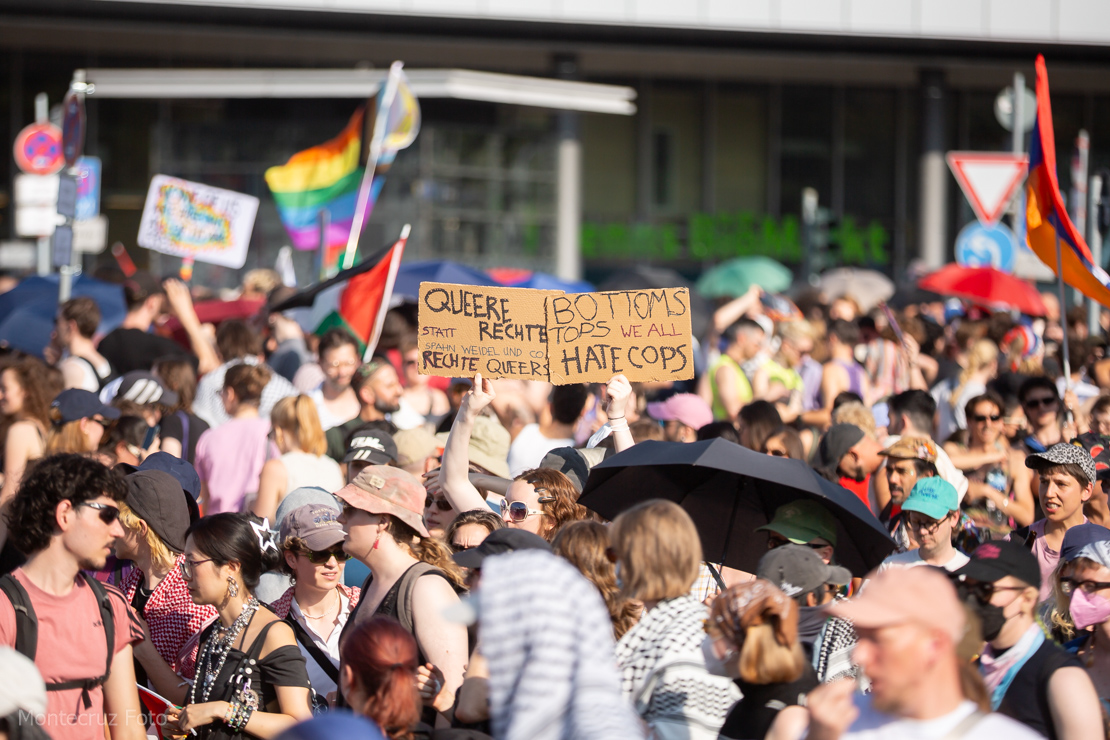
The growing police presence and escalation of police activity throughout the city is consistent with Germany’s drift toward the right and authoritarianism. A demonstration in support of Casa Kuà and The Dolls is scheduled for this Saturday, 24 October, under the banner ‘Hands off trans lives!’ from 2 to 5 PM between Mariannenplatz and Casa Kua on Naunystr.
The SPD’s Pantisano claims that Casa Kuà’s doors will remain open for the time being. Nonetheless, they are entering a period of immense legal and financial pressure. In order to ensure Casa Kuà and the Dolls can continue serving the public in the interim, a crowdfunding campaign has been launched to cover groceries, mental health support, clothing for those who need it, team training, and several other necessities. You can make a donation here.
Sunday’s events are the latest example of the Berliner Polizei’s brazenness and the CDU/SPD coalition’s callous disregard for their constituents and incoherent priorities. Saturday’s demo is a crucial opportunity to stand with the providers of community care for and by the people, and against state oppression. In the organisers’ own words: ‘Organise. Get angry. Stay glamorous.’
Note: A name has been redacted from an earlier version of this article to protect the speaker’s anonymity.