Hi, there. Could you start by introducing yourself?
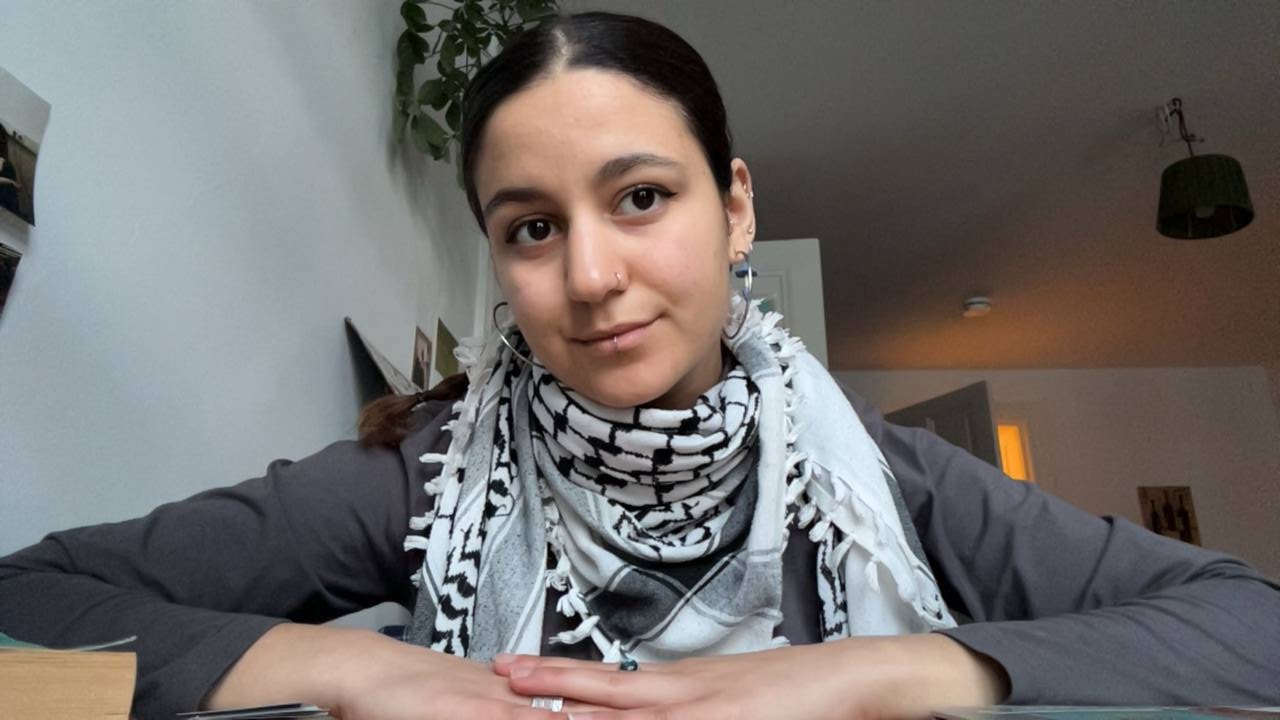
My name is Dima. I’m Palestinian. My parents are from Palestine. I was born and raised in Germany, but I consider myself Palestinian.
I’m a student in my last year. I’m studying social work at a Spanish university in Almeria. Currently I’m doing an internship working with unaccompanied minors who are refugees, and who came to Germany either by themselves or with a parent. At the same time I’m writing my dissertation.
And as part of this dissertation you are doing a survey?
Yes. It’s a research project, basically. The topic is the experiences of pro Palestinian activists in Germany with a special focus on violence and discrimination.
Are you trying to address all pro Palestinian activists, or just a particular sort?
I’m interested in talking to anybody who is active around Palestine. You don’t have to go to
demonstrations all the time, or consider yourself an activist. Some people are engaged and active, but they don’t consider themselves activists, and that’s completely fine.
I don’t care how old you are or what back story you have. All genders, all ethnicities are welcome. The important thing is that you’re open to talk to me. It’s obviously only in the way that you want to. I’m not looking for a specific profile. It just has to be activists in Berlin.
I’m interested in talking to anybody who is active around Palestine. You don’t have to go to
demonstrations all the time, or consider yourself an activist. Some people are engaged and active, but they don’t consider themselves activists, and that’s completely fine.
What are you interested in hearing about in particular, or won’t you know until you hear it?
I want to hear about experiences that either you had by yourself or you have observed in terms of discrimination and violence. So if you can tell me about something that happened to you that was discriminatory or difficult to handle, or that had an impact on you.
It can be police violence. It can be just violence on the street, family topics, or professional consequences of participating in something. That happens a lot as well. I’m looking to find out how that impacts people, because there is a huge difference in activism in different countries. And Berlin is very different from the rest of Germany.
I’m studying in Spain, and I lived in Spain for the past three and a half years. Activism is handled very differently there. Because it will be published in Spain, I want to show my university that there are huge differences between activism in Germany and Spain, using examples from people who have lived it.
Why are you specifically interested in Berlin? You could have done this about Spain or about Bayern. What’s so interesting about Berlin?
I didn’t know that Berlin was interesting in that sense until I moved here a couple of months ago. I wasn’t here before, but I saw it in the news a lot. Friends that I know here told me that the violence and polarization in Germany is brutal. Even if you’re a Leftist, it doesn’t guarantee that you are pro Palestinian, and that’s worrying for me.
Berlin is also such a concentration point for activism and political standing that I think it’s a really good place to analyse the dynamics and find out what the reality is for Palestinian activists living here.
What have you experienced about the differences between the Palestine movement in Germany and in Spain?
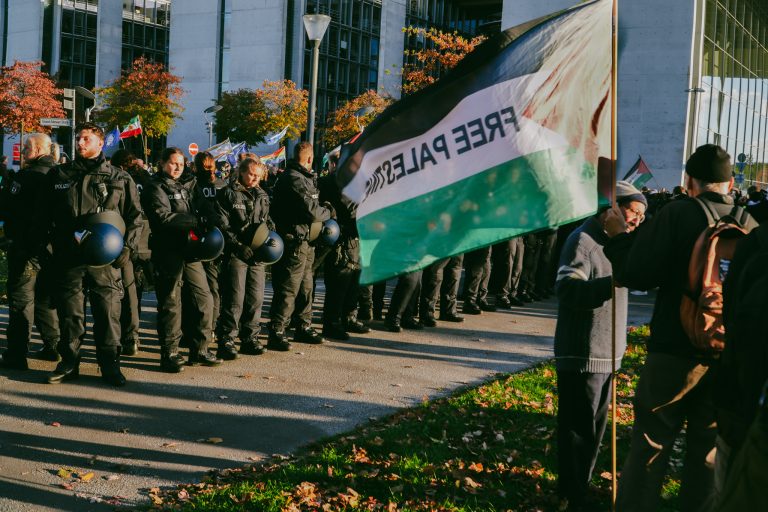
It’s so different. The first protest that I went to here was in March, about three weeks into me being in Germany, and the vibe was completely different. There were a lot more police. People were, like, really engaged with everything.
In Spain, often the protests are kind of cute and wholesome and really beautiful to see. I’m not saying the protests here aren’t beautiful, because it is beautiful to see a lot of people united and fighting for the same cause. But in Spain, you don’t have to be worried about anything. You don’t have to be worried about being discriminated against because you’re wearing a Palestine scarf or for expressing your political views. In that sense, the police are really, really chill.
If you have a leftist political opinion in Spain, then you’re pro Palestinian in Spain. I hung out with a lot of leftist people, and no one would ever consider defending Israel’s right to exist or the genocide. No one ever denied the definition of what’s happening in Gaza, which is a genocide.
Is there a difference between the Spanish and the German governments?
The Spanish government is pretty great in that sense. Well, Pedro Sánchez is. I’m not a huge fan of him, because I think there’s a lot of things that he’s not doing right, but regarding Palestine he’s doing the right thing. He condemns Israel’s actions. He condemns the genocide. He supported the flotilla. It’s really great. Such things as antisemitism accusations would just not happen.
And then there’s the German government. You’re not allowed to wear a Palestine jumper in parliament. I think that says it all.
Do you think that Sanchez means it, or is he responding to public opinion?
Great question. I think he wants to be popular as well. Obviously, he needs it. He would lose the vote very quickly if
he wasn’t responding to public opinion. I don’t think it’s great, but we’re in desperate times. If his actions are these, but his opinion is a different one, I think I have to just try to ignore that.
Tell us about your survey. You’ve only just started. How’s it going so far?
It’s going okay. My deadline is in five and a half weeks. I work well under pressure, so I hope the pressure will kick in soon. It’s difficult to get people to do an interview with me, because people are busy. Activists are busy. I know political work takes a lot of energy and courage and time. So sometimes people just can’t make the time, which I understand.
But sometimes I think people also don’t trust—not me, maybe, but my work, and maybe how safe they are. Maybe they think I expect too much, but I just want to have a normal conversation and then try to bring that into my work.
Obviously, everybody’s anonymous. You won’t be in danger.
To meet your other deadlines, the interviews should really be finished by around 10 May. How many interviews do you intend to do in that time?
My dream would be to have between 8 and 10 interviews. We’ve just done my third interview. I’ve got another one later on. Eight would be really good, because without that the research wouldn’t have that much credibility or weight.
I know it’s just a dissertation, but personally, it means so much to me. The more I can cause an impact, the happier I will be.
If someone wants help, how much of their time are you going to take?
All three interviews I’ve done so far were pretty exactly one hour and 20 minutes. We can make it quicker. We can make it longer. But between an hour and an hour and a half is normal.
But if someone only has half an hour, you can fit them in as well?
Yeah, of course. I can ask the important questions, but it’s always difficult to talk about Palestine within only half an hour.
Are there any findings you have made already, or have you done too few interviews to tell?
I can’t say exactly, and they were all three very different interviews, which I really like. But in terms of safety as an activist, people said similar things, also in terms of the perception of Palestinian activism in Berlin. The situation is difficult and it needs a lot of work and engagement.
Is there any specific sort of person who you haven’t interviewed yet that you really want to hear from?
I haven’t interviewed any Palestinian people yet, which would be really cool. But, I’m genuinely open to anything. I can do interviews in Spanish, English, and German. Arabic would be a challenge, but I can try with the help of friends or family. I’m open to anybody who’s interested.
What do you want to do with what you learn? Do you see further ways of using this knowledge to be able to help the movement?
I think with this dissertation, I wanted to show my university in Spain what the reality is there and here. It’s also an important piece of work for myself, because I want to know how to have a positive impact on the movement and find ways to make the movement grow.
One topic is the emotional work that you connect with Palestine activism. I want to see how people deal with those challenges and emotions, because I’m a social worker, so it would be cool to offer psychological and social health to people that suffer from oppression.
I want to help the movement. I’m also trying to find ways of bringing myself into activism in Berlin
What’s the next step for you personally? Are you going to stay in Berlin? Are you going to move back to Spain?
I’m staying in Berlin. Four months in Berlin is not enough. I want to stay in Germany. I was born and raised here, and I haven’t lived here in almost seven years. So I want to be back here.
I want to become a social worker. My internship is working with migrants and teenagers. I’d like to stay in that area.
Do you see a specific link between your social work and your Palestine activism? Or are they two separate things?
I can’t separate that very well. Social work means defending human rights and acting against repression, and my area will be antiracist practice. So it’s very combined.
As a social worker I have to work with the system, but at the same time I have to somehow trick the system to help people out.
You’ve only been here for a couple of months. Have you already got involved in the Palestine movement in Berlin?
I went to a plenum of the Gaza Committee on Monday, and I’m planning on going to a few more. I want to bring myself in there. I go to demonstrations whenever I can. I go to a lot of fundraisers and donate. I talk a lot about my type of activism as well, just spreading the word.
I know you’ve got to go in a minute to your next interview. So just quickly, if people are interested in talking to you, how can they contact you?
They can e-mail me at dj873@inlumine.ual.es.
Just say: “Hi, I’m interested. Can you tell me more?” If you’re unsure, I’m happy to respond to questions. I’d love to hear from people who are interested and want to help me make this project.
People have until 10 May, so rather sooner than later. And maybe you can write us something about the results when you’re finished?
I’d really love that. Thank you so much for the opportunity.