Siblings and Elders,
We are the Ulm 5, and we are currently being held in five different prisons in South Germany, awaiting trial for resisting the manufacturing of arms and military technology used in the Israeli genocide in Gaza and the military occupation of Palestine as a whole. Your solidarity has kept us waking up with a strong and steadfast spirit. So thank you for taking precious time to visit us in our cells through letters of solidarity. Thank you for breaking the repressive tool of isolation.
While Germany continues to arm and advocate for the genocidal Israeli state, let us be clear that no severity of repression can break our solidarity with our Palestinian siblings. That no severity of repression can break our solidarity with our siblings surviving occupation, colonial and neo-colonial rule all over the world.
While protecting profit and private property connected to manufacturing genocide remains more important than preventing the greatest crime against humanity, it has been clear for all too long that “nie wieder” is an empty promise.
Germany, you have made your position very clear: international law, human rights and basic decency do not concern you, as long as you are able to secure your geopolitical and economic interests. You will not stop short of aiding barbaric military violence and unthinkable semantic violence in executing and justifying the unjustifiable – genocide.
Now it is time for conscious people of Germany and the world to make our position clear – a position we must make clear day in and day out. We shall not be complicit or satisfied in a system where every tool available is used to legitimise colonialism and occupation and their result – unbelievable suffering. It is our duty to interrupt and disrupt until the narrative is set straight and justice is served.
To resist through anti-colonial struggle is not just justified, but necessary.
Free Palestine. ! فلسطين حرة
This is the joint statement by the Ulm 5, read at yesterday’s press conference addressing their case – five Berlin-based activists who have been in pre-trial detention for six months, following a non-violent direct action targeting Elbit Systems in Ulm, Germany.
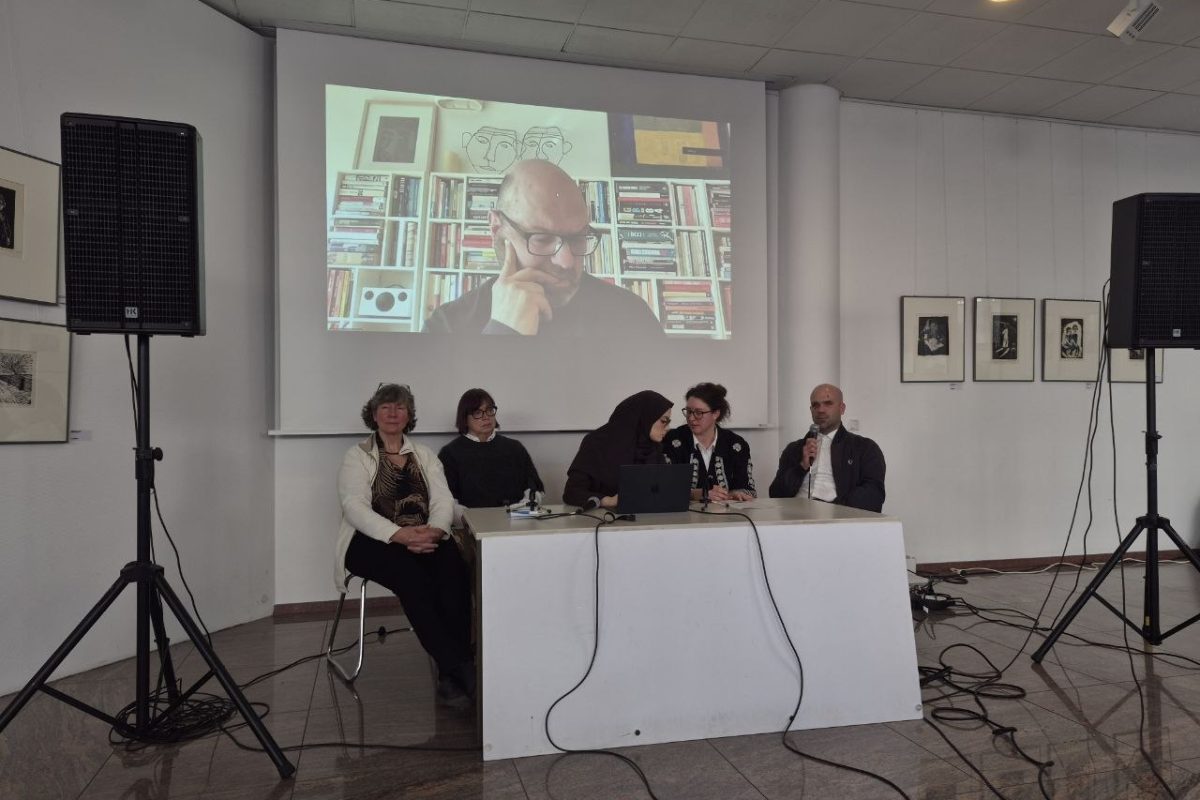
The press conference, chaired by Nehal Abdulla (Cage International), brought together the defence attorneys Nina Onèr and Matthias Schuster, mothers of Daniel and Zo from the Ulm 5, and investigator Andrew Feinstein (Shadow World Investigations). The speakers framed this case as part of a larger effort to crack down on political dissent in Germany and highlighted how it may be designed to make an example out of the activists.
The case
Daniel, Zo, Crow, Vi and Leandra were arrested on 8 September 2025, after participating in a direct action targeting Elbit Systems in Ulm, Germany, aimed at disrupting the flow of arms to Israel and stopping the genocide in Gaza. Ever since, the activists have been held in pre-trial detention in prisons across south-west Germany – despite this timing violating the principle of expedition in detention matters – and face a potential sentence of up to five years in prison.
The charges against the Ulm 5 are of trespass, property damage and, most significantly, membership of a criminal organisation, under Section 129 of the German Criminal Code – which, historically, has been used as a tool of political repression. Its elements are so vast that almost any act can be interpreted as support for a criminal organisation. Previous instances where Section 129 was used “were always catalysts for infringing on the rights of the defenders”, lawyer Nina Onèr said. UN rapporteurs have previously criticised Germany for using Section 129 against climate action groups.
This case needs to be understood in a wider context: Andrew Feinstein, director of Shadow World Investigations, stated that the large majority of genocide scholars consider Israel’s actions in Gaza to constitute violations of international law, and such military operations depend heavily on global arms supply chains. Elbit Systems is a key manufacturer in supplying military and surveillance technology, including drones and targeting systems used in Gaza and Lebanon. According to Feinstein’s team’s analysis of customs data, Germany exported substantial military-related items to Israel in 2024, with a notable share linked to the subsidiary through which Elbit Systems operates in the country.
Faced with a legal system that fails to address such injustices, direct action and boycott play an important role, as they did in apartheid South Africa, Feinstein said. He added that “the German legal system should trade its focus on those arms companies that continue to enable and facilitate this genocide”, adding, “it is those complicit in genocide that should be on trial, not these five courageous, principled individuals. They should be released immediately”.
The defence team is seeking to introduce this argument into court, arguing that by acting to disrupt the supply chain linked to unlawful violence against Palestinians, the Ulm 5 acted in defence of others under international law. However, establishing Elbit Systems’ direct involvement will be legally complex to prove, and the defence’s requests for the prosecution team to investigate the company’s role have gone unanswered so far.
The trial will take place at Stammheim, a maximum-security prison in Stuttgart associated with the Red Army Faction trials in the 1970s. The defence claims this choice might indicate how this may be a “show trial” and that the prosecution is trying to paint a picture that these are “high criminal people, which we strongly oppose”, Onèr said. Besides, the state’s Higher Regional Court (Oberlandesgericht) stated that the five were unlikely to receive a sentence at the lower end of the scale, and that any sentence was unlikely to be suspended – this before the trial even began.
The detentions
The Ulm 5 are all being held in separate prisons across southwest Germany. According to the lawyers and families, they are facing restrictive conditions and, in some cases, violations of their human rights, such as prolonged solitary confinement of up to 23 hours a day, alongside restricted visits, restricted phone calls, restricted mail, inadequate medical care, and degrading treatment (one of the detainees was stripped naked and kept in a diaper for six hours).
Beyond this, there have been barriers to preparing a coordinated defence. Appeals against their detention have been repeatedly rejected, and the court has yet to provide clear reasoning for dismissing the defence motions.
Nicky, one of the mothers, recounted how her child struggled to access basic healthcare in prison – or, in the “human dustbin”, as Zo baptised it. Zo’s mother shared how they took on a prison cleaning job, paid at 1,04€/hour – which translates to 15 hours of work to afford a 30-minute call. Beyond their own inhuman treatment, the activists report being traumatised by bearing witness to the treatment of other prisoners – in particular, people of colour. “These are young people who acted without violence,” one mother said, “yet they are being treated as high-level security threats before their trial has even begun.”
What happens next
The trial is scheduled to start on 27 April in Stuttgart. For the defence and families, the case could set an important precedent for how political activism – especially Palestine solidarity – is treated in Germany.
The proceedings will be held publicly and include two lay judges, though it remains unclear what influence they may have on the outcome. Lawyers and supporters have emphasised the importance of transparency, calling for strong public and media scrutiny as well as the presence of trial observers to ensure accountability and the protection of fundamental rights. Nehal Abdulla, in her closing remarks, described the case as “not just a legal matter, but a political one,” adding that it will serve as “a test for the integrity of legal and democratic institutions”.
The demands for this specific case are clear: the immediate release of the Ulm 5, an investigation into Elbit Systems, and justice in the courtroom. But the stakes extend far beyond them, and it should concern and worry us all. In Nina Onèr’s words, “this specific case is a demonstration, and maybe a preview, of what we are to expect in the future from this government towards politically undesirable actors in general, and Palestine solidarity in particular”.
As of now, court dates are scheduled from the end of April to the end of July (27 April; 4, 6, 11, 20, 22, 29 May; 15, 19, 29 June; 1, 3, 22, 24, 27, 29 July). Possibilities of arranging group transport from Berlin to the court are being discussed.
For all enquiries, write to ulm5media@proton.me.