This article is the fifth piece in the series Neo-Nazis and Anti-Fascism in Germany since the 1990s. The rest of the series can be found here.
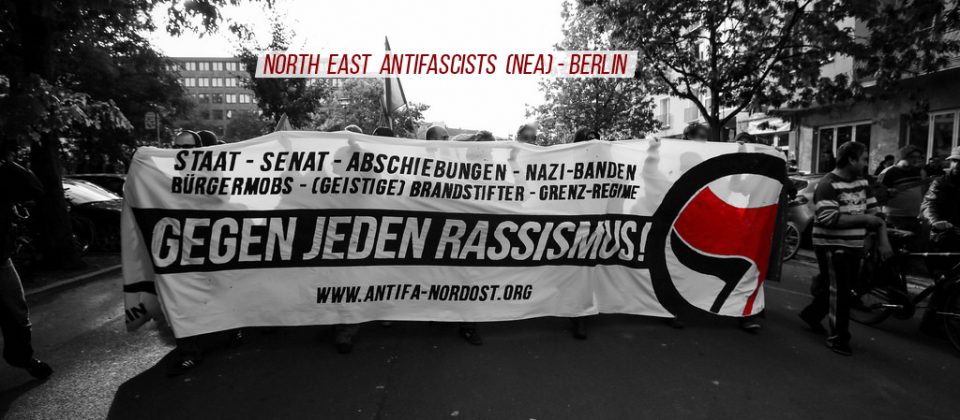
For this article, we interviewed Antifa Nord Ost about their research on far-right mobilizations in Berlin. We also discussed their anti-fascist work, and why working on the outskirts of the city is crucial.
TLB: Thank you for taking the time to speak to me. Can you tell me about your group, and why it exists?
We founded it back in 2007, although there has been turnover and changes in structure since then. The founders were already active in various anti-fascist circles and wanted to start something new on the outskirts of the city. This was deemed important, especially in East Berlin, because fascist structures have been strong there for a long time. At the time there were Freie Kamaradschaft activists [a self-description for loosely formed neo-Nazi groups], the NPD, and so on. So the founding of our group was, in some ways, a response to that. At the same time, it was also meant to keep an eye on the bigger picture, which is why we also have an anti-capitalist stance. We do not see the current social order as the end goal; rather, we adhere to communist and anarchist ideas.
TLB: And what kind of work do you do concretely?
We’re not a public group, we’re a closed group with a committed core of members. Sometimes we just assess what kind of fascist structures there are in the neighbourhood and beyond. We also do classic Antifa work, such as protests when fascists march or at right-wing meeting places. We support victims of right-wing violence when we have contact with them. We do commemoration work for those murdered in fascist attacks, such as the campaign Niemand ist vergessen [No one is forgotten]. Also other things I won’t get into here. We do a monthly info evening at Bandito Rosso, where people can get involved in practical work or just come talk to us and support open Antifa meetings at the outskirts like the OAT Hohenschönhausen. We have an email and social media where people can contact us. We’re also turning towards doing more anti-militarism work.
We have also worked on various issues in the group, including gentrification, international issues such as work on Rojava with Kurdish comrades, and we also try to engage feminist issues. Anti-militarism is another one, which is often a bit of a blind spot in the anti-fascist movement. We’re not a huge group, but we’ve always tried to connect with other political struggles. And, of course, throughout all of this we emphasise our connection to the city’s outskirts. We were never the typical inner-ring Antifa group, instead always willing to go where it was needed, even if it meant getting hurt.
It’s also important to show a presence in the city centre, and people do that, but there’s also often a lack of mobilisation outside the ring. It’s difficult to get people from inside the ring to go there, something which you can often see at Dritte Weg marches with okay [anti-fascist] turnouts. But when fascists want to go through Friedrichshain, thousands of people come out. So there’s an imbalance there, and that’s what we’re pushing to rectify.
TLB: I get why you emphasize the areas outside the Ringbahn, but why specifically Northeast?
Fascist structures are strong there, and many youth groups focus there. There’s also practical reasons: people who are active in our group have their lives there. There are many antifascists in the outskirts, and it makes sense to network there. We’re going to be politically active in the place we live, where we spend most of our day.
TLB: Do you experience state repression?
Well, it depends how you define it. We’ve definitely been mentioned in the annual report of the Verfassungsschutz for years. That shows that we have some visibility and success. Of course, it happens quickly when you’re not the kind of Antifa that supports the state, but are instead critical of the current social conditions. You have plainclothes cops hanging around your events to check out who’s in your group.
But let me put it this way: we’ve never been subject to a §129 proceeding or anything like that. So we haven’t faced any extreme state repression, but of course, you have to assume that the state has you on its radar. That’s how it is when you’re active against Nazis.
TLB: What is a §129 proceeding?
A §129 proceeding is the criminal process that now affects, for example, the people who are charged in the “Antifa-Ost-Komplex” case or in the Budapest proceedings. The prosecutor claims that you are a criminal organisation, and the whole group is morally responsible for its actions and therefore charged as a whole. Then there’s §129a StGB, which specifically refers to terrorist organizations, and §129b StGB, the equivalent for so-called foreign groups. People are repeatedly affected by these proceedings. Our Kurdish friends, for example, are frequently affected by §129b. But our group has not had a similar proceeding.
TLB: To change tracks, I’d like you to imagine you are sitting with a comrade who is completely new to Berlin. What would you tell them about fascists in the city?
In Berlin, you have several relevant groups, such as Der Dritte Weg [The Third Way] and the Nationalrevolutionäre Jugend [National Revolutionary Youth] (NRJ). The Dritter Weg has been in Berlin for over ten years now, and is active throughout Berlin, but mainly in the East; especially in Hellersdorf, where many of them live. They feel safe there and often practice martial arts in public parks, shoot propaganda videos, or go to Cottbusser Platz and spray graffiti on the walls.
They’re also very active in Pankow, where many NRJ members live, including their leader Erich Storch, in the Neumann neighbourhood. They’re trying to show their presence there, spraying graffiti on school walls and putting up posters. They also target left-wing youth centers, especially the JUP [Unabhängiges Jugendzentrum Pankow] and the Bunte Kuh [Colorful Cow]. There have been several threats and they showed up at events organised by left-wing groups here. La Casa [a cultural youth center] in Hellersdorf is also often targeted. La Casa and JUP have faced actual attacks.
The National Democratic Party of Germany, now called Die Heimat [The Homeland, a term with Nazi connotations], was active here in Pankow around Christian Smidt, but he switched to Dritte Weg. For a while, Die Heimat was practically irrelevant here. Now, they’re trying to recruit young people from the Deutsche Jugend voran [German Youth Ahead] movement. Oliver Niedrich is particularly prominent in this regard, having already traveled with the group to anti-CSD demonstrations in the summer. He also attempted to hold an anti-Romani march through Mitte in November — hate of Romani people being one of his favourite topics — which was successfully blocked by anti-fascists. These are some of the shifts in the balance of power in the fascist scene in Berlin.
Over the last couple of years, we’ve been seeing fascist youth groups develop that are less organised or ideologically committed. Groups like Deutsche Jugend voran, Patriotische Jugend [Patriotic Youth], and others. These groups have formed across Germany and are very active on social media to recruit new members, but also on the streets. They have mostly gone to CSD parades in East Germany, but they also tried to threaten the one in Berlin. These groups are not ideological; people tend to switch between them because of friendships instead of political reasons. That doesn’t make them less dangerous, though. They create real threats in schools, youth centres, and places where youth affected by racism, who are Jewish, or are somehow left-wing, gather. Finally, the AfD, with its fascist wing clearly dominating, is also present in Berlin and has run a strong election campaign in Marzahn-Hellersdorf and Lichtenberg.
TLB: When you say attacks on gatherings or youth centers, what do you mean?
For the Bunte Kuh, it has been limited to threats so far, although they have tried to attack the building multiple times. Sometimes it’s just small actions, like throwing glue at the wall, but it carries a threatening message: ‘we’re here’.
Then you also have physical attacks, for example, on people who have a queer button on their shirt. Deutsche Jugend voran has attacked several people who were wearing an anti-fascist shirt or something like that, some of whom were then physically incapacitated. One person had a brace on their elbow and was attacked by seven or eight youths in Marzahn. And in 2024 there was this attack at Ostkreuz, where the NRJ attacked anti-fascists from behind in the busy station when they were going to an anti-fascist demonstration in Hellersdorf. This had a dimension that we haven’t experienced in Berlin for years.
In Rennbahnstraße, at the sports complex TSC Preußen 97, they held fascist training sessions for years. This is also a pretty crazy story. The district of Pankow basically provided club rooms free of charge for right-wingers to train in martial arts. Since at least 2019, several members of Die Heimat have been training here. They hosted training sessions together with AfD members and people from the Identitarian Movement. This was documented with photos, but at the time, no connection to TSC Preußen was identified. Later, the trainer in the photos was identified as the manager of TSC Preußen. Now, it’s clear that Dritte Weg has been training there since at least 2023, including very young people, likely also to integrate them a bit into their structures. There, they were able to train undisturbed for attacks like the one at Ostkreuz.
In response, we launched a big Schaut nicht weg [Don’t look away] campaign in order to put pressure on the district and kick these fascists out of the sports club. With the campaign, we also wanted to tell fascists that we had them on our radar, that they can’t just come here and train undisturbed. We were at least partially successful. After much back and forth, the district presented a list of cadres who are no longer allowed to train there. Although the sports club doesn’t totally abide by the rules, it’s an improvement.
TLB: You mentioned several youth groups. Why do you think this is such a focus among the fascists? Or why do you think they find more success there?
I think it has to do with a general shift to the right within society and parliamentary politics. All the bourgeois parties are moving to the right, from the CDU to the Greens. You have drastic tightening of asylum laws, as well as a billion-dollar rearmament package and drastic militarisation of society. And so AfD positions and demands are already being anticipated, so to speak. At the same time, the AfD’s nationalist wing is becoming more and more aggressive, and young people are growing up in this environment. These are the discourses that they pick up on. And then you add the skinhead or right-wing youth movements of the 90s that offer a certain kind of excitement. When these things come together, certain positions become more acceptable. That’s how we understand it at least, but of course, this is an open topic that needs to be studied more
TLB: These groups are also very active on social media. What are they doing there?
The AfD is definitely very present on TikTok, together with these right-wing groups of young men that I mentioned earlier, like Deutsche Jugend voran. TikTok and Instagram are definitely where they recruit new people. Some of them write really stupid things and argue with each other publicly via Instagram stories, which is obviously useful for our research. However, on the other hand, it makes the subculture they’re part of seem cool. Some young fascists post right-wing music in their stories and then post where they’ve been at demonstrations today, which CSDs they tried to disrupt, and so on. That’s going to reach a lot more people than in the 90s, when the village fascists would get together.
And social media is where left-wing groups sometimes still hold back, for valid reasons. But still, left-wing structures might need to show a stronger online presence. Of course, many of the apps are also dangerous in how they handle data, but we need to start offering content in some way.
TLB: Thank you for taking the time to speak to us. As a last question, what kind of collaborations would you like to see happening in Berlin? And how can other groups support your work?
They can connect with us, even if it’s just one person – it’s always interesting for us to get more information about where fascists are meeting, their events in different neighbourhoods, or stickers and posters you have noticed that weren’t there before. People can also let us know if they’re experiencing threats or attacks themselves. Otherwise, we’re happy to have people at our actions or to work on promoting things with other groups.
And collaborations are really important, the networking between different struggles. We want to get involved in other people’s struggles as well, so we are all better informed about different problems, and can support each other in terms of repression. As a group we have a broad range of interest, from international struggles to feminist issues, and refugee rights. So we’re definitely happy when groups approach us.