Hi there. Thanks for talking to us. Could you start by introducing yourselves. Who are you and what do you do?
Thank you for the opportunity to talk about our collective and our festival! We are the Solidarity Group Auswärts, a Berlin-based collective founded by Greek-speaking immigrants almost a decade ago. Even though our political activism and expression has evolved throughout the years, our goal is the solidarity and self-organization of immigrants, workers, unemployed and students, who are fighting together for liberation and social justice against ethno-patriarchy, capitalism, fascism and colonialism.
Today we want to talk about the Aus der Nachts heraus film festival. What is the festival and why are you organising it?
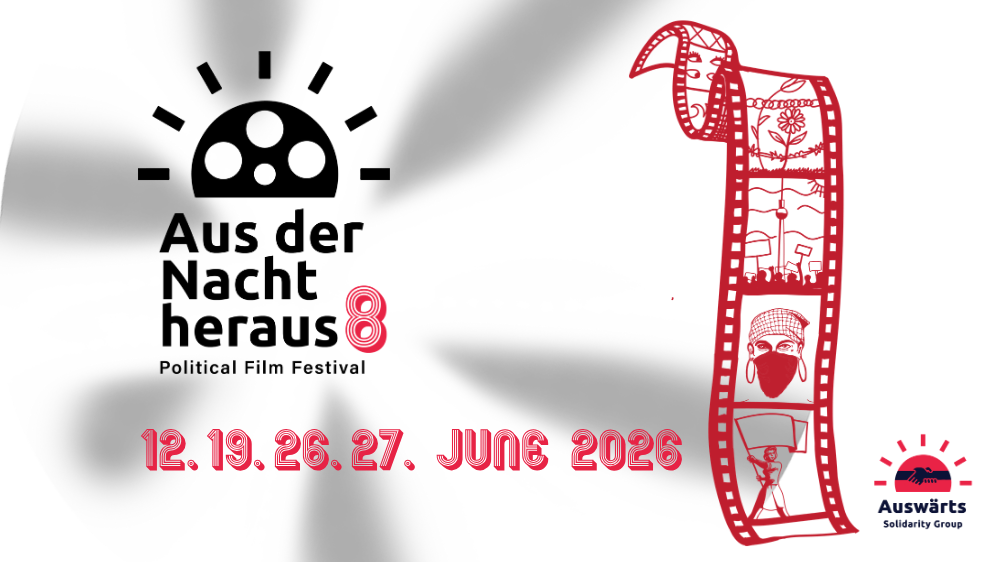
Aus der Nacht heraus is a political and solidarity-based film festival and the collective’s most long-standing project, now in its eighth year. The festival brings together films, discussions, and guests who challenge oppressive systems and inspire collective action. Each edition focuses on different critical topics.
The main goal is to offer space for critical dialogue, learning, and collective empowerment, connecting activism, art, and solidarity across borders. Berlin is a big political mixing pot where groups and collectives fight for the same things, though they rarely share the same space. We would like to change that!
This is going to be the eighth edition of the festival. Is this year going to be any different to previous years?
Yes, definitely. In many ways, this year’s festival is quite different from previous editions, although its core and values remain the same.
Since its beginning, the festival has been a living project—constantly evolving, growing, and transforming. Over the past eight years, it has reinvented itself step by step, responding to changing realities, new urgencies, and the experiences of those who shape it.
This growth has unfolded against the backdrop of profound political and social transformations that have shaped both our generation and our collective outlook: from the global financial crisis and its devastating consequences in Greece—which forced many of us to migrate abroad—to the first large refugee crossings across the Mediterranean, the rise of far-right movements across Europe, the COVID-19 pandemic, Russia’s invasion of Ukraine, and Israel’s genocidal policies against Palestinians, enabled by the political and military support of European states and other Western powers.
The first obvious difference this year is the location. For many years, the festival took place at Prachttomate Community Garden, and we are deeply grateful to the people there for hosting and supporting us throughout that period. This year, we decided to move to Wagenburg Lohmühle, and we are very happy and thankful to organize the festival in this new space.
Another major change is the growth of our audience. The number of participants has increased significantly from year to year. In the past, our visitors were mainly Greek-speaking migrants, but over the years we have welcomed an increasingly international audience, which makes us very happy.
As we witnessed this transformation, we began reflecting on how the festival itself could evolve. We wanted it to become more than a space for theoretical discussions or expert debates. While political analysis and critical reflection remain important, we also wanted to create a space that could encourage collective action and contribute to the development of broader grassroots political movements.
This year, the biggest and most innovative change is precisely in that direction. On each of the four festival days, alongside the panel discussions and film screenings, a variety of organizations, collectives, and initiatives will have their own presence at the festival. They will be able to present their work, share information about their struggles and campaigns, interact directly with visitors, and use the festival as a platform for collaboration and collective action.
In that sense, we hope that the festival can contribute to strengthening connections between different movements and communities. We would also like to sincerely thank all the groups and organizations that accepted our invitation and are participating this year.
At the same time, the festival’s essence remains unchanged. At its core, it continues to be a strongly political and solidarity-oriented film festival and the main goals remain the same as well: To create a common space where people from different backgrounds, but with a shared understanding of solidarity, can meet, exchange ideas, discuss, listen, learn from one another, and build meaningful connections.
For each screening you have chosen a general theme: Climate injustice, Europe’s border regime, feminist liberation struggles, and the ongoing militarisation and rearmament. What made you choose these specific themes?
The way we choose our festival themes is identical to how we make all our decisions—consensus in our general assembly. Different topic ideas are proposed and discussed, we usually attempt to establish umbrella-themes and combine topics and, in the end, we vote.
As every year, the themes of the eighth edition are heavily inspired by the general status quo as well as topics of interest of our group. The world is on fire and, in order to resist and change it, we need to understand it.
This year’s themes focus on the rise of racist and militarist right-wing policies globally, the devastating and all-encompassing effects of war and (neo)colonialism as well as solidarity and collective action as a means of fighting imperial, colonial and patriarchal oppression.
The concept of necropolitics is underlying in all four themes; death has become the driving force of the contemporary “murder-state”, either through warfare, destruction and extreme precarity that forces the people to migrate to survive, by killing the same people before, while or after crossing the borders or by generating and feeding apartheid states, genocides and ecocides.
Whoever is considered a threat and enemy to the capitalist, colonial state has a target on their back and becomes the subject of severe oppression, even elimination.
These are the issues we would like to shed light on and hear the perspectives of people from the different movements that resist the politics of death.
Do you think that these different themes are linked together?
Yes, absolutely. They aren’t just linked; they are entirely inseparable. We cannot understand the modern climate crisis without looking at war, we cannot understand migration without looking at climate and military destruction, and we cannot deconstruct any of these systems without the anti-patriarchal, anti-militarist resistance we highlight on the final days. They are different symptoms of the exact same global engine.
The festival’s schedule actually maps out a brutal, real-world cycle of cause and effect. It begins with neocolonial resource extraction and war, which actively destroy local habitats and economies. The direct consequence of that destruction is forced displacement—yet when people flee these unlivable conditions, they encounter the violent, criminalizing borders of the EU, which exist to protect the wealth of the very nations that caused the instability in the first place. Finally, to maintain this unequal status quo, states rely on the expansion of military spending and patriarchal control to suppress dissent and police marginalized bodies.
By framing the festival this way, we are showing that these aren’t isolated, academic debates—they are intersecting forces shaping our daily survival. But the most vital link across all these themes is the nature of the resistance. Every single day of the festival intentionally shifts the focus from state violence “from above” to radical organizing “from below.”
Whether it is environmental activists, border solidarity networks, or feminist liberation movements, they are all fighting the same root structures. We weave these themes together to show that our struggles are interconnected, meaning our solidarity and our liberation must be transnational as well.
Which films are you going to be showing?
In total there will be three different movies/documentaries screenings on the 12th, 19th and 26th of June. The final day (27th of June) does not have a movie, instead it features a more extensive panel discussion and the closing celebration (a vibrant migrant folk fiesta—Panigýri).
On 12th June we showed The Dreams We Share (Los sueños que compartimos) (2025) by Valentina Leduc Navarro. On the 19th, we will be showing Deserted–Europe’s Deadly Migration Policy (2024) by Philipp Grüll and Erik Häußler; and on the 26th Shot the Voice of Freedom (2024) by Zainab Entezar.
Each screening will be accompanied by a podium discussion. Who have you invited to speak and what else are you offering?
We have a range of speakers from Spain, Afghanistan, Iran, Greece, and other countries. You can see a full list of our speakers on our Instagram page. Our extra offers include screen printing, a photo exhibition, music, and much more.
You have said that the festival creates a space for exchange, political reflection and collective resistance across borders. How does this work in practice?
We understand our festival as a platform for internationalist fight and solidarity. In our panel discussions, we always try to bring together activists working in different contexts, carrying with them a variety of experiences and perspectives.
We try to work on three levels. First, we want our festival to connect movements and resistances working in Germany and more specifically in Berlin. All of us working here would probably agree that there is a necessity for the establishment of deeper relationships of solidarity and cooperation among the various organizations and movements working here and we would very much like to contribute to this cause.
Second, as we are a Greek-speaking migrant group, we always try to bring the Greek perspective in the discussion. We would like our festival to work as a bridge between the movements operating here and the movements working in Greece, fostering their bonds of solidarity and cooperation.
Third, we want to extend our perspective far beyond Germany and Greece, even outside the rather closed borders of Europe. We try to bring on the discussion table the experiences and perspectives of feminist, anti-war, anti-colonial, climate, liberation movements across the world, anywhere where people fight for their liberation, against injustice, war and exploitation. We believe that our fights are common.
We try to apply these principles to the selection of our films as well, providing a space in which marginalized voices and voices from below will be heard!
What does Auswärts do between festivals?
We actively organize our own events and participate in various grassroots actions and demonstrations. As our film festival suggests, screenings are a primary tool for our political expression and education. Over the past year, our work has spanned several vital struggles.
We have held film screenings about Palestine, Rojava, and to mark the anniversary of the 2008 police murder of 15-year-old Alexandros Grigoropoulos in Athens. We organized a protest demanding accountability for the thousands of lives lost to deadly EU pushbacks and criminal migration policies. We mobilized against the Greek state regarding the Tempi train disaster—a crash caused by privatization, systemic negligence, and a political system that prioritizes profit over human safety.
In our most recent protest, we marched to defend the self-organized Prosfygika refugee squat and their right to housing against violent state evictions. We were active around International Women’s Day, demonstrations against the racist attack in Hanau, the 1st of May, Nakba Day, and Venezuela.
How can people get tickets, or should they just turn up?
Our festival is entirely self-organized and self-funded. The rejection of any kind of external sponsorship and private or state funding is first and foremost a political decision. To secure the independent character of our festival against any kinds of potential external pressures and to keep providing a platform for solidarity and organization from the movements and resistances from below is for us non-negotiable.
On top of that, we always try to organize our festival in solidarity spaces that operate outside any shorts of market and profit logic. For this reason, Aus der Nacht Heraus is strictly organized on a solidarity basis and all our screenings and panel discussions are open to everyone and free of any shorts of charge.
Have you already got plans for preparing Aus der Nachts heraus 9? How could people help with the preparation?
As we sometimes joke within the group, “After the festival is before the festival.”
That being said, it is probably still a bit too early to talk in concrete terms about the 9th edition, especially since the 8th edition is only just about to begin. So, unfortunately, we do not have any big secrets or detailed plans to reveal yet. 🙂
What we can say, however, is that we already see a clear direction for the future. As we mentioned before, this year’s festival represents an important step in the transformation of Aus der Nacht heraus into a broader political, grassroots, and solidarity-oriented space. We would like to continue developing this approach, improving it, and expanding it further in the coming years.
One of our main goals is to involve even more people, initiatives, collectives, and solidarity groups from different communities and struggles. We would love to see the festival become an even stronger meeting point where various actors from Berlin’s solidarity scene can come together, exchange experiences, build networks, and organize collectively.
As for how people can help: the best way is simply to become part of the process. Attend the festival, participate in the discussions, connect with the organizations and groups present, spread the word, share ideas with us, and stay in touch after the festival ends. Projects like this grow through collective effort, and every person who contributes their energy, experience, creativity, or political engagement helps shape what the festival can become in the future.
So while we are still focused on making the 8th edition a success, we are already excited about continuing this journey together and building the next editions with an even broader community behind them.