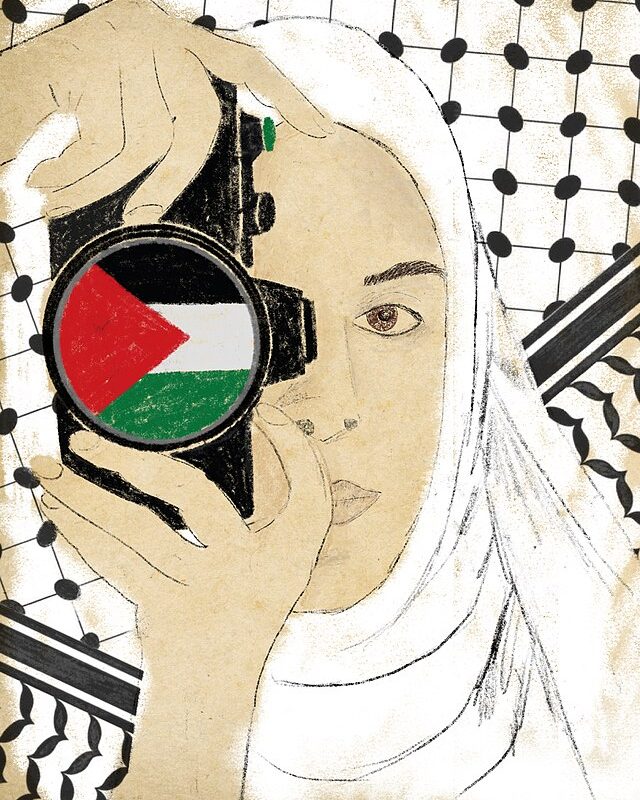
The voice of author and translator Alaa al-Qaisi falters as she recalls the Palestinian photojournalist Fatima Hassouna from Gaza. “She was still alive when I translated her text,” she says, sobbing. Hassouna was the central figure in the multi-award-winning documentary “Put Your Soul on Your Hand and Walk,” which premiered at the Cannes Film Festival in May 2025. Shortly after learning that the film would be screened there, the photographer was killed in an Israeli airstrike; six of her family members died with her. All that remains of her are her photographs and her writings.
“We have lost many people who constituted our cultural memory,” adds Ahmed Saleh, a poet and writer from Gaza who has applied for political asylum in Brussels. “I have lost my memory.” He explains that Israel has bombed and destroyed the archives and universities in the Gaza Strip during the current war. The 28-year-old belongs to a generation that has experienced five wars since 2008, “suffocating sieges” and “ongoing genocide”. His nephew was born in a tent, like his grandmother. “He doesn’t know what a home is, what a television is, what a house with walls is.”
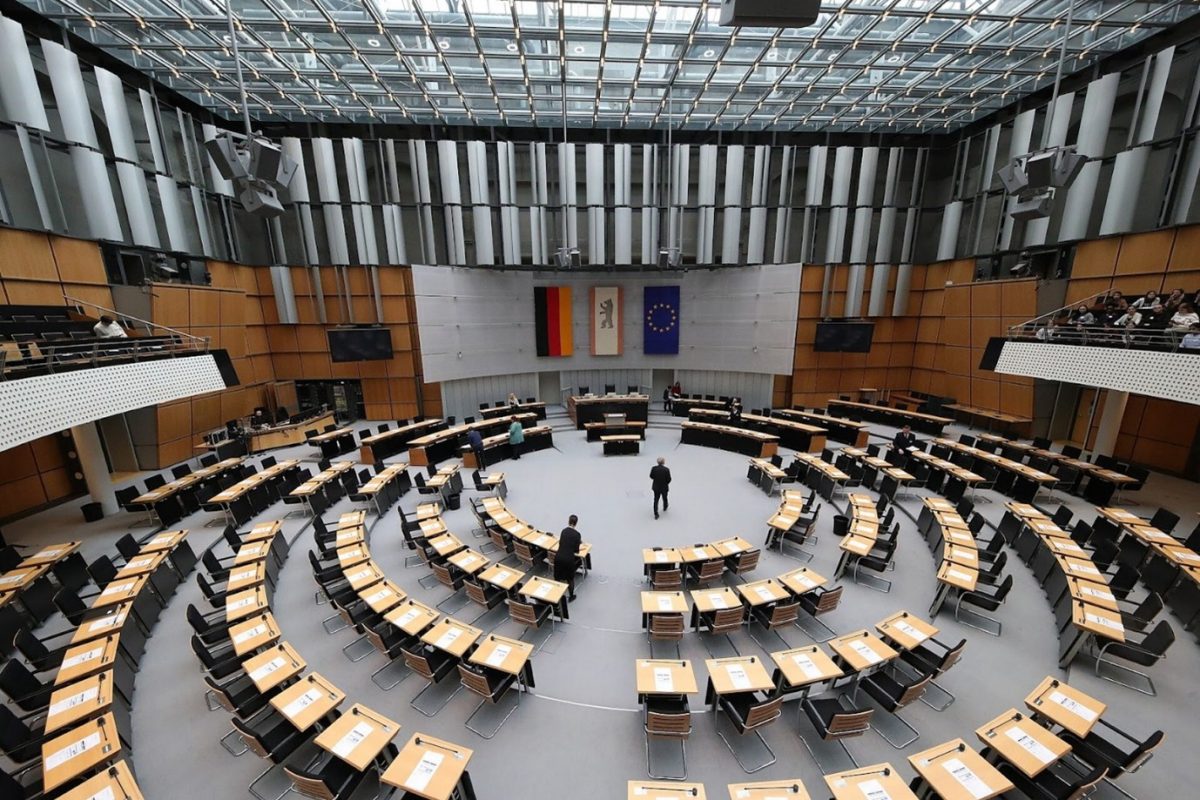
The reading was scheduled for Wednesday evening at the Acud cultural center on Veteranenstrasse in Berlin’s Mitte district. In recent years, the center has hosted “Goethe-Institut in Exile” festivals featuring artists from Ukraine, Belarus, Afghanistan, and Iran. However, less than 48 hours beforehand, the event was canceled at short notice.
And not only that: the Goethe-Institut’s board of directors decided to discontinue the entire “Goethe-Institut in Exile” program “with immediate effect”, its press office announced on Wednesday. The “acute strain” and “limited funding” made it impossible to continue the program “under the current circumstances”, the statement explained.
Abrupt end without real explanation
The program was scheduled to end in a few months anyway, but around 20 events were still planned until then. The Goethe-Institut declined to comment on whether and how the sudden cancellation was related to the planned reading. However, the abrupt termination of a long-running series of events is highly unusual and gives the impression that someone pulled the emergency brake.
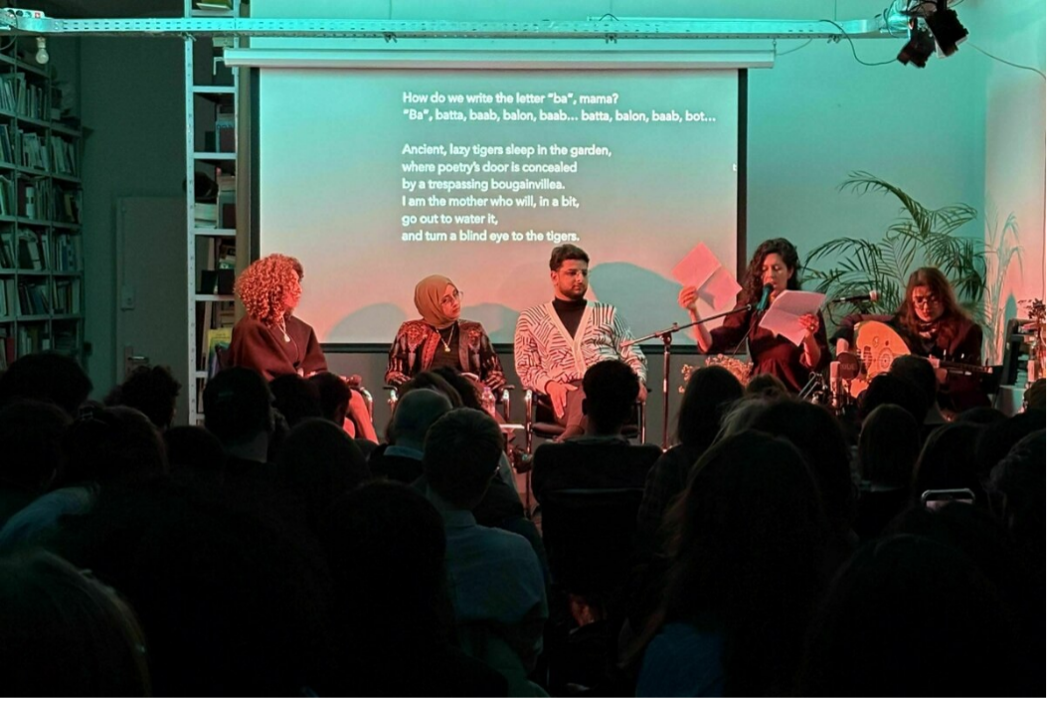
The curator and his friends therefore moved the reading at short notice to a cultural venue in Schöneberg, where over a hundred people crowded in that evening. Among them were the former director of the German Federal Cultural Foundation, Hortensia Völckers, and Bernd Scherer, former director of the Haus der Kulturen der Welt (House of World Cultures).
“We are authors, we are poets, we are artists,” said the writer Abdalrahman Alqalaq in English at the beginning of the event. He had curated the reading. But every text is inherently political—especially against the backdrop of genocide and oppression. The author, born in the Yarmouk refugee camp near Damascus, whose poetry collection “Transition Rite” was published in 2024 by Wallstein Verlag in Göttingen, had been compiling the program for the reading since December 2025 when the Goethe-Institut pulled the plug.
Because the funding was withdrawn, they couldn’t afford to pay a translator, explains literary scholar Maha El-Hissy, who is moderating the evening. Palestinian suffering has existed for decades, she says. But texts about it are perceived as disturbing in Germany. History, however, is inherently disturbing.
“We are all children of the Nakba,” says poet Asmaa Azaizeh, thus drawing a parallel to her two colleagues from Gaza. The 41-year-old is from Haifa, in Israel. The atmosphere of censorship and self-censorship is familiar to her. Until 1967, the Palestinian minority that remained in Israel lived under military censorship. Theaters were closed, and artists were imprisoned. The parents had taught the children to be silent, and in schools, they learned nothing about their own history, but a great deal about Auschwitz and the Cold War. She only learned later that before the Nakba, there had been over 30 Arab publishing houses and over 50 weekly newspapers in Haifa. The memory of urban Palestine had been suppressed.
Language has become functional
Like most people, she followed the events in Gaza on her smartphone. She’s still searching for a way to process them. “I don’t want to put the catastrophe into words,” she says, reading a poem she wrote for her son on the plane from Frankfurt to Tel Aviv. The poem is about her feelings and revolves around the cartoon character Peppa Pig. “I have nothing left. Everything was stolen from me, including my right to a normal life.”
Language has become functional, Alaa al-Qaisi says, referring to the people in Gaza. “Do you have water? Do you have gas?” These are the kinds of questions people in the Gaza Strip ask themselves. There’s no room for poetry. When she calls there, she can’t simply wish someone a happy birthday. The children there talk about tanks and fighter jets, not about happiness or joy. The slender author and translator, who wears a headscarf, will soon be moving to Dublin.
Maha El-Hissy says it is difficult for her to say that the “Goethe-Institut in Exile” program no longer exists. But the program is now history.
This article was translated by Ana Ferreira and originally appeared in German at taz.de.