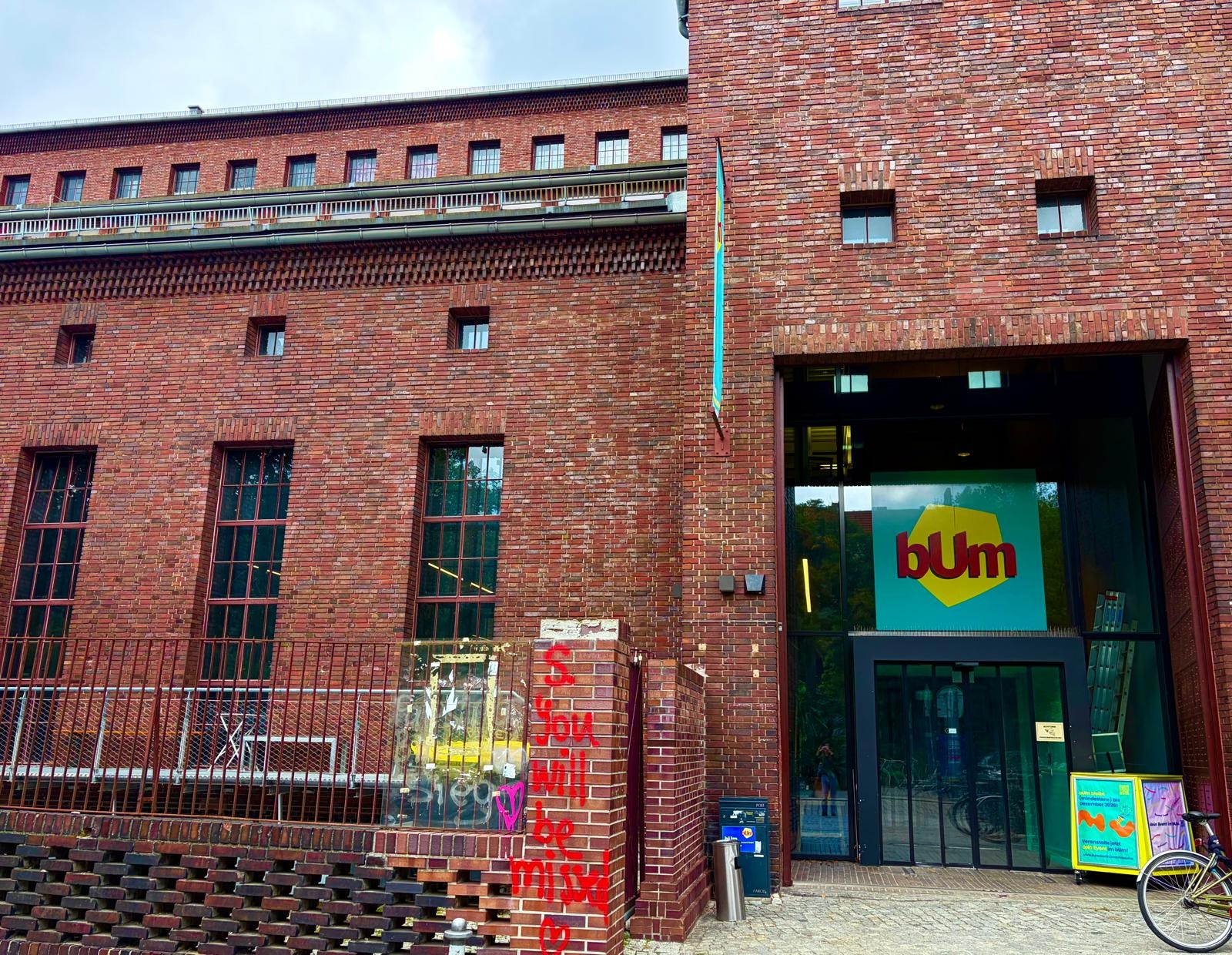
Berlin is about to lose yet another independent civil society space. The former Umspannwerk on Paul-Lincke-Ufer is not a squat or a makeshift venue but a large, airy red-brick building, nestled between historic cafes, next to the weekend Maybachufer Flohmarkt. Yet it has hosted the kind of political and community events that struggle to find spaces to operate anywhere else in the city.
That’s because of the building’s unique history—a quintessentially Berlin success story of a community claiming a space for their use by redirecting corporate interests in their favour. But despite this, it is soon slated to close and sit vacant.
bUm’s story is one of community victory; but it also signals an uneasy trade-off that most nonprofit community spaces in Berlin face—achieving operational and political independence at the expense of permanence and stability. It is a challenge that Berlin’s organisers, as well as its politicians, will have to confront to maintain the city’s flourishing civil society.
A Kreuzberg community success story
bUm (“betterplace Umspannwerk GmbH”) is a self-described “space for engagement and solidarity” located in the historic electrical substation that dates back to 1926. But it wasn’t always a space to bring together community organisations and people. In 2016, Google announced its plan to lease the building and open a startup campus—its seventh globally.
But the tech giant didn’t expect to get caught in the middle of an already heated discussion about gentrification and the displacement of long-term residents and businesses in the historically working-class neighbourhood. Upon learning of the lease, the Kiez exploded in protests attended by those from diverse walks of life—from small-business owners and long-term residents concerned with the skyrocketing rent prices that a new Google campus would bring, to tenants’ associations, to activists objecting to big tech’s historic propensity for data surveillance and tax evasion. The protests lasted more than two years, with activists even briefly occupying the building in 2018.
The result? In a rare capitulation, Google finally agreed to hand over control of the space to two social nonprofit organisations, “betterplace” and “Karuna”, who then founded bUm. Google would remain the main tenant and cover the rent, furnishing, utilities, and renovations for the nearly 3,000-square-meter space for a period of five years (which was later extended in 2024 by two more years), while relinquishing control of the space and its use, specifically for civil society engagement and solidarity. At the end of 2024, the bUm team purchased all of their company shares, becoming fully autonomous and politically independent.
bUm: What emerged from the resistance
Since then, bUm has been operating as both a co-working space for nonprofits and socially focused organisations, as well as a forum for activists, creatives, and people seeking to connect with their community. bUm currently houses more than 50 associations and initiatives—mostly grassroots—working on topics from political education to art and culture to anti-discrimination to climate, and bringing together affiliations both professionalised and informal in a space where they can meet, build networks and exchange ideas.
They host everyday events, from singing clubs and crochet circles to a support group for neurodivergent community members, as well as open community lunches, making it a valuable third space for community-building and fostering support networks.
But bUm also serves as a professional venue that can host events and speakers which are often unable to be hosted in other spaces due to political constraints—for example, actions on Palestinian solidarity, spaces for open dialogue on topics such as migration and abortion rights.
The space also houses numerous organisations that engage in direct solidarity with Palestine, many of which have suffered loss of funding and spaces due to Germany’s ongoing targeting of groups involved in Palestinian advocacy. They have hosted well-known, and often politically controversial figures like anti-Zionist historian and author Ilan Pappé, and UN Special Rapporteur on the Occupied Palestinian Territories, Francesca Albanese—who, after having a public lecture on Gaza cancelled at the Freie Universität Berlin due to political backlash, moved the talk to bUm.
The current situation
Google’s lease contract (and with it, bUm’s rent-free usage agreement) will end in December 2026. The bUm community has, since then, been searching for solutions to continue its tenancy, and has been in active negotiations with the building’s proprietor, New York-based real estate firm, RFR Holdings.
According to bUm, the team explored the creation of a mixed business model, which would also rent to for-profit organisations to finance the rent. It offered to the landlord €20,000 net base rent per month for the spaces that it currently uses. However, RFR Holding rejected the offer to continue the tenancy. According to bUm, “There was no counteroffer and no constructive dialogue” in the negotiations with the landlord. At the moment, there are no publicly known plans to fill the vacant space after bUm’s departure.
RFR Holding did not respond to a request for a statement about the ending of bUm’s tenancy at their property.
Political constraints of Berlin’s community solidarity spaces
Unfortunately, the closure of bUm is not an isolated case in Berlin. For example, Oyoun, a Neukölln cultural centre focused on decolonial, queer, feminist, and migrant perspectives, lost its Senate funding after hosting a November 2023 event by Jüdische Stimme (Jewish Voice for a Just Peace in the Middle East), which the Senate had asked it to cancel, with then-culture senator Joe Chialo (CDU) speaking of opposing “every hidden form of antisemitism”. Oyoun alleges that the funding cut was a form of political censorship, and that funding had been promised to them until 2025. Its lease was terminated shortly thereafter.
Unlike Oyoun, there is no evidence that bUm is being forced to close because of political motivations. This makes a space like bUm even more important to the community—since bUm’s operations have not been dependent on the inflow of state-level funding, its operations have evaded state-level censorship and political whims. It has been a space accessible to a wide range of groups, including those that other venues turn away due to political considerations, without the restrictions and regulations that come with receiving state funding.
The future of independent community spaces in Berlin
As Die Linke emerged as the leading force in Berlin’s last state elections, its strong campaign around protecting non-commercialised public spaces could be a welcome opportunity for grassroots and non-profit organisations seeking low-cost spaces to organise (if these promises can survive current coalition talks). But these spaces will still depend on political will and state funding, which can change with each election cycle, and will face political constraints on the content and organisations they can host.
To be sure, bUm’s funding arrangement was a win for the community: a corporate patron paying the bills for a space serving civil society. But it also exposed the limits of this model; bUm was an independent space only because Google, after two years of protest, agreed to finance it. Though the arrangement was won through tireless community resistance, it came with an expiry date and is not necessarily a model other community spaces could widely replicate.
If Berlin wants independent spaces for political thought and gathering, it will have to look beyond grants and gifts that come with terms and conditions, toward models that give communities lasting control: long-term ground leases, collective community ownership, or rules that stop viable spaces from sitting vacant while community groups are turned away.
Until then, independent political spaces like bUm are one election or one lease expiry away from closure.
Support bUm
bUm will hold its Big Closing Party on the 5th of December, and a rally on the 17th of December, as it has promised to “leave loudly”. See here to learn more.