The Left Berlin News & Comment

This is the archive template

“Even when there is the worst kind of repression, it’s laying the seeds for opposition”

Interview with Hossam el-Hamalawy, author of Counterrevolution in Egypt: Sisi’s New Republic


18/01/2026

Hi again, Hossam. Since the last time we spoke, you’ve become a doctor.

That’s true. I finished my dissertation, and now it will be published by Verso. I’m really honoured to have a book with them that will come out this May.

Maybe you can explain what the dissertation and book are about.

It’s based on research that I’ve conducted from 2018 till 2023, but in practice, it’s based on over two decades of my involvement in the dissident movement in Egypt – as a journalist, as a photographer, as a labour organizer, and also as a researcher who’s been interested in the repressive apparatus of the modern Egyptian state. 

The main argument of this book is that, contrary to the general belief that a counter-revolution restores the old order, actually, the old order has failed. This is not a failure around governance and human rights and social equality and what have you. In the eyes of the counterrevolutionaries, the old regime has failed because it failed to repress the revolution. This is why the kind of regime that evolves out of a victorious counter-revolution is usually one that tries to avoid the mistakes of the past. It is even more repressive and more efficient at repression. 

This is not uniquely an Egyptian phenomenon. When the German revolution failed, you didn’t get the Kaiser; you got Hitler. When the Italian revolution failed, you didn’t get a constitutional monarchy; you got Mussolini and Fascism. When the Egyptian revolution failed, we didn’t get Mubarak; we got Sisi.

Are you arguing that Sisi is objectively worse than Mubarak?

Objectively worse, but also different. And this is what’s more important. My book tries to explain how this regime is different from the previous regime. I mainly focus on a couple of things. One is how the security apparatus was organized before the coup, and how it is organized now. 

The modern Egyptian repressive apparatus was born after the 1952 coup. It was fragmented by design. In 1952, we had a coup by a group of eclectic nationalist army officers who called themselves the Free Officers. They were led by Colonel Gamal Abdel Nasser, and they overthrew the British-backed monarchy, and declared a republic a year later.

There was a lieutenant colonel among the conspirators. His name was Zakaria Mohieddin, and he was dubbed as “Nasser’s Beria”, in reference to his role in restructuring the security establishment. He was Nasser’s right-hand man, like Beria under Stalin.

Mohieddin organized the Egyptian modern security apparatus, and he fragmented that apparatus by design, because the immediate concern of the officers at the time was simply a counter coup. This was very fashionable. There was a joke at the time in the Arab world, for example, that the officer who wakes up the earliest usually stages a coup. Coups were the order of the day at the time. 

If your dominant perceived threat is a military coup, you fragment your apparatus. You create organizations with overlapping mandates in competition with one another. They hardly exchange information, and the communication channels are not horizontal. Only the ruler would have the bird’s-eye view. 

When it comes to the security sector, the interaction between the components of the Egyptian repressive apparatus for decades, whether it’s under Nasser, Sadat, or Mubarak, shaped Egyptian politics. This formula basically continued up until 2011. 

Someone would naturally ask, were the rulers only worried about a military coup? What about the people on the streets rising up? Now, it’s natural that any autocrats, if they want to stay in power, have to protect themselves from all sorts of dangers and threats. However, at the same time, there is always one dominant perceived threat. And they organise their apparatus according to that dominant perceived threat. 

Up until 2011, the Egyptian ruling class never took us seriously. They knew that every now and then, you could have riots here, some protests there. But they never imagined, even in their worst nightmares, that a revolution like 2011 could take place. So now you had a revolution, and for two and a half years, the gallows haunted the dreams and the nightmares of the Egyptian ruling elites and generals, until the coup happened in 2013.

The generals who led the coup, together with el-Sisi, who was the minister of defense back then, regarded Mubarak as too weak, too lenient,  someone who gave so much room for the press and NGOs to criticize him. If it wasn’t for his leniency, they said, we wouldn’t have had this catastrophe of 2011.

So they opted for a new model, which rested on two main things. One is that they unified the security apparatus for the first time since 1952. The components of that apparatus are mainly the military, the police, and the General Intelligence Service. For the first time, they were forced to coordinate and to unite these three components and to exchange information in order to face this existential threat of a revolution. 

In the book, I trace how Sisi reorganized that apparatus. It wasn’t an easy job. This wasn’t just an automatic transition that the security services had opted for. There were those inside those organizations who resisted, and they had to be purged. 

That is one thing. I argue that the other thing that distinguishes the Sisi regime is that while it is true that Mubarak was a dictator, he presided over a vibrant civil society, and this civil society acted as a buffer to protect society from the excessive intrusions of the executive state. 

It also protected the state against a potential uprising. Let me give you a concrete example. If atrocities flared in Gaza, Mubarak was worried that this might trigger riots and mass protests in Egypt. But he had the Muslim Brotherhood, a mammoth organization that existed in almost every province in Egypt. They were reformists and were more than happy to play the game with the regime, and Mubarak would turn a blind eye and allow the Muslim Brotherhood to hold protests, which never chanted against Hosni Mubarak, never left the university campus to go into the streets, and never left the premises of the professional syndicates. These protesters never chanted against the police. They never clashed with the security forces. And if things got out of hand, Mubarak would send in the Central Security Forces, which is our version of the riot police.  

If there were rising frustration in society over the deteriorating living conditions. Mubarak had a network of Salafi sheikhs who could use their Friday sermons to start blaming unveiled women, or Christians, or Shia, for the economic malaise. To divert attention, they could tell everyone it’s a moral crisis before it is an economic crisis. 

If there were industrial actions flaring, Hosni Mubarak had the state-backed General Federation of Trade Unions, which was a pyramid-like structure dominated by state bureaucrats. They had a presence in almost every workplace. 

Mubarak would strike a bargain with those bureaucrats, together with striking a bargain with the legal left-wing organization, the Tagammu, which was our die Linke more or less, or with the Egyptian Communist Party. These bargains defused the industrial militancy in exchange for some seats in parliament.

More importantly, there was something called the ruling National Democratic Party, a mammoth organization that existed in almost every neighbourhood in Egypt. These guys were not just thugs for the regime. They were bureaucrats who were the product of generations of experience from the Nasser time—the Arab Socialist Union days. This was the one party of the regime. And they all transformed themselves and metamorphosed into the National Democratic Party. 

These guys had 20 or 30 or 40 years of bureaucratic experience. They knew how to wield power. So, if you had a problem in your neighbourhood with the police or with the authorities, before you go and set yourself on fire in front of the police station, you would go to your local NDP guy. You would talk to him, and in exchange for a small bribe, or even for free, he would act as a mediator between you and the state to solve the problem. 

Now, Sisi and the generals saw this as one of the reasons for the “catastrophe” of 2011. So the kind of regime that they built after 2013 rested on unifying the security apparatus and completely destroying civil society. Egypt is now being ruled without a ruling party, without opposition, without NGOs, without independent trade unions, without even the old power structures that Hosni Mubarak had. 

Instead, you have the state micro-managing society on a daily basis, without any buffer in the middle. You have the repressive arm of the state, meaning the military, the police, and the intelligence service, who are cannibalizing the civilian organizations of the state. 

So, for example, many of the responsibilities of the various ministries and civil agencies were transferred to the military. It is true that since 1952 and especially under Mubarak, the regime used to pump in retired officers into the bureaucracy. This is not new, but what’s new here is, first, that it’s being done on steroids at this point. And secondly, officially, the military institutions are now replacing the civilian institutions. 

If you want to know which military agency is running what sector in Egypt, simply go to the Facebook page of Sisi’s presidential spokesperson, where the guy posts daily pictures of whatever meetings Sisi is having. Look at any picture at any point of the day, and examine the attendees. Each civilian official would have a military counterpart. The latter has the upper hand.

For example, when he tells you that today, Sisi held a meeting to discuss the agricultural sector, on Sisi’s right will be the Minister of Agriculture and the Minister of Irrigation. On the other side will be Colonel Bahaa el-Ghannam, who is now running the Future of Egypt agency, which is the business arm of the Air Force. The Air Force is now in charge of our agricultural sector, believe it or not. 

If Sisi is having a meeting to discuss education policy in Egypt, you would find the Minister of Education sitting on one side of the table. On the other side would be the director of the Egyptian Military Academy. So it’s the Egyptian Military Academy that is now running the education sector.

Starting from 2023, every single applicant for any civil service job has to be vetted by the Egyptian military academy. I’m talking here about every single civil service job, where, after you pass your exam, you go to the Egyptian Military Academy for six months, where you go through an ideological indoctrination boot camp

You wake up in the morning, and you practice sports just like a conscript. You do physical training, and then you take courses and classes on national security, on the conspiracies to bring down the state, and what they’re calling “Fourth generation warfare” – a crackdown on internal dissidents who are serving foreign powers without even knowing.

You’ve talked a lot about how the state has restructured itself and tilted towards more naked repression. The history of Egypt and the history of the region show that naked repression of its own will not sustain itself indefinitely, that there will always be discontent. I presume there is discontent about Palestine and about living conditions. What’s the state of our side? You’ve explained well what their side is doing. Is there any organised attempt to counter this? 

At the moment, the situation is bleak. I will not try to paint it as rosy. First, after the coup, Sisi started cracking down on the Islamist opposition, mainly the Muslim Brotherhood, but also the Salafis and the Jihadis. And then he started cracking down on the secular opposition, whether they are on the left, liberals, or youth groups. He dismantled all of them, killed scores of activists, and imprisoned tens of thousands of others.

From 2011 to 2021, 43 new prisons were built. The prison population is very difficult to estimate because there is no transparency whatsoever. Some figures ran as high as 60,000 political prisoners at some point. Now, I think that the number has gone down to anywhere between 10,000 and 20,000.

The Egyptian left, meaning our side, has been largely neutralised and destroyed. And this happened through mass arrests, through drying up the funding of these organisations, through security crackdowns. Then the regime also adopted this revolving door detention technique called Tadweer in Arabic, which means recycling.

They will arrest you today and hold you in pre-trial detention for, let’s say, a couple of years. on some bogus charges. Then, before you go on trial, they will release you on paper, but accuse you of the same things in a new case. So you stay in this revolving door forever. You have people who have been recycled for over seven years. No trial, just getting in and out on paper.

At the same time, this is not a reason to despair. I always say this, there is a saying: “The Darker the Night, the Brighter the Star”. We are Marxists who understand the dialectics. This means that even when there is the worst kind of repression, it’s laying the seeds for opposition.

What’s been the reaction of the Egyptian street to the ongoing attacks on Gaza?

It’s been largely muted compared to the previous decade. I am 48 years old. I got radicalised through the Palestinian cause. My political upbringing was always through solidarity with the Palestinians, and it’s through this solidarity that I got into radical leftist politics. 

But what has happened is that under the sheer level of repression that the country has seen, most of the organisations have been destroyed, and there is also fear among the public. It would be suicidal to have a protest for Palestine. 

Despite all of that, with the outbreak of the war on Gaza, spontaneous protests did take place on the campuses. These were probably the first protests that the campuses had seen in almost a decade since Sisi pacified them. There were also sporadic protests in mosques and public squares, but the state cracked down and arrested hundreds. As I’m talking to you today, there are at least 120 people who have been in prison in pre-trial detention since 2023.

At the same time, the regime was spreading through the media that Sisi was doing its best to disrupt the transfer scheme and the expulsion of the Palestinians into Sinai, and that we’re doing our best to help our Palestinian brothers, even though, at the end of the day, Sisi was completely complicit in this war. 

That’s why it didn’t translate into mass protests in the streets, but it revived this sense slightly, and solidarity with the Palestinians was expressed through other forms, especially the boycott campaign, which spread like wildfire in Egypt.

What has been the reaction in Egypt to the recent developments in Iran? 

It’s been mixed, depending on the kind of news they are receiving. There will definitely be a section of the Egyptian public who would buy into the propaganda that the whole thing is solely about Israelis bringing down a regime that’s anti-Israeli. But I would say that the majority of Egyptians would find parallels between themselves and the Iranian protesters.

What triggered this mass wave of protest in Iran is the deteriorating economic condition and sheer brutality of the state, which is something that the Egyptians know quite well. So I think Egyptians will be watching closely and also contemplating whether something similar could happen in Egypt.

Of course, you cannot predict the future, but what could happen next in Egypt?

I am hopeful for a very simple reason. Sometimes, a counter-revolution could diffuse the factors that led to the outbreak of the revolution in the first place. Some counter-revolutions are successful, not just because of repression, but because they also address those problems. This is not the case in Egypt.

To put this in clearer terms, the 2011 uprising did not happen simply because activists or opposition figures decided to mobilise. Individual action and political agitation matter, but they are never enough on their own. Revolutions emerge when broader structural conditions make society combustible, and when organised political forces are able to intervene at the right moment.

In Egypt, two such objective conditions came together. The first was pervasive political repression and routine police brutality. The second was social injustice, particularly the unequal distribution of wealth and the steady deterioration of living conditions. These factors created a society primed for explosion.

What was missing for long periods, and what briefly materialised in 2011, was what Marxists call subjective intervention. By this, I mean the presence of organised actors, networks, and movements capable of translating popular anger into sustained collective action. The counter-revolution did not resolve any of the underlying structural problems. On the contrary, repression intensified, and economic conditions worsened. This means the objective conditions remain firmly in place. What remains absent, for now, is that organised political intervention capable of turning discontent into a mass challenge to the regime.

Did the counter-revolution provide answers or solutions to these problems? No, they actually made it even worse. Today, when it comes to political repression, Hosni Mubarak is a human rights activist compared to Sisi. When it comes to the economic conditions, many people are yearning for the Mubarak days. I don’t blame them when they say: It wasn’t that bad under Mubarak. 

The existence of these two factors means that there will always be an environment that’s fertile for resistance. What’s missing here is the subjective intervention. And over the past few years – and this got accelerated by the genocide in Gaza – there’s been a slight revival in left-wing activity. It’s still very confined to the margin. But this margin did not even exist a few years ago. 

Simultaneously, there is an increased wave of industrial actions, not on the same level as the waves in 2006 or 2011, which was our winter of labour discontent that made the road to the revolution. But an incremental increase is happening. In 2025, at least 100 labour protests were recorded, and these are the ones that we know about. There will definitely be other wildcat strikes that we couldn’t know of. 

These strikes are triggered by low salaries, and by the management refusing even to implement Sisi’s decrees of raising the national minimum wage. So, managements are not even sticking to that bar that the government is setting. Amid this industrial action, this creates an audience for people like you and I to start talking socialism again.

Does the fact that things are now worse than they were before 2011 mean that the Arab Spring was a failure? 

I’m not a fan of dichotomies or of binaries, saying that something failed, or something didn’t. That wave of the Arab Spring, or whatever you want to call it, as some people don’t like that term, has been defeated; there is no question about that. But this is not the end of the story. I would disagree with the kind of narrative that sees defeat as the end. There are people who have seen this revolution, and they are still alive. 

In the 1990s, when my comrades and I were starting in underground cells trying to talk about revolution against Mubarak, people treated us like lunatics, like extraterrestrial aliens. What are you talking about? We never had a revolution in this country, or the last time we had a revolution was in 1919, against the Brits.

Today, you can tell an 18-year-old to look at YouTube, in order to find footage of what happened. This makes the revolution an actuality, something concrete, and not just something abstract that you read about in books. You’ve seen it happening. 

This is one of the positive things that came out of the Arab Spring. At least when we are talking about a new revolution, there is something concrete that we’re based on. But I would say that this first wave definitely got defeated. But let’s learn from it, build on it, and take the movement forward. 

Is there anything that you haven’t said that you’d like to add?

One last thing is that comrades here in Germany have a role to play. You are in the belly of the beast. Sometimes people romanticise the global South. They say: “That’s where the repression is, so that’s where the revolutions will happen. We will never see it here in Germany”. That’s not true. 

The entire capitalist system is getting into a crisis, and we’ve already started to see symptoms and signs of it, whether it’s here in Germany or in the industrialised West. People here in Germany and in Europe and in the West have a role to play. This role is number one: you reign in your own governments from supporting and endorsing our regime. 

One of the main reasons why the counter-revolution prevailed in Egypt was that it was endorsed by regional and global allies, and that would include Germany. So you have a role to play in pressuring the local government here into stopping support for Sisi.

On the other hand, there will be a rise in social dissent here in Germany. There is no question about it. This is not because Germans are left-wing or right-wing, but because the economic situation is deteriorating. If you are not organised enough, people will start looking to the far right for answers if the radical left is not ready with those answers.

Any local fight that you engage in here in Germany is helping us in Egypt. It’s not just about protesting in front of the Egyptian embassy. If you win a fight against the privatisation of the S-Bahn, you are helping the Egyptian revolution. If you win a fight here against the cuts in social spending, you’re helping the Egyptian revolution. If you bring a halt to this militarisation drive here in Germany, you’re helping the Egyptian revolution.

The entire capitalist system is like a matrix. You weaken it in one spot, and that helps all the other ones. 

Your book is now available for pre- order. How can people order it? You can pre-order on the Verso website. You can also order via any book-selling platform, including Amazon, but I would prefer that you buy from Verso directly.

Power and powerlessness

What next, after Gaza broke the art world?


17/01/2026

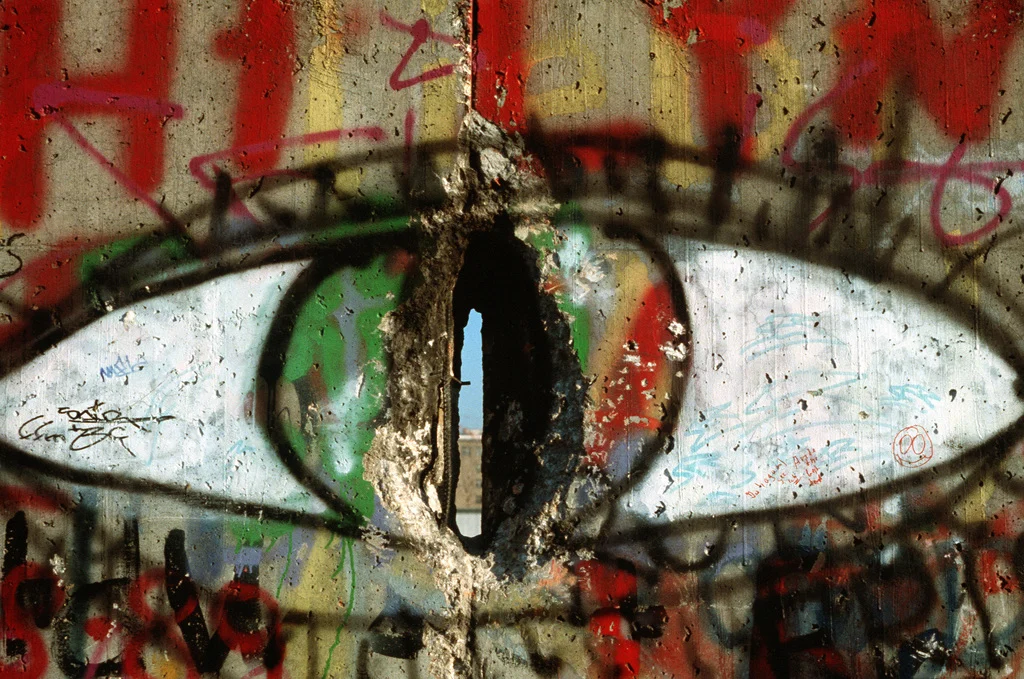
Graffiti eye with red and green iris. There is a huge gash cutting right through the eye and showing view of something on the other side of the wall.

At the end of 2025, three articles once again articulated—from different perspectives—the silence and failure of political discourse in the art scene. David Velasco, long-time editor-in-chief of Artforum, the US “North Star” of art criticism, reflected on and recapitulated the past two years of “division, fear, and silence” in Equator, the British online magazine for politics, culture, and art. In October 2023, a few weeks after the Hamas attack in Israel and the publication of a letter of solidarity on the Artforum website signed by more than 8,000 people calling for Palestinian liberation and a ceasefire, Velasco was fired without notice. Bonaventure Soh Bejeng Ndikung, who had been director of Berlin’s Haus der Kulturen der Welt (HKW) for just ten months at the time, summed up shortly before Christmas that he did not want to get drawn into political debates, but rather “talk about humanity in the coming years and decades, perhaps for the rest of my life […] so back to those Christian values we always talk about.” A few weeks earlier, Berlin-based artist and activist Adam Broomberg had published a scathing critique of the “Global Fascism” exhibition at the HKW.

At the end of his essay, Velasco writes that he has spent the last two years in an “unofficial hiatus” from the official art world. His final sentences: “It’s increasingly hard to care about the fate of an art world narcotised by money and self-regard. We had a chance to at least try and make a difference. We had a chance to not sell ourselves out. We had a chance, and we blew it. This did not end well, and still we can choose to begin again, tilting—collectively, contingently—toward the pitch of liberation.” He does not elaborate on his optimism. I would like to share it, because capitulating to the power of the market and the violence of power has also mentally catapulted me out of a “scene” that I always wanted to understand as a left-liberal seeking a self-critical public sphere. This basic trust in a shared world, which uses artistic work to address the dilemma of subjectification and subjugation, of deviation and form, has been shattered. Definitively after October 7, 2023. In recent decades, during which I was involved in the art world as a writer, researcher, and curator, there have been various phases in which momentous political events—such as the imposition of martial law in Poland in 1981, the first Iraq War in 1990, the Tiananmen Square massacre and the fall of the Berlin Wall in 1989, and the crushing of the so-called Arab Spring after 2011—during which I was unable to find the peace of mind to turn my attention to individual works. But art also participated in all these events, albeit with a delay. Without the work of artists, the discussion about the colonial basis of power in the Western world would probably have remained confined to academic circles in Europe for a long time. In this very world, there is now—once again—talk of the “end of the West,” of democracy, of the transatlantic alliance. In 2003, an important congress was held at the HKW: “Former West” (March 18-24). From the flyer: “Although the events of 1989 shook the world to its foundations, the West stubbornly clung to the fiction of its own superiority. Former West examines how contemporary art can unhinge this fiction and at the same time rethink the future.” The fiction is gone. Which art points to the future?

In his text, Velasco reconstructs how—not so much why—Gaza broke the art world. The means and methods were repressive: staff dismissals, cancellations of exhibitions and award ceremonies, criminalization, and legal prosecutions. In the context of art, it was (almost) always just about language and images—not about violence, sabotage, or self-interest. It was about words and works demanding justice for Palestinians (including the right to mourn) and an end to Israel’s internationally supported armed violence, which killed tens of thousands of Palestinians in a very short time. In the “cultural nation” of Germany, “reasons of state” became a tool to intimidate and silence criticism of Israeli policy (see archiveofsilence.org). According to Velasco, grandiosity “is one of the art world’s key features, the soil for its spectacular financialisation—its unparalleled ability to transform radicalism into capital. This grandiosity was inflected in much of the bright and lofty material that we published. The stakes were high; we believed we were writing history, and we often were.” During the crackdown on the Gaza protests, it was the collectors, galleries, and institutions that demanded ‘calm,’ not the artists. “Some collectors are calling up individual artists who signed, threatening to sell off their works or stonewall exhibitions by refusing to lend to museums. […] I am aware that much of the sentiment is divided by class: the letters’ signatories are mostly artists, the letters’ detractors are mostly their dealers and collectors. This is not a new rift in the art world, but Palestine seems to have deepened it beyond repair.”

What was striking in Germany after the Hamas massacre and the subsequent sanctioning of Palestinian solidarity was the role of curators and directors of art institutions, who positioned themselves hierarchically and firmly above the “opinion” of artists. Velasco highlights a prime example of this: Klaus Biesenbach’s distancing speech at the opening of Nan Goldin’s exhibition at the Neue Nationalgalerie. In the spring of 2024, however, two artists, Bank Cenetoglu and Pirvi Takala, confidently canceled their exhibitions at the Neuer Berliner Kunstverein because, in their opinion, its director did not distance himself clearly enough from Israel’s war policy. No artists, no exhibitions. Marius Babias then published a cryptic statement: “We are seeing increasing attempts to instrumentalize conflicts for personal agendas and reject the adoption of predetermined political positions.” It becomes apparent in that and his interview with the Berliner Zeitung, that his understanding of art is as the pure language of the works versus a political language and which politics lies behind this idea. “For us, the artwork is in the foreground; the messages should be codified in it.” (Spiegel) It is about the detachment of the work from everything: from the author, from an external artistic public, in principle also from its time, in order to propagate concepts such as autonomy, independence, and institutional self-determination—but only within the framework of the White Cube. This is the place where art is negotiated and nothing else. The institution exists precisely to maintain this fiction. To the point of self-appeasement, when Babias says: “In practice, the Bundestag’s resolution on the BDS is irrelevant to us. That was and is symbolic politics. […] We deliberately did not sign GG 5.3.1, like many other institutions. As it now turns out, the initiative further politicized the debate and polarized the arts instead of defusing it. […] The anti-discrimination clause in its originally proposed form would have had just as little impact on us as an institution as the BDS resolution.” One can only hope that such wishful thinking will not be followed by a rude awakening… Babias’ concept of art refers to the Enlightenment and fascism, mentions postcolonial discussions, but does not mention that all of this could also have an impact on the concept of art, the art system—if it were not immediately absorbed by the cunning of capital (see Velasco). Curators are a new profession that cultivates and encloses art. Previously, only art historians held leading positions. 

The Berlin art bubble is international. Many artists who live here have fled repressive and violent regimes. Many also refer to the knowledge and experiences of non-Western and indigenous practices in their art. Why is criticism of “our art system” not becoming louder and more radical? I often recall a conversation I had with London-based Roma artist and curator Daniel Baker in 2020 on the occasion of the FUTUROMA exhibition in the Venice Biennale program. The exhibition attempted to transfer the impulse of Afrofuturism—namely, to retell history from a subject position—to the discriminated community of GRT (Gypsy Roma and Traveller). Among other things, he said: “The idea of a closer connection between the practices of art and life also has implications for reclaiming art from the privileged arena of the museum and an art world focused on market interests and knowledge hierarchies—on a separation of intellectual, cultural, and financial capital.

“You live in Florence, the birthplace of autonomous art, and encounter the meaning, power, and joys conveyed by Renaissance artworks on a daily basis. At their core, however, these objects remain instruments of the power of the state and the church. The audience is convinced of the transcendental nature of art, of its beauty and skill, which serve to promote ideas and narratives that point away from everyday life and toward the deeply spiritual and intellectual. This model of separation is how the modern museum is still understood, and from my perspective, there seems to be little appetite for approaching things differently.”

Returning to Ndikung’s interview with Deutschlankfunk, he suggests that he can work freely as a curator without taking a position in political debates: “My only position is humanity. I will not compromise. […] I don’t care who is holding the gun. That’s why I won’t get drawn into this debate. And my job is to keep the spaces open, to keep the art spaces open. People from Palestine, from Israel, from Syria, from Haiti, from Myanmar, and elsewhere will always have a place in [the HKW] to present their artwork.” That sounds confident, as if it were possible to stay away from power constellations, even to free oneself from them, even when working within them. 

In his aforementioned text about the “Global Fascism” exhibition at the HKW, Broomberg mentions the necessary, subtle “anticipatory obedience” of a state institution in its concrete exhibition policy, and reminds us that its director also had to clearly distance himself from BDS before taking office. In 2014, Ndikung allegedly wrote on Facebook: “You will pay millions for every drop of blood in GAZA! Palestine must be free […] come rain or shine!” and signed the open letter from the “Initiative GG 5.3 Weltoffenheit” (Initiative GG 5.3 Cosmopolitanism), followed in 2021 by the open letter “Palestine Speaks,” which called on the German government, among others, to withdraw its support for Israel. Yet in the 2025 interview, Ndikung speaks for “humanity.” Meanwhile, Broomberg criticizes how “Not one work in the [Global Fascism] exhibition acknowledges the world burning just beyond the door.” The only Palestinian artist in the exhibition is represented with a work from 1974, which is described in the exhibition guide as “a possible allegory about the burden of Palestinian existence under occupation.” Broomberg’s bitter conclusion: “What were once our most progressive institutions and artists have become instruments of that silence, helping the genocide to proceed politely. When an institution reaches this level of corruption, it neutralizes any political potential of the art it shelters. Every work becomes a prop in the pretense of inclusion, queerness, Indigeneity, and postcolonialism. This theater serves the institution’s simulation of anti-fascism. […] The fact that these institutions—apparently in full seriousness—engage with ‘global fascisms’ while blithely enabling it at home is salt in the wound of the German cultural scene’s demise.”

In public institutions, one can assume a direct relationship of dependency between management and the state, i.e., obedience. In so-called “grassroots democratic” institutions such as the numerous German art associations, power is exercised through the rules of representative democracy: the members elect a board of directors. And this board is usually not made up of artists and citizens, but of potential sponsors (savings bank directors, private patrons, collectors). On the surface, it is often said that they alone are in a position to personally absorb the financial risk of failure—although this has long since become an industry for insurance companies. I never wanted to work in “powerful” institutions, perhaps because I took the pressure to represent too seriously. But in both art associations where I worked as director, I learned how fragile the protection of artistic freedom is. When I wanted to exhibit Hans Peter Feldmann’s cycle “Die Toten” (The Dead) at the Badischer Kunstverein 25 years ago (the independent book publication was already available), the board blocked the exhibition preparations and invitations could not be sent out. The work “Die Toten” documents, used previously published media images: 100 people who died between 1967 and 1993 in connection with the RAF—victims of the RAF as well as RAF members. After extensive discussions, in which Feldmann also participated with written statements, the conflict finally culminated in a meeting at City Hall and the question: Is the art association free in its work or should it be closed down? The conflict did not escalate further, the exhibition took place, and the art association was able to continue its work. However, if the representation of artists in art associations becomes too strong structurally—precisely as association members—this is often stopped, off the record, of course, as happened in the second association I headed. A tacit agreement then prevails between the financial backers (in this case, the state) and the board: it is better to remain among ourselves and retain control. There would be much to discuss…

Who decides what is permitted and in whose name? Is the political sphere limited to “state and civil society representatives, parliaments, global courts, organizations such as the United Nations or the UN Security Council,” as Babias told the Berliner Zeitung? It is not the controversy over “autonomous” art and activism that is decisive, but the recognition of power over (artistic) publics.

Now, at the latest, after Gaza broke the art world (Velasco), the upcoming discussion should be devoted to a retelling of recent art history and to searching for infrastructural relationships that can give space to the intimacy and intellectuality, the passion and sensuality of art in a self-determined way. It is time for a self-critical assessment: can we in the art scene really still assume that we live in the best of all possible (state-subsidized, highly professionalized) worlds? Can we only fight to preserve our vested interests? Shouldn’t the discussion about inclusion and exclusion concern not only the “others,” but above all our own systemic narrative? What trap have we fallen into? What went wrong? Do we also work with double standards and hypocrisy? Should we re-read and reinterpret our own past, that of the so-called rehabilitation of modernism after fascism and during the Cold War—as was done, at least retrospectively and to some extent, with Documenta2?

  1. The GG 5.3 Weltoffenheit initiative was an appeal in 2020 by numerous public cultural and scientific institutions in Germany, which spoke out in favor of freedom of art and science, research and teaching (Art. 5.3 Basic Law) and commented on the possibility of political abuse of the accusation of anti-Semitism in the BDS resolution of the German Bundestag. ↩︎
  2. Documenta. Art and Politics. German Historical Museum, (June 18, 2021 – January 9, 2022) ↩︎

The revolution will not be televised

Sudan’s long road to freedom


19/11/2025

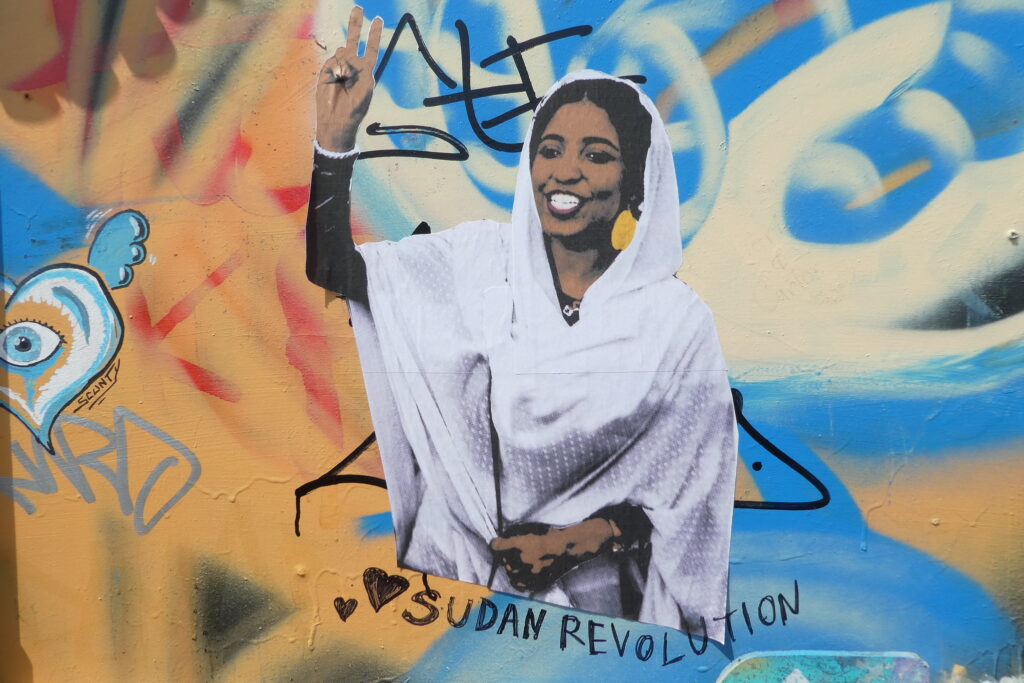
A photograph of a street mural depicting Alaa Salah, whose image became a widespread symbol of the Sudanese revolution.

I would like to start this article by honouring the Sudanese revolutionaries, the unsung heroes of Sudan’s long road to freedom and democracy; the victims of the El Fasher massacre, the disappeared, the indigenous, the women, the children, the Kandakas, the Neighbourhood Resistance Committees (NRCs), the Sudanese Professionals Association (SPA), the Forces for Freedom and Change, the journalists, the doctors, the human rights defenders, the displaced, the boys in Greece and the Sudanese diaspora.

Just days after images captured in space recorded the blood spilled during the El Fasher massacre appeared on smartphones across the world, the Rapid Support Forces (RSF), responsible for the atrocities, called for a three-month ceasefire while the Sudanese Armed Forces (SAF) refuse to accept any deal recognising the RSF as an equal political actor.

The news from the RSF, that many see as tactical deception, will provide little respite for the Sudanese population who have fallen victim to a vicious landgrab of their resource-rich country once again.

‘For any kind of peaceful solution, the RSF has to disarm themselves. What we have seen is that you cannot trust the RSF with weapons. They kill civilians, they rape women. They loot and destroy food and crops,’ says Sudanese analyst Yasir Zaidan.

The war that has been widely and deliberately ignored for over two and a half years—while other more Eurocentric wars have taken centre stage—is the biggest humanitarian crisis of our age.

It has cost an estimated 150,000 people their lives, with some figures suggesting the death toll may be much higher. It has forced 14 million people to leave their homes, has pushed 24 million people into food insecurity and famine, and has left 30 million in urgent need of humanitarian assistance.

The paucity of coverage of the war, global aid cuts, political and ethnic elitism, racism and international interest in the country’s resources have forsaken the Sudanese population and have contributed to global inaction to prevent the escalation that has at long last put Sudan on the agenda.

Despite warnings of possible genocide, the UK opted for the ‘least ambitious’ plan to protect civilians and prevent atrocities due to aid cuts over a year ago. USAID cuts left 80% of emergency kitchens unfunded, forcing 1100 kitchens to close. Although the UK has recently pledged to allocate £120 million in aid, the Independent Commission for Aid Impact reports that aid budget reductions in previous years have damaged relationships with partners and ‘calls for the UK to increase direct funding to local organisations and simplify its complicated compliance procedures to better support Sudanese-led responses’.

To put the urgency of the situation into context, the country blighted by the 30-year dictatorship under Omar Al-Bashir until 2019 already had some 1.1 million refugees and 3 million internally displaced people in September 2021, prior to the start of the war in April 2023. The day the war broke out, telecommunication systems were damaged and still remain unusable for the vast majority of the population. This has contributed to the difficulty of getting information out, exacerbated the logistical challenges of getting aid in and compounded the vulnerability of the civilian population, many of whom feel attacked by both sides—the Rapid Support Forces (RSF) and the Sudanese Armed Forces (SAF).

A great number of our Sudanese comrades here in Berlin fled Sudan between 2003-2008 when the Arab nomad militia group, the Janjaweed, committed genocide in Darfur. To quell an insurgency by the Sudan Liberation Movement/Army and the Justice and Equality Movement (led by indigenous ethnic groups in Darfur fighting structural inequality and economic marginalisation), the Janjaweed, under the al-Bashir government, killed 200,000–400,000 non-Arab Darfuri people.

As news of the thousands killed by the RSF in El-Fasher in recent weeks reach our shores, reports on social media frequently call for a boycott of the UAE over its support for the RSF militia group through the supply of weapons and mercenaries in exchange for gold.

Meanwhile, other reports accuse the national army—the Sudanese Armed Forces (SAF)—of being the other side of the same coin, a claim that has been fiercely refuted by some Sudanese commentators on social media platforms.

So, what happened to the 2019 Sudanese Revolution, who are the RSF and the SAF and how did Sudanese civilians get trapped between them?

After years of economic discontent, ethnic and gender inequality, and decades of conservative Muslim Sharia law, when Omar Al-Bashir announced he was running for an unconstitutional third term, the protest movement organised by the Sudanese Professionals Association (SPA), an umbrella organization of doctors, lawyers and journalists, started to gather momentum.

A revolution led by women

Following popular protests demanding an end to the 30-year long dictatorship and its sexist and oppressive laws, in which an estimated 70% of protesters were women, the SAF toppled Omar Al-Bashir in a coup d’etat in April 2019.

Sudanese women’s rights activist Asha al-Karib remarked:

The world-admired Sudanese revolution is marked by unprecedented contribution and participation of women throughout the country, including women from all walks of life. The participation of women is not a by chance event, as Sudanese women own a strong history of resistance in the face of dictatorships and patriarchy.

The old guard

The subsequent self-appointed head of state Lieutenant General Ahmed Awad Ibn Auf, having previously served as the Defense Minister and Vice President in the toppled Al-Bashir government, refused to extradite Al-Bashir to the ICC for crimes against humanity and war crimes, leading to continued widespread protests.

The Transitional Military Council (TMC), the military junta that was established on the same day to govern Sudan, was equally denounced by activists. Leading anti-government protesters, the SPA, stated ‘the regime has conducted a military coup to reproduce the same faces and entities that our great people have revolted against,’ continuing ‘those who destroyed the country and killed its people want to appropriate every drop of blood shed by the great people of Sudan during their revolution’.

Auf resigned the following day and on 12 April 2019 Abdel Fattah al-Burhan, the former Inspector General for the Al-Bashir army, was announced as head of state.

Al-Burhan formally headed the TMC following the resignation of Auf and Mohamed Hamdan Dagalo, also known as Hemedti, was appointed the deputy head, promoting the commander of the RSF to a key position in Sudan’s political sphere.

The aforementioned Janjaweed, responsible for up to 400,000 deaths in the Darfur genocide of 2003–2008, is a direct predecessor of the RSF—the new name being a simple rebrand.

The SPA and other democratic opposition groups called for the TMC to step aside in favour of a civilian-led transitional government, resulting in many attempts to disperse sit-in protesters outside the military headquarters in Khartoum. The TMC worked to end the peaceful sit-in with excessive force and violence and several people, including a pregnant woman, were killed.

What followed was a pivotal moment in the fight for democracy and a sign of things to come. In what became known as the Khartoum Massacre, on 3 June 2019, 120 protesters outside the military headquarters in Khartoum were killed and hundreds more went missing, with actual figures concealed with the help of internet blockages and the deployment of brutal military forces across the capital.

Unrelenting protesters took to the streets again on 30 June, finally prompting the international community to pressure the military into sharing power with civilian politicians in August.

Hope on the horizon

The Forces of Freedom and Change, a committee that coordinated the nonviolent resistance movement, and the TMC agreed to a 39-month transition period in July. On 20 August 2019 the FFC-nominated Abdalla Hamdok, who was appointed Prime Minister of Sudan.

The high aspirations for Abdalla Hamdok to bring about democracy in Sudan, however, weren’t to last. Though described as a ‘diplomat, a humble man and a brilliant and disciplined mind’ by the United Nations Economic Commission for Africa who agreed to implement a peace deal hailed as an ‘historic achievement’ by the UN Secretary-General António Guterres, the senior Sudan analyst at the International Crisis Group think-tank, Jonas Horner warned, the ‘devil will be in the implementation’.

Horner noted that ‘Sudan’s economy is in freefall and there has been limited international assistance, and none pledged specifically to support the implementation of the [peace] agreement’.

Moreover, researcher Ahmed Soliman stated that offering government jobs to rebel chiefs could ‘lay the foundations for democratic transition and economic reform’. Soliman said: ‘This requires the forces of change to share responsibility for implementing peace above their own interests and will also necessitate a commitment to devolve genuine authority to communities and people at the local level.’

Apparently unable to do so, the RSF committed atrocities across Darfur as a reprisal for the 2019 uprisings and the TMC’s military chiefs ‘undermined and side-stepped’ Hamdok’s leadership.

‘The armed Arab groups—the RSF as well as many less organised militias—have seized lands, livestock, and goods and see these as payment for their military undertakings to the Khartoum regime,’ Eric Reeves, a professor at Smith College and a fellow of the Rift Valley Institute research group told Al Jazeera.

Another coup dashes hope for democracy

And so, it wasn’t long before the Sudanese military under General Abdel Fattah Al-Burhan led another coup and took over the government in October 2021.

The majority of the Hamdok cabinet as well as pro-government protesters were detained and the prime minister, who called for the Sudanese to ‘defend their revolution’ was besieged in his home and pressured to support the coup.

The Prime Minister’s Office, along with the Ministry of Foreign Affairs and the Ministry of Information, refused to recognise a transfer of power to the military. The African Union suspended Sudan’s membership, pending the reinstatement of Hamdok, while Western powers stated they continued to recognise the Hamdok cabinet as the constitutional leader of the transitional government.

The SPA, the FFC and the Sudanese resistance committees refused to cooperate with the military coup organisers, leading further protests and strikes which spanned the country. Security forces retaliated by killing 15 members of the Sudanese resistance committee on 17 November 2021.

On 21 November, Al-Burhan signed an agreement reinstating Hamdok to restore the transition to a civilian government. This was met by fierce opposition from pro-democracy protestors who now refused any deal involving the military.

After two more were killed in pro-democracy protests and the already weak Sudanese economy steeply declined, Hamdok resigned as prime minister in January 2022, dashing hopes for democracy in Sudan.

Two war criminals fighting for supremacy

Oscar Rickett explains both Al-Burhan and Hemedti were fierce, reliable lieutenants of the Al-Bashir regime that had ‘plundered the resources of Sudan for decades’. Fearing a shift of power from the military elite to a civilian-led government, both ‘had to’ carry out the coup in order to cling to power and prevent being investigated and charged with war crimes.

With the prospects of a civilian-led transition to democracy eliminated, Siddig Tower Kafi, a civilian member of the Sovereign Council, commented that ‘it was becoming clear that the plan of Al-Burhan was to restore the old regime of Omar al-Bashir to power.’

And while Al-Burhan sought to centre power back to the elite ethnic groups around Khartoum, Hemedti, a Darfuri Arab, had become the leader of a powerful and brutal paramilitary force and had built a vast business empire. He had taken control of Darfur’s biggest artisanal gold mine in Jebel Amir, and his family company, Al-Gunaid, became Sudan’s largest gold exporter.

Writing for Al Jazeera, Jérôme Tubiana explains:

‘This is not just a war for power between two generals, but rather one between the two heirs of the not-yet-defunct regime: the legitimate and illegitimate sons of one father, at the head of two fundamentally different forces. On one side, an army long headed by officers hailing from Sudan’s ethnic and political centre (the northern Nile Valley); on the other a paramilitary corps that is the latest avatar of Darfur’s Arab militias.’

Arabs and non-Arabs caught in the crossfire of supremacy

Omar, from the capital of Hemedti’s Mahariya tribe, Ghreir, an ‘old Arab settlement and stage post for nomadic camel herders’ where Arabs and non-Arabs long lived side-by-side, explains that the region became the heartland for Janjaweed recruitment in 2003.

Omar and some other members of the Arab tribes rejected joining the Janjaweed and joined the rebels instead. Feeling manipulated by the government and not wanting to be associated with the Janjaweed, he explains how students understood that ‘the government was instrumentalising their communities to kill their non-Arab neighbours.’

When Hemedti, who attended school in Ghreir but dropped out of primary school to become a trader around the age of 8 or 9, rose to the ranks of leader of the RSF in 2013, he continued aggressively recruiting from his own tribe and taking rebel territory.

International vultures and hypocrisy

Foreign interests, extraction and colonialism—spanning over a hundred years, with Anglo-Egyptian control over Sudan spanning from 1899 to 1956—continue to this day.

The complex web of support for the two warring parties, as explained in this article include Egypt, Saudi Arabia, Iran, Qatar, Algeria, Libya, the UAE, Turkey, Ethiopia, Eritrea, Russia, China, Chad, and South Sudan, have further complicated peace talks and neglect the interests of Sudanese civilians.

Recent evidence showing UK manufactured weapons have surfaced in Sudan proves the UK’s complicity in the atrocities. In breach of its own arms trade rules the UK continued to sell weapons to the UAE, known for being a diversion hub for weapons to conflict zones.

The UK’s failure to invite any of the principal Sudanese actors or members of civilian society, while inviting the UAE to the ceasefire conference in April, is symptomatic of the wider neocolonial narrative. Such actions make the call for peace by UK Foreign Secretary David Lammy ring hollow:

‘The biggest obstacle is not a lack of funding or texts at the United Nations; it’s lack of political will. Very simply, we have got to persuade the warring parties to protect civilians, to let aid in and across the country, and to put peace first.’

While we all seek to differentiate between the ‘bad guys’ and the ‘good guys’, ultimately the horrors that are unfolding in Darfur reflect the story of centuries of colonialism, supremacy, capitalism and land appropriation.

Silencing the voices of the indigenous, peaceful resistance and of the ancestral owners of the land perpetuates the supremacist violence that has cost so many Sudanese people their lives and loved ones.

Their resilience untold.

We don’t need feminism because we have #girlbosses

On the neoliberal roots of girlboss feminism


05/11/2025

To all my male friends 

who try to convince me that we “achieved gender equality”

because women can work as CEOs.

To all women

who are a #girlboss and try to convince us 

that we are responsible for our own success.

To all those people

who are complicit in the perpetuation of 

the patriarchal, neoliberal, and racist capitalist agenda.

What does it mean to live a feminist life? If feminist ethics refer to the opposition of oppressive societal structures that privilege men over women, what does a daily embodiment of this opposition look like? Throughout conversations with my male friends and family members, I have often encountered the argument that there is no need for feminism in daily life anymore. We do not need to oppose structural oppression of women, because there is none. Women can work and they have the opportunity to become CEOs. And if women are not financially independent, it is not the patriarchy’s fault but instead, their own decision to stay at home. At least, that’s what they argue. If you agree, I have to tell you that you are living under a false illusion. This illusion is called neoliberal capitalism and is based on gendered and racist structural exclusion. However, I can see why you might believe this deceptive vision of reality. If I search for “female empowerment” on the internet, I am bombarded with the so-called #girlboss attitude. This ideological movement is promoted by financially successful women, portraying the narrative that any woman can live their dream of becoming a successful entrepreneur. She just needs to work hard enough, or to use the words of Kim Kardashian, she just needs to “get her fucking ass up and work”. This essay aims to deconstruct the illusion that the girlboss movement indicates gender equality. In the following, I will reveal to you why this logic operates within a patriarchal framework and further perpetuates interconnected systems of racist and classist oppression. Aiming to present you with an alternative conceptualization of how to approach collective women’s liberation, I will first explain the concepts of the girlboss ideology. Then, I will draw a connection between the girlboss narrative and the neoliberal agenda, highlighting that it operates within a patriarchal framework. Further, the racist and classist dimension of the narrative will be examined, arguing why privileged successful women continue to comply with systems of oppression. Throughout my analysis, I will draw upon different feminist scholars and elaborate on how their ideas play into the debate on girlboss feminism. 

To begin with, let us re-examine what the girlboss movement stands for. Sophia Amoruso described the movement for the first time in her 2014 book #Girlboss, where the word represents the idea that every woman can become financially successful if she works hard and takes responsibility for her life. The focus on individual “agency”, “self-responsibility” and “hard work” resembles the neoliberal ideology and creates a feminist subject who is occupied with her individual economic success, accepting full self-responsibility for her goals, as Catherine Rottenberg describes in her 2013 paper on neoliberal feminism.

If women’s empowerment is equated with female entrepreneurship or leadership, it seems that the proponents of that logic are influenced by Betty Friedan’s The Feminine Mystique (1963). Friedan critiques the cultural norms that push women into the domestic sphere (p.32). She argues that women are deeply dissatisfied with their condition and can only find true fulfillment when pursuing a professional career (p.32). Whilst Friedan criticized cultural and gendered norms for bringing women into this condition of dissatisfaction, girlboss entrepreneurs refrain from blaming patriarchal structures. Instead, they emphasize the individual responsibility of women to climb up the professional ladder and become satisfied with their lives. Either way, achieving financial or entrepreneurial success is posited as a realization of female liberation and gender equality. Consequently, the idea is that successful female entrepreneurs escape patriarchy by challenging gendered labor division.

Following this argumentation, there are feminist voices who would probably applaud the #girlboss we find online. One of which is Simone de Beauvoir. In The Second Sex (2009), de Beauvoir highlights that social and existential conditions constructed women as the “the other sex”, meaning that they have been socially placed in an inferior position to men (p.32). De Beauvoir argues that women submit to their constructed condition of inferiority and thus, emphasizes upon women’s responsibility to stop complying with that role (p.28). The girlboss mentality is focused on hard work and taking risks. This corresponds to the existentialist standpoint of de Beauvoir, who calls on women to transcend their socially ascribed inferiority. While one might think that female entrepreneurs transcend gendered labor division, they do not truly challenge patriarchy. Have you not wondered why there even is the need to call a successful woman a girlboss? Can she not just be a successful woman? Or even more simply, a successful entrepreneur? Certainly, this semantic superficiality already highlights the patriarchal and patronizing undertone of how women are perceived in the professional world. But if now you think that merely abolishing the word is enough to truly challenge the roots of patriarchal logic, you are mistaken. Girlboss women do not escape their role of the “other” (p.32). Instead, they strive towards resembling the “default norm”, and this norm continues to be the male entrepreneur, as Susan Marlow and Janine Swail examine in their 2014 paper, where they critique the manner in which gender influences are being studied in entrepreneurship research. De Beauvoir unfortunately falls into the same trap when thinking about female liberation. Hooks examines that de Beauvoir positioned herself as an exceptional woman who had the “mind of a man”. Thereby, de Beauvoir continues to operate within patriarchal paradigms, because she considers women to be capable of reaching the gendered, male ideal. Consequently, neither de Beauvoir, nor the girlboss challenge the patriarchal roots of gender inequality. 

Continuing to operate within patriarchal paradigms, the girlboss narrative devalues any work done outside the entrepreneurial or professional world. A 2022 policy brief by the Forum for Research on Gender Economics (FROGEE) outlined that all domestic and unpaid care work is predominantly done by women. Keeping this in mind, the girlboss narrative perpetuates and reinforces the patriarchal devaluation of housework. It is when financial and entrepreneurial achievements are equated with success and liberation that we must remember Silvia Federici’s call for Wages for Housework (1975). Federici emphasized that gendered labor division is part of the capitalist logic that devalues women’s labor in the domestic sphere and keeps capitalist exploitation running (p.78). One can draw a link to contemporary neoliberalism, which “has no lexicon that can recognize let alone value reproduction and care work”, as Caroline Rottenburg argues in her 2018 article, Women who work (p.8). 

While the girlboss movement partly transcends gendered work division, it overlooks that domestic work remains devalued and unpaid. Thereby, it continues to operate in capitalist patriarchal frameworks and fails to challenge systemic inequalities at its root. So, what if we wage housework and stop complying with the neoliberal logic that entrepreneurship equals success? What if we call mothers, cleaners, and all other women who are deemed to be “non-aspirational” girlbosses as well (p.1079)? Wouldn’t this perspective deconstruct the idea that only entrepreneurial success, a domain that is still predominantly occupied by men, is true success?

Having revealed why girlbosses operate within and thereby perpetuate patriarchy, let us unravel the mechanisms of how their success creates new and intensified forms of racialized and class-stratified exploitation. Or did you really think becoming a girlboss is attainable for all women? In reality, only a few privileged women can emerge as girlbosses because their success relies on the racist and classist domination of other female comrades (Rottenberg, 2013, p.434). When aiming to transgress gendered work divisions, girlboss feminists focus on sex as the only marker for female identity. In her 2013 essay, True Philosophers, Hooks emphasizes the need for a more nuanced understanding, highlighting that female identity and experience are “shaped by gender, race, and class, and never solely by sex”. She poses a question that entrepreneurial power women tend to ignore: Who will be called in to take care of the domestic sphere and housework if more women enter the domain of entrepreneurship, which is considered to be the male sphere, asks bell hooks, in her 1984 book, Feminist Theory – From Margin to Center. The reality is that, most often, women of color, poor, and immigrant women serve as unacknowledged care workers who enable professional women to strive towards „balance“ in their lives. Hence, when examining the success of girlboss women, we must not forget the racist exploitation that sustains it. 

What about women who can not afford to pay for a care worker while pursuing their professional career? What about single mothers who need to earn money and simultaneously raise a child and do the housework? When women are expected to continue their traditional role as mothers whilst becoming successful businesswomen, we must become suspicious. The idea that any woman has the opportunity to become a successful entrepreneur is an illusion and we must not forget that this opportunity is largely based on class privilege.

One might wonder why girlboss women comply with systemic classist and racist oppression of other women and thereby, obstruct collective women’s liberation. The paradox that individuals continue to be complicit with oppressive structures that they individually manage to “escape” from is not uncommon. Barbara Applebaum examined in her 2008 essay White privilege/white complicity: Connecting “benefitting from” to “contributing to”, how benefiting from a system of exclusion leads to one´s participation within it. Similarly, Audre Lorde emphasizes that white women are complicit with several mechanisms of systemic oppression, as they focus on their “oppression as women and ignore differences of race, sexual preference, class, and age”, in her 1984 essay, Age, Race, Class and Sex: Women Redefining Difference. Girlboss women focus on sex as the marker for exclusion from the male professional sphere and are heavily influenced by the neoliberal agenda of individualized success. Therefore, I argue that successful female entrepreneurs are being tokenized by the neoliberal agenda. I base my claim on Wendy Brown’s conceptualization of neoliberalism being not merely an economic system, but a certain mode of thinking that becomes deeply internalized in the “inner workings of the subject“. Thereby, neoliberal values of self-responsibility and individualization infiltrate the minds of those girlbosses, making them believe that they transgress patriarchy when in reality, they are deeply stuck within it. They are a token for the broader neoliberal agenda, as they perpetuate the illusion of female empowerment.   

When focusing on white, privileged middle-class women as the archetype for female lived experiences, successful girlbosses leave no space to address differences among women. Kimberle Crenshaw critiques this ignorance rampant in contemporary feminism, in her 1991 journal article Mapping the Margins: Intersectionality, Identity Politics, and Violence against Women of Color. According to her, those movements often fail to center intersectional identities which consequently leads to separation and tension amongst women. Rottenberg (2013) similarly concludes that women become increasingly separated rather than united in their actions. She draws the connection to the neoliberal agenda which frames the feminist social question in highly individualistic terms and consequently, erases the opportunity for genuine collective liberation (p. 419). I assume you agree that focusing on your individual success creates disregard for the interconnected struggles of other individuals. And this condition is highly problematic.

The ignorance of those “interlocking systems of domination”, to speak in hooksian terms, makes white, privileged, and successful women complicit in the domination of others (hooks, 2012, p.235). Thereby, girlbosses continue to coexist in patriarchal oppressive power structures, as they benefit from them. They seemingly made it out of gender-based oppression and universalize their individual experience to be achievable for all women. Girlboss culture operates within and thereby, reinforces the capitalist depiction of success in terms of finances and profession. Not only does it fail in challenging the neoliberal conceptualization of success, it also disregards differences within women and thereby, eliminates the opportunity for united female solidarity and liberation. Promoting girlboss feminism feeds into into patriarchal, racist, and capitalist systems of oppression. Therefore, I want to provide you with an alternative approach towards collective women’s liberation.

Drawing upon Lorde and Crenshaw, the denial of differences within groups leads to tension and separation among them (Lorde, 1984, p.115; Crenshaw, 2013, p.1242). Hence, we must acknowledge different female experiences and identities, and think about patriarchy as being interlocked with racist and capitalist modes of exploitation. This requires us to bring to attention other feminist movements that challenge neoliberal values and demand economic, cultural, and social change. The girlboss promotes the idea of women achieving success, within a patriarchal, classist, and racist logic. She prioritizes individual success within the system rather than changing the system itself. She ignores that this path is predominantly accessible to white, privileged, middle-class women and fails to address different lived experiences of less privileged and marginalized communities. But “the master’s tools will never dismantle the master’s house”, as Lorde famously noted. In that sense “the master’s tools” are the patriarchal, neoliberal agendas of individualized success. And while I do not intend to blame girlbosses for wanting to achieve entrepreneurial success, I certainly intend to blame them for creating the illusion that this is the ultimate path to gender equality. I blame them for promoting a one-size-fits-all approach to female empowerment while ignoring that this approach is deeply hostile and exclusionary for women who do not fit this one-sized, privileged archetype. 

We need to find tools that are not the “master´s”. Hence, we need to find tools that do not repeat the patriarchal, neoliberal and racist agenda. This might include re-conceptualizing our societal views on what it means to be successful. It might include waging housework and refusing the narrative that female entrepreneurs are the ideal successful women. It might include creating a world in which all women, no matter whether they are mothers, housewives, care workers, or entrepreneurs, are being recognized and cherished for the work they do. In doing so, we must always work towards abolishing neoliberal blaming of individuals and publicly reveal the structural inequalities that allow for the success of the privileged few. Whilst this approach will certainly be uncomfortable for those of us who have the privilege to become a girlboss, we must dismantle the systemic oppression upon which this privilege builds. And most importantly, we must face our own complicity within those dynamics.  

Lee-Ann finished her Bachelor of Liberal Arts and Science, majoring in Politics, and is a certified teacher and student of holistic health. In her work, she aims to combine arts, culture, and politics to raise political awareness on a community level.

Yes, the German Democratic Republic was socialist—and we have much to learn from it

Response to ‘Red Flag: No, East Germany wasn’t socialist—and neither is “democratic socialism”’

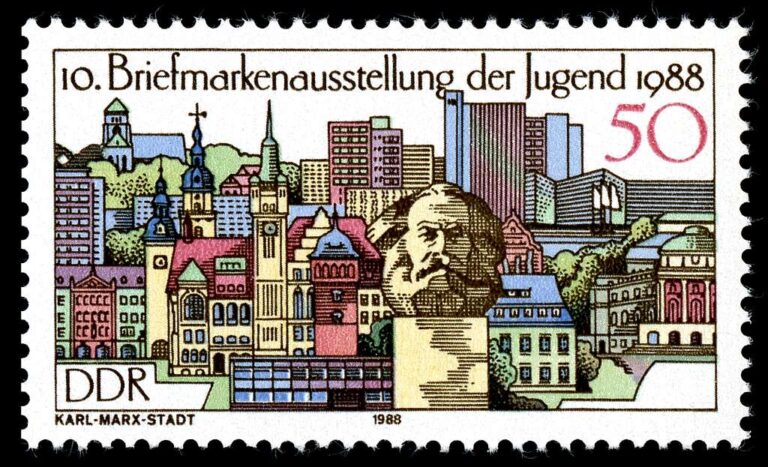
DDR stamp featuring the bust of Karl Marx with a colorful cityscape in the background.

In early September, Die Linke leader Heidi Reichinnek made headlines after claiming her party’s vision of “democratic socialism” had nothing to do with the German Democratic Republic (GDR): “What we had in the GDR wasn’t socialism. At least not the kind my party envisions.” Germany’s conservatives soon jumped in to disagree: “The GDR was pure socialism. It was an unjust state.” Rather than counter this narrative, Nathaniel Flakin recently wrote an article which—though critical of her party’s programme of “democratic socialism”—agrees with Reichinnek’s assessment of the GDR. According to Flakin, “a society can only be described as socialist if it meets Marx’s criteria of evolving towards the abolition of classes and the state” and the GDR “did anything but wither [away].”

Underlying both Reichinnek’s and Flakin’s arguments are the anti-GDR talking points that have long been propagated in the Federal Republic of Germany (formerly “West Germany”). The GDR is said to have been thoroughly undemocratic or, as Flakin puts it, a “Stalinist state” ruled by a “privileged bureaucracy, obsessed with control.” The lack of democracy and “suppression of all criticism” was not only “an insult to human dignity”, it also “produced constant inefficiencies” and prevented “good planning.” The GDR is presented as a caricature of bumbling, self-enriching bureaucrats who could only uphold their ailing system through mass surveillance. Rather than being a point of reference that progressives can learn from, the GDR should be written off as nothing more than a “footnote of history” (Stefan Heym). Reichinnek and Flakin assure us that their versions of socialism will be different.

Decontextualization and distortion

Such arguments against the GDR follow a similar pattern. First, a real and concrete problem in the GDR is identified. It is then taken out of its historical context and greatly exaggerated, before being generalized as a core, indefinite characteristic of the “Stalinist state.” Historical developments are distorted and decontextualized to create the impression that the GDR was broken and chronically ailing society. Flakin does exactly this when describing the East German economy. It is indeed true that the GDR faced significant challenges such as raising labour productivity or finding an adequate mechanism for price setting in the planned economy. However, blanket statements about “constant inefficiencies” are simply inaccurate and misleading.

The GDR economy proved itself to be robust and efficient over its 40-year existence. From 1949 until 1989, not a single year of stagnation or recession was recorded. In fact, in a paper published by Professor Gerhard Heske in 2009, East Germany’s annual growth rate (4.5%) is shown to have exceeded West Germany’s (4.3%) during the era of socialist planning (1951 to 1989). Data on the production and consumption of consumer goods confirms that the GDR was able to achieve the official objective of “meeting the growing material and cultural needs of the population” and thus progressively improving living standards.

Detractors of the GDR invariably ignore the context in which this socialist state operated. Since Germany’s heavy industries had historically been concentrated in the western regions of the country and due to the heavy damage inflicted on eastern Germany during the end phase of the Second World War, the GDR was compelled to construct large-scale industries from scratch in the late 1940s. The means of investment for this endeavour had to be accumulated internally, for East Germany possessed neither overseas colonies nor foreign benefactors (in contrast to West Germany, which received massive capital inflows through the Marshall Plan). The GDR alone had to rectify the damage inflicted by Hitler’s war after the Western powers violated the Potsdam Agreement and suspended reparation payments to the Soviet Union in 1946. Western sanctions also meant that trade with the resource-rich Ruhr Area in the West was no longer possible. All in all, seventy percent of East Germany’s pre-war industrial capacity was no longer available after 1945, which meant that living standards and productivity in the East were only nearly half of what they were in the West.

Through the resolute effort of millions of workers and through the efficient socialist planning system, the GDR was able to increase the volume of investment more than three-fold during the decade of socialist construction in the 1950s. By 1989, industrial production had increased by a factor of 12.3, and the gross domestic product had quintupled. These achievements were made possible by socialist property relations and the scientifically grounded planning process: far from being syphoned off and consumed by an exploitative “privileged bureaucracy,” the GDR’s surplus product was accumulated in the public hand and consciously reinvested to accelerate industrialization and economic development. The intricate planning system was structured around the Leninist principle of democratic centralism: economists and planning specialists collected data and analysed international and technological developments to draft perspective plans for the GDR’s economy. Workers and mass organizations then collectively discussed and amended these plans at the factory and neighbourhood levels. These plans thus combined complex expertise with democratic legitimacy.

Flakin withholds the title of socialism from the GDR because it failed to fulfil Leon Trotsky’s pronouncement that “socialism must increase human productivity, or it has no historical justification.” Here again, Flakin not only ignores the disadvantageous starting conditions in East Germany, but he also distorts reality. The GDR was in fact able to achieve a permanent increase in labour productivity throughout its existence. Even during the 1970s, when foreign trade was greatly affected by global energy crises and the GDR struggled to balance domestic accumulation and consumption rates, labour productivity continued to rise, albeit at slower rates than in previous decades. Many factors contributed to this trend, including the serious shortage of workers (meaning that existing production capacities could not be maximally utilised) and the political decision to prioritize consumer goods over industrial investments after 1971. These factors did not, however, alter the socialist nature of the GDR. It would be prudent to learn from the challenges that previous socialist states faced rather than brush them aside with the claim that “next time will be different.”

It is important to emphasize that the aforementioned economic problems did not lead to the “collapse” of GDR. Despite unsettled questions around pricing policies, labour productivity, and accumulation rates, the GDR was able to meet its domestic and international obligations and pay all wages until its final days of existence. The infamous accusations of bankruptcy are part of the narrative that seeks to discredit socialist planned economies: in 1989, East Germany’s debt-to-GDP ratio (roughly 19 percent) was less than half of West Germany’s (42 percent). In truth, the GDR was able to fundamentally change the face of the formerly underdeveloped agricultural region of East Germany and—in the span of just 40 years—propel the country into the ranks of the top fifteen industrialised states in the world.

Undemocratic socialism?

Flakin and Reichinnek may disagree on Die Linke’s vision of “democratic socialism”, but they do agree on one thing: the GDR was certainly not democratic. This conclusion is easy to reach if one measures the GDR by the standards of bourgeois constitutionality: the separation of powers, the protection of private property, and equality before the law. Marxists have long argued that these principles were created by and for the capitalist class. Private property necessarily curtails democracy and limits popular rule over significant sectors of society. In a society divided into poor and rich, de jure equality can only lead to de facto inequality. Recognizing this reality, communists and social democrats in East Germany never sought to establish the GDR as a bourgeois constitutional state. They aimed to construct a fundamentally different type of democracy in which public ownership over the means of production would be enshrined in law and developed further by the people. The planning system was a core element of this idea: planning was understood as a social relation in which the people were to become increasingly active and conscious of their role as co-creators of society. Democracy was thus conceived of as a process, a continuous task to be deepened throughout the course of socialism.

 The foundation for the GDR’s socialist democracy was laid during the so-called “anti-fascist upheaval” of the late 1940s. The East German economy was radically democratized through a land reform that redistributed the aristocrats’ lands to the peasants and the expropriation of industrial monopolists, which led to the creation of Volkseigene Betriebe (“companies owned by the people”). Economic power was thereby devolved to the working masses. Far from being bureaucratic policies from above, these measures were carried out by the people themselves. The Soviet military administration made a point to entrust the German people with the task of identifying and investigating which companies and estates should be marked for expropriation. Tens of thousands of workers and peasants joined so-called Sequester Commissions and Land Reform Commissions to collectively scrutinize their employers’ participation in Hitler’s Third Reich. Suddenly, workers and landless farmers found themselves entitled to investigate secret business records and uncover the connection between capitalism and fascism. In West Germany, on the other hand, popular efforts to socialize industries and banks were quashed by the authorities, despite democratic referenda on the issue. The “anti-fascist upheaval” of the late 1940s and “socialist construction” of the 1950s were profoundly democratic in both content and form. The claim that such major social feats were achieved through oppression and coercion is nonsensical.

Flakin claims that the GDR “suppressed all criticism.” In countless interviews with former GDR citizens, we heard otherwise. The factory and neighbourhood committees were in fact places of heated and controversial debate. Whereas in capitalism, democracy stops as soon as you enter the workplace, democracy in the GDR began behind the door of the factory or office. As a “workers’ and peasants’ state”, the GDR guaranteed employees the right to participate in factory management as well as a long list of social rights such as health and childcare, company holiday resorts, and further education. Many of these rights were laid out in the Labour Law, which was passed in 1961 after some 7 million citizens discussed and suggested over 23,000 amendments to the original draft. These laws authorized the workers themselves to monitor company directors and ensure adherence to health protections and workplace democracy. Company directors did not own the factories and could not enrich themselves off the backs of the workers; they were de facto employees of the state and merely charged with the supervision of public property. Workers who felt mistreated could complain through their union or the popular Eingabensystem (“system of appeal”), which guaranteed citizens the right to a response within four weeks. The extension of democracy into the economy also impacted the countryside, where the creation of cooperative structures helped to not only democratize decision-making processes, but also offered farmers and peasants the previously unknown benefits of paid holidays, childcare, and cultural activities.

In the GDR, all areas of society were to be democratized by drawing the masses into everyday governing. Citizens had the right—and the means—to participate in decisions not only regarding the workplace, but also the education of children, the distribution of housing, the development of the neighbourhood, and legal mediation. A pioneering aspect of socialist democracy was the mass organisations, including the Free German Trade Union Federation, the Peasants Mutual Aid Association, the Democratic Women’s League of Germany, the Cultural Association of the GDR, and the Free German Youth. These organisations were connected and interwoven with all areas of society to ensure representation for different groups. The Women’s League, for example, was guaranteed representation in residential committees, schools, cultural centers, and parliament, where it helped advance women’s economic emancipation from men. In contrast to the unions and organizations in capitalist societies, the GDR’s mass organizations were not fragmented and treated as private lobby groups; they were political organizations empowered by the state to encourage the collective deliberation and implementation of socialist policies.

The judiciary, which in capitalist societies is typically far-removed from popular will, was also democratized in the GDR. So-called societal courts were set up in workplaces and residential areas to address conflicts and problems in direct and relatable ways. Members of the courts consisted of one’s peers, for they were elected by the people directly. Workers, teachers, scientists, craftsmen, and artists were all practicing law to help settle issues. Through the courts, the mass organizations, and the Eingabensystem, GDR citizens had many ways to bring about concrete changes in their everyday lives.

Recognizing these institutions as innovations of socialist democracy in no way precludes critical appraisal. It is clear when assessing GDR history that while certain periods were marked by rapid advances, others were characterized by stagnation. The latter phases should be analyzed in their historical context if we are to learn anything from them. It cannot be forgotten that the GDR was located on the frontline of the “Cold War,” with West German leaders openly declaring the intention “to do everything and to take every measure to retake [East Germany].” Nevertheless, socialist democracy is an evolving process in which citizens must increasingly recognize and use the means of production and the instruments of democracy as their own. This requires the consistent use and further development of established institutions. In the GDR, there are clear signs that this process slowed down towards the 1980s. But, again, such developments did not change the socialist character of the GDR. Rather, they point us to a problem that all post-capitalist states have faced in the past: how can revolutionary momentum be maintained in the long run to ensure that social relations continue to evolve? It is especially difficult when this necessity to open up institutions and broaden democracy comes into tension with the need to defend against counterrevolution and external threats. The GDR was by no means the only socialist state to face this challenge of balancing democracy with security, and it would be naïve to believe that future attempts to construct socialism will be free of it. As Lenin wrote in 1920: “The proletariat’s conquest of political power does not put a stop to its class struggle against the bourgeoisie; on the contrary, it renders that struggle most widespread, intense, and ruthless.” Praxis—not abstract speculation—is the criterion of truth. The idea that the state will immediately begin withering away under “true socialism” is a regression to the utopianism Marx and Engels criticized so sharply in their time. Instead of kow-towing to the ruling narrative and disowning the GDR, we must uphold it as Germany’s first socialist state. The collective efforts of millions of GDR citizens have given us four decades of praxis to learn from. By reclaiming this history as our own and investigating it on our own terms, we can gain a deeper perspective on the fundamental possibilities and difficulties that arise when constructing social, economic, and political models beyond capitalism.