The Left Berlin News & Comment

This is the archive template

Red Flag: Berlin cops beat up Queers for Palestine

In his weekly column, Nathaniel Flakin reports from Internationalist Queer Pride


28/07/2025

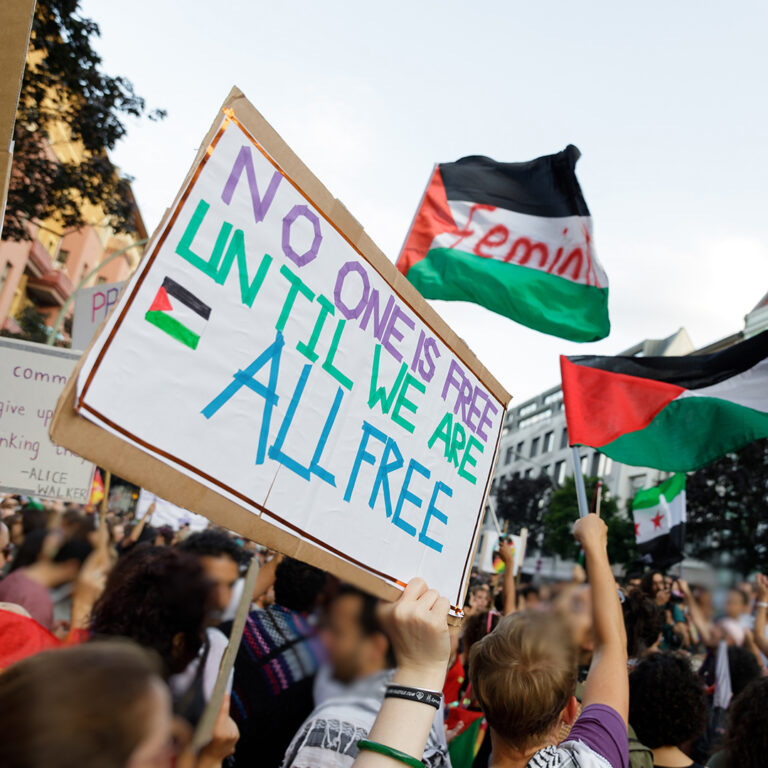
Hands in a crowd hold up Palestinian flags and a sign saying "No one is free until we are all free."

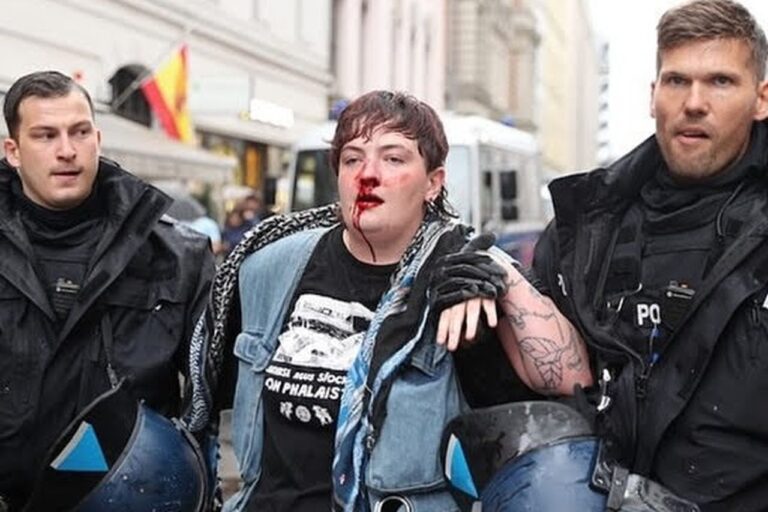
On Saturday, Berlin police detained a queer person for wearing a white t-shirt with a pink triangle. That symbol was forced on gay men in the concentration camps—wouldn’t German cops remember?—and has since come to stand for remembrance and resistance. Yet under an increasingly authoritarian government, a pink triangle might be a banned marker of a terrorist organization.

People at an anticapitalist pride demonstration got punched, shoved, and arrested by heavily armed cops. In previous years, police seemed hesitant to create images of such unhinged violence in a city that officially supports gay rights. But as democratic freedoms have been squashed in the name of suppressing Palestine solidarity, Berlin police have come to understand they can do whatever they want without fearing criticism from politicians, media, or judges.

This festival of queerphobic violence took place just a few kilometers down the road from the city’s main pride demonstration. 

CSD

Berlin’s right-wing mayor Kai Wegner went to Christopher Street Day (CSD), as the Pride demonstration here has been called since it was launched in 1979, to say that the rainbow flag “belongs in the center of our society.” This was a rebuke to Friedrich Merz and Julia Klöckner, Wegner’s colleagues in the CDU, for refusing to raise the rainbow flag at the Bundestag.

Hundreds of thousands of people danced at CSD alongside floats from Vattenfall, Siemens, Commerzbank, and Mercedes-Benz, companies which often only find their voices to champion queer liberation every July. The CDU—the party that deports queer refugees, voted against marriage equality, and prevented the rehabilitation of all gay men convicted under Germany’s notorious paragraph 175—had its own float, as did the far-right media company Axel Springer.

Wegner marched behind a banner that said “Homos Jews Women,” which might sound strange, giving Wegner’s long-standing connections to far-right antisemites. Yet East Pride Berlin is not a Jewish group—it appears to be older white men who support Israel’s far-right government and attacked the Dyke March for speaking out against genocide. Wegner is just another example of antisemites who love Israel.

For decades now, CSD has been a space for reactionary and queerphobic institutions to drape themselves in rainbow flags, yet only if it helps the bottom line. This year, some corporations pulled back in the face of Trump’s anti-woke offensive.

In 2016, CSD gave a stage to the Israeli ambassador, while Palestinian and Israeli queer who protested against him were beaten. Far from being a safe haven for queers, Israel carried out the deadliest attack on queer people in history when it bombed Evin prison in Teheran, murdering 100 trans people.

IQP

A couple of hours later, well over ten thousand people gathered for anticapitalist pride demonstration and chanted “Fuck pinkwashing!” Internationalist Queer Pride, organized by immigrants from all over the world, was taking place for the fifth time. Anticapitalist alternatives to Berlin’s CSD date all the way back to 1998, but certain German leftists always had a problem with Palestine solidarity. IQP was born when the organizers of a “radical” German pride demonstration called the cops to kick out Queers for Palestine—as a result it has always been primarily in English.

This year, IQP’s floats, organized by Black, Asian, and Latino immigrants, moved slowly from Südstern via Hermannplatz toward Kottbusser Tor, through the immigrant neighborhoods where Berlin’s Palestinian diaspora is concentrated. German media would have us believe these communities were particularly homophobic—but older Palestinians showed full solidarity for younger queers. Heavily armed police attacked demonstrators again and again, dissolving the demonstration at 8pm just before it reached Kotti, nowhere near its destination at Oranienplatz.

Tagesspiegel published a headline about right-wing extremists threatening CSD, in reference to a counter-demonstration of 30-50 Nazis. Ironically, the image chosen for the article shows a black-uniformed cop in front of a rainbow flag. Thus, this fervently pro-government newspaper unintentionally revealed the truth: Berlin cops, well known for their right-wing views, committed more queerphobic violence on Sunday than everyone else in the city in an entire year.

Red-Pink

While CSD was a celebration of the privileges that have been granted to wealthy white gay cis-men, IQP was a powerful display of solidarity among oppressed people. Sex workers, disabled activists, and Jewish Queers for Palestine chanted together, “None of us are free until all of us are free.”

A Red-Pink Bloc at the front, organized by revolutionary socialist groups including Klasse Gegen Klasse, drew the connection between class struggle and queer liberation. Anika, a trans electrician at a public hospital, recalled the example of Madygraf, a printshop where workers went on strike to defend a trans colleague—and ended up occupying their workplace. As Anika put it, it’s not advocacy for queer rights that divides the working class. “Queerphobia divides us,” she called out, “and strikes unite us!”

Nathaniel Flakin’s anticapitalist guide book Revolutionary Berlin is the first book to include Internationalist Queer Pride.Red Flag is a weekly opinion column on Berlin politics that Nathaniel has been writing since 2020. After moving through different homes, it now appears at The Left Berlin.

Red Flag: Karl-Marx-Straße is done—and still a huge traffic jam

In his weekly column, Nathaniel Flakin explains why car supremacy must end


23/07/2025

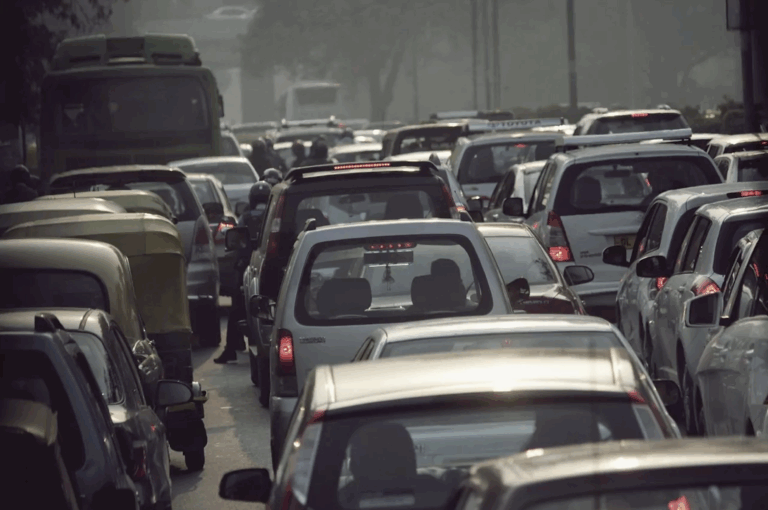
View from behind a sea of cars, as if viewer was also stuck in a car in traffic.

After 15 years of construction work, Karl-Marx-Straße in Neukölln is finally open again. Is this a good time for a joke about Berlin’s notoriously incompetent government? No, since this is a political decision: infrastructure is falling apart because the German ruling class wants to spend trillions on weapons.

I go down KMS several times per day. Even as a proud car hater, I assumed the chronic traffic jams would clear up. But absolutely nothing has changed: during rush hours, autos stand still, spewing out poisonous fumes and blocking ambulances. It turns out what blocks cars is not construction sites—it’s other cars.

This is why adding new lanes doesn’t improve traffic flow: Investment in car infrastructure just puts more cars on the streets. As an old German saying puts it: “If you sew streets, you reap traffic.”

Investments

A new segment of the inner-city highway A100 is set to open this year—three kilometers of road for €700 million. The Senate wants to extend it further into Friedrichshain, which will cost over €1 billion.

Last weekend, a segment of the S-Bahn around Schöneweide shut down because there were no workers for the signal box. The U-Bahn line U1 hasn’t been running for two weeks due to a lack of drivers.

Every euro invested in roads is one missing for public transport. Paradoxically, money for subways, trams, and buses is what gets people out of cars—and thus prevents traffic jams.

Car supremacy

I’ve written that car culture seems like an addiction: users claim to love it, even when it clearly makes them miserable. Another way I’ve been thinking about this is “car supremacy.” German traffic rules go back to a Nazi law from 1935, which defined motorized vehicles as the Übermenschen of the streets.

Today, German drivers still enjoy enormous privileges. If you want space to keep a car, for example, the city will provide it to you for free (or at most €10 per year). If you need that space for anything else, including living, you’re on your own.

This kind of extreme privilege can make people feel like any proposed change is an attack. Take white South Africans, who make up 7 percent of the population but control 70 percent of farmland. As soon as anyone talks about reducing inequality, they shout “white genocide.” As the saying goes, “when you’re accustomed to privilege, equality feels like oppression.”

The same thing is happening with drivers. They kill about 50 people per year in Berlin—yet any measure to stop this constant mass murder feels like an attack on their human rights.

On the remodeled Karl-Marx-Straße, drivers complain that the unprotected bike lanes now take too much space. Most of the limited space, however, is taken up by parking spaces, so huge metal boxes can stand unused for 23.5 hours per day. Meanwhile people are forced to squeeze past each other on narrow sidewalks.

Referendum

Sometime next year, Berliners should be able to vote on a referendum to make the inner-city car-free. I don’t think this has even a tiny-chance of passing. Thanks to the Greater Berlin Act of 1920, countless villages are included inside the city borders. Our odious, provincial mayor comes from the distant town of Kladow, for example. Many suburbanites insist they need cars—and I wouldn’t want to decide for them, as I live in a completely different place. Unfortunately, millions of them are allowed to vote on transport policy for the actual city.

Nonetheless, this referendum will get people thinking. People inside the S-Bahn-Ring are far less likely to own a car than people out in the boondocks. Why do we dedicate so much space to a means of transportation most people don’t use? Why should cars rule the road, even as they are blocking trash pickup and regularly killing kids?

Berlin’s constitutional court just declared that there is no fundamental right to a car. As a communist, I am a democrat—I believe in the equality of all people. I despise apartheid for the same reason I despise cars. KMS, with its myriad cultures, could be beautiful—if only we could get rid of the cars. 

Red Flag is a weekly column on Berlin politics that Nathaniel Flakin has been writing since 2020. After moving through different homes, it now appears at The Left Berlin.

News from Berlin and Germany, 23rd July 2025

Weekly news round-up from Berlin and Germany

NEWS FROM BERLIN

Schönefeld votes for asylum center at BER airport

The municipality of Schönefeld has cleared the way for an entry and exit center for refugees at BER Airport. According to a spokesperson, most of the municipality has approved a development plan that provides such a facility. According to the Ministry of the Interior, this means that the formal requirements have been met. According to current plans, the center is set to open in 2028. According to the Federal Ministry of the Interior, the federal government wants to rent office space there. The center at BER is highly controversial. Refugee organizations speak of a deportation center and see human dignity at risk. Source: berliner Zeitung

Berlin is growing faster than expected

A new internal report suggests that the population of Berlin is growing faster than expected, with the total number of residents projected to surpass four million as early as 2036. Despite growth in recent decades, the city still has fewer inhabitants than it did 100 years ago. The largest population ever recorded in Berlin was around 4.4 million, just before or during the Second World War. However, Berliners are not having children. The city has the lowest birth rate in Germany. It is thanks to immigration, then, that growth is expected to continue, with 109,000 new residents projected to arrive by 2040. Source: the Berliner

Weapons banned in public transport in Berlin

Since 17 July, Berlin has established stricter regulations concerning the carrying of knives and other
weapons in public. The new rules are intended to curb a rise in violent crime, granting yet the police additional powers to conduct searches without specific grounds for suspicion. From Thursday on, knives – regardless of blade length – will be prohibited on all forms of public transport. There are exceptions, however, for people who work in restaurants or snack bars at train stations, for instance. Since it is a blanket ban, there will be no signs indicating designated prohibited zones. Besides, knives, firearms are also banned, as well as irritant sprays such as tear gas. Source: the Berliner

NEWS FROM GERMANY

Brandenburg now requires a commitment to Israel for naturalization

Since 1 June, anyone wishing to become a naturalized citizen in Brandenburg must acknowledge Israel’s right to exist. In addition, the state requires a clear commitment to the Fundamental Law (“Grundgesetz”), acknoweldgment of the Nazi past and the ability to independently secure a livelihood. Interior Minister René Wilke (non-party) said in the state parliament in Potsdam that he had made a corresponding change to the naturalization procedure in consultation with Minister President Dietmar Woidke (SPD). The new regulation has been in force since the beginning of June. Saxony-Anhalt was the first federal state to link naturalization to a commitment to Israel’s right to exist in 2023. Source: welt

Use of “Payment Card” could be expanded in Hamburg

Over a year ago, Hamburg was the first federal state to introduce payment cards for asylum seekers. Such cards can be used by refugees like a credit card: 50 euros cash can be withdrawn per month, 10 euros for minors. The cards can be used in the supermarket or at the hairdresser, for example – but not abroad, in online shops, for money transfers or gambling. The Hamburg tax authorities are now working on extending the use of the payment card to other areas where social benefits are still paid out in cash. The Left Party criticized the payment card as an instrument of control for welfare recipients. Source: ndr

More complaints about the post office than ever before

Complaints about the postal service and its competitors have reached a new high. As the Federal Network Agency announced on request, it received 22,981 complaints about postal services in the first half of the year, 13% more than in the same period last year. If the current pace of complaints continues, the previous annual high of 44,406 from 2024 could be broken this year. Almost 90% of the complaints were directed against the market leader Deutsche Post/DHL, and they are related to delays, incorrect deliveries or damaged consignments, whether letters or parcels. Source: tagesschau

Immigrants in Europe and North America earn 18% less

As many countries grapple with ageing populations, falling birthrates, labour shortages and fiscal pressures, the ability to successfully integrate immigrants is becoming an increasingly pressing matter. However, a new study from Nature, a British scientific journal, found out that salaries of immigrants in Europe and North America are nearly 18% lower than those of born in the country, as foreign-born workers struggle to accesshigher-paying jobs. They analyzed the salaries of 13.5 million people in nine immigrant-receiving countries. Among the results, it is shown that the children of immigrants faced substantially better earning prospects than their parents. Source: the conversation

A large sum for a big goal

Back to the top of the global economy: this is the common goal of the German government and corporations in Germany. To achieve it, an investment summit was held on 21 July in the Federal Chancellery. Visibly satisfied and optimistic, the heads of Siemens and Deutsche Bank lined up to the left and right of Chancellor Friedrich Merz (CDU) for a press statement after the meeting. The “Made for Germany” alliance wants to help shape this upturn. Merz declared: “Germany is back.” But not everyone sees it that way. There was a lot of criticism of the fact that small and medium businesses were hardly represented or not represented at all. Source: tagesschau

“Scheisse AfD!“: Alice Weidel’s summer interview

As Alice Weidel (AfD) started her “summer interview” with presenter Markus, they could hardly
hear a word of each other. Nearby, speakers had been set up by the activist group “Zentrum für Politische Schönheit”(Centre for Political Beauty), and they drowned out the interview with the lilting sound of a choir. It sounded like a Christmas carol, but with the words “Scheisse AfD” (literally “Shitty AfD”) being sung. Berlin police have initiated proceedings for disruption against the activist group, who had not registered the protest in advance. The Centre for Political Beauty were not the only protesters; they were joined by “Omas Gegen Rechts” (Grandmas Against the Right). Source: the Berliner

Red Flag: A German newspaper finally notices that Berlin cops lie

In his weekly column, Nathaniel Flakin is amazed Süddeutsche did more than copy-pasting police statements


16/07/2025

A group of police with helmets and heavy-duty jackets stand between the camera and a group of protestors. The closes police holds their hand in front of the camera, as if to say "don't film me"

For almost two years, social media and bourgeois media in Germany have reported from parallel universes, one a bizarro mirror of the other.

In the Instagram and Tiktok universe, people get an endless sequence of horrific images: heavily armed cops assaulting peaceful demonstrators at Palestine solidarity protests almost every day. This has drawn the attention of Amnesty International, the Human Rights Commissioner of the Council of Europe, and other international organizations.

Meanwhile, people who get their news from a German newspaper or the Berliner Fenster in the subway hear the exact opposite: every time, big capitalist media apparatuses report that police were attacked by demonstrators. There is never a shred of evidence for this. But most so-called journalists in Germany see it as their duty to transcribe whatever police say.

A particularly dramatic example was the coverage of the Nakba demonstration in Kreuzberg on May 15. The police had tried to ban it, but a court had allowed a rally. Over 1,000 people showed up, surrounded by hordes of cops. As countless videos documented, these black-uniformed thugs proceeded to beat any demonstrator within reach.

By the evening, the police had made a particularly dramatic claim. “We have a seriously injured officer who was dragged into the crowd and literally trampled,” in the words of a spokesman. A cop was admitted to the hospital with a hand fracture and a spinal bruise. Every major outlet repeated this version, from the far-right tabloid BILD to the supposedly serious Tagesspiegel to the avowedly liberal Süddeutsche. None of them relied on reporters on the scene—none asked the cops for evidence.

Politicians took up the narrative. Berlin’s mayor Kai Wegner (CDU) (who loves antisemites, by the way) referred to a “cowardly, brutal act of violence.” Neukölln mayor Martin Hikel called  this “attempted murder.” Alexander Dobrindt (CSU), now the interior minister, said in parliament that this happens “every day.”

Almost two months later, a big German newspaper finally got around to checking the facts. Or rather, the Süddeutsche had Forensis, the Berlin branch of Forensic Architecture, do it for them. And while the video scenes are chaotic, it’s absolutely clear that Officer 24111 was not dragged into the crowd or knocked over at any point. His hand appears to be injured after punching a demonstrator in the face—in other words, he might have broken it on someone’s face.

Why did he subsequently collapse and require medical attention? The video offers no clues. I can offer some speculation. Before these violent frenzies, Berlin cops often have been observed to display tics that are commonly associated with the use of stimulants like cocaine or amphetamines: twitching, jumping, and of course extreme aggression. While my policy is to never talk to police, I have occasionally talked to people who know police personally, and I hear that steroid abuse is rampant. Just last year several cops were investigated for using cocaine which they had confiscated.

Is it possible that 24111 collapsed from overexertion after mixing different drugs? Was this the “attempted murder”?

I predict that we will never know for sure. I doubt that either cops or prosecutors will ever offer an explanation—the case will be quietly dropped sometime next year. Not a single politician will apologize for spreading fake news. No major media outlet will issue a correction. Even Süddeutsche has neglected to correct their original false reporting.

Now, most major outlets have reported on the debunking—yet there is no hint of critical self-reflection. The video analyzed by Forensis did not just suddenly pop up—it was available on social media immediately, and any semi-serious reporter could have tried to find the truth before publishing a report. Heck, I was on vacation in a distant land, and even I could find video evidence while sitting at the beach!

I also predict this will also not lead to a reckoning among bourgeois journalists. Policing is the only profession whose members lie so consistently and so blatantly that we require them to film themselves. Yet most people who call themselves journalists are happy to repeat whatever cops say. In a sense, I get it—that is far easier than doing actual journalistic work.

Red Flag is a weekly column on Berlin politics that Nathaniel Flakin has been writing since 2020. After moving through different homes, it now appears at The Left Berlin.

News from Berlin and Germany, 16th July 2025

Weekly news round-up from Berlin and Germany

NEWS FROM BERLIN

Mohrenstraße can be renamed

The Mohrenstraße in Berlin-Mitte may be renamed after years of legal dispute, announced the Berlin-Brandenburg Higher Administrative Court. The street can now be called Anton-Wilhelm-Amo-Straße. Born around 1703 in what is now Ghana in West Africa, Amo was abducted to Germany as a child, where he became the first known philosopher in the country. An application for an appeal was rejected, meaning that the ruling is legally binding. The Berliner Verkehrsbetriebe (BVG) announced that if the street is renamed, the subway station of the same name will also change its name. Source: rbb24

What happened to policeman 24111?

During pro-Palestinian protests in Berlin, a police officer is said to have been seriously injured by the demonstrators, being dragged into the crowd and trampled. The case became a topic in the Bundestag. The video, analyzed by the research agency Forensis, part of the Forensic Architecture network, shows a different picture than the one presented by the police. Süddeutsche Zeitung and NDR were also able to view and examine it. According to the police, 24111 is still not fit for duty. However, if officers were handled very roughly, an analysis of the footage displays that police officer 24111 was not pulled to the ground, but rather was attacking protesters himself. Source: SZ

NEWS FROM GERMANY

Number of right-wing extremists in Brandenburg rises substantially

Right-wing extremists are on the rise in Brandenburg, according to the latest report from the Office for the Protection of the Constitution. A total of 3,650 people were recorded—almost 20% more than in the previous year, as reported by Interior Minister René Wilke (no party) at the presentation of the 2024 report. Of these, almost half are classified as “violence-oriented,” whose number has risen by 130 to 1,430. On the other side, the number of left-wing extremists remained at 550, unchanged compared to the previous year. Source: rbb24

German schools should limit spaces for migrant kids, according to minister

On show Politikergrillen (“Grilling politicians”), host Jan Burgard pressed Germany’s Education Minister Karin Prien (CDU) as to why German schools had recently performed so poorly in the OECD’s PISA assessment. Prien said that this was due to the mix of children in the school system and that many refugee children in Germany start school with insufficient German skills. Burgard then told Prien that the Danish government requires schools in areas with a high proportion of migrant-background children to pause pupil applications to attract more “ethnically Danish” students, which she presented as one route for the country. Criticisms came from a broad political spectrum. Source: iamexpat

Deutsche Bahn commuters still have to wait

Deutsche Bahn (DB) announced it intends to extend the comprehensive refurbishment of particularly important routes until 2036. The general overhaul of more than 40 busy lines in urgent need of refurbishment will therefore take at least five years longer than originally planned. Previously, these projects were all due to be completed by the end of 2030. The upcoming general refurbishments will affect, among others, the Hamburg-Berlin line from August 1. The Lübeck-Hamburg and Frankfurt-Heidelberg corridors, previously planned for 2027, will also be postponed. Passengers will now probably have to put up with the dilapidated network and the resulting high level of unpunctuality for much longer. Source: dw

More than 100 people remember murder victim Rahma A.

More than 100 people remembered the dead Rahma A. from Algeria in Hanover on Thursday. A neighbour is said to have stabbed the 26-year-old to death in an apartment building in Arnum near Hanover on July 4. The young woman had been living in Germany for two years, worked in a hospital and wanted to start training as a nurse. The background for the crime is still unclear, with a possible racist or Islamophobic motive. Source: t-online

Lieferando: 36-hour strike

The Food, Beverages and Catering Union (NGG) is trying to convince Germany’s largest delivery service to sign a collective agreement for its 6,000 employees—so far without success. This is set to change: NGG wants to force Lieferando to the negotiating table with a “nationwide wave of strikes.” “Especially after the high inflation of recent years, a collective agreement is more than overdue,” said NGG head of department Mark Baumeister. The starting signal was given on 11 July in Hamburg with a 36-hour warning strike, with further warning strikes to follow. Source: fr