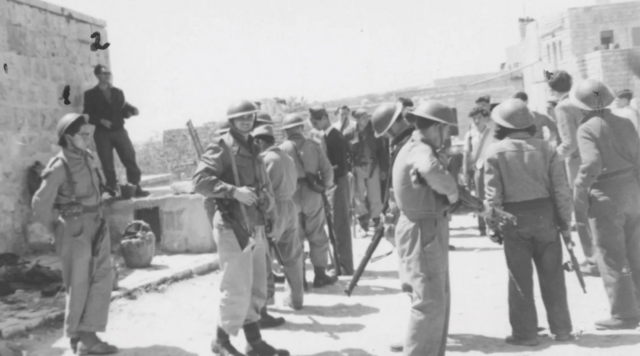
Just before dawn on Friday 9th April 1948, two Jewish militias – the Irgun and the Stern Gang (also known as Lehi) – attacked the Palestinian village of Deir Yassin, near West Jerusalem. The Zionist militias who were the precursor to the Israeli army, the IDF, went through the village, throwing hand grenades into every house, before entering and butchering the inhabitants. Villagers were then allowed to flee the village as a warning to occupants of neighbouring villages.
How could the Deir Yassin massacre happen? In November 1947, the UN ordered the partition of Palestine. 56% of the country was awarded to Jews who had until then only controlled 6% of the land. This was not enough for Zionist leaders like David Ben Gurion, later first prime minister of Israel, who said: “There are 40% non-Jews in the areas allocated to the Jewish state. Such a demographic balance questions our ability to maintain Jewish sovereignty. Only a state with at least 80% Jews is a viable and stable state”.
To achieve this state with at least 80% Jews, Zionist forces started to organise the forced expulsion of Palestinians, the Nakba. Unlike recent attacks on Gaza, the aim was not extermination but expulsion. It is thought that around 100 Palestinians died in Deir Yassin, but their attackers inflated the figures, so as to encourage Palestinians in neighbouring villages to flee. By the end of the Nakba, 750,000 Palestinians – half the country’s population – had been forcefully expelled.
In his book The Ethnic Cleansing of Palestine, Israeli anti-Zionist historian Ilan Pappe argues that Deir Yassin was the start of Plan Dalet, the blueprint for the occupation and ethnic cleansing of Palestine. Pappe wrote: “The systematic nature of Plan Dalet is manifested in Deir Yassin, a pastoral and cordial village that had reached a non-aggression pact with the Hagana in Jerusalem, but was doomed to be wiped out because it was within the areas designated in Plan Dalet to be cleansed.”
Deir Yassin was by no means the largest massacre of Arabs in 1948, but it showed that Palestinians would not be welcome in the new Israeli state; at best, they would be second-class citizens in their own country. Israeli historian Benny Morris later wrote that Deir Yassin “probably had the most lasting effect of any single event of the war in precipitating the flight of Arab villagers from Palestine.” The following month, the State of Israel was formed on the back of the expulsions and killings which started at Deir Yassin.