A leaked memo reveals how Germany’s largest union body consorted to exclude pro-Palestinian speech at this year’s May Day demonstration. In an internal strategy paper, the Leipzig branch of the German Trade Union Confederation (DGB) lists various “unacceptable” and “inappropriate” political positions, slogans and symbols, most of which entail supporting Palestinian liberation.
The document split pro-Palestine symbols and slogans into two types. The first category is “completely unacceptable” and would lead to immediate removal from the protest and reporting to the police. These include: the red triangle, denying the Zionist state’s existence, the slogan “From the River to the Sea Palestine Will Be Free,” any relativisation to the Holocaust (such as the claim that israel is currently committing a Holocaust-like crime against the Palestinians) and antisemitic statements such as “Israel, murderer of children.”
The second category is “inappropriate but not criminal,” in which case, the memo notes, stewards should either ensure that the individuals are not visible at the front of the protest, or that they simply leave. These include: Palestinian flags, Palestinian keffiyehs, “one-sided portrayals of the Middle East conflict” and flags and symbols of “problematic groups.”
The document then refers to several pro-Palestinian and communist groups as “potential disruptive elements,” categorising them as “authoritarian/anti-Semitic leftists.” The Socialist German Workers’ Youth (SDAJ) and the Communist Party (DKP), are considered “problematic,” while Young Struggle, Zora, Handala, Communist Organisation (KO), Gewerkschafter4Gaza and Communist Aufbau (KA), are labeled as “highly problematic.”
In 2024, during the Munich May Day demonstration, as different groups chanted for Palestinian liberation, the DGB leadership stated to the press: ”They are not part of our movement, and we do not share their views.” Meanwhile that same year, in Berlin, the DGB leadership tried to exclude pro-Palestinian representation by issuing a pre-demonstration statement banning all national flags. Despite the attempted repression, on the day, many participants chanted for Palestine and were thereafter told by stewards that pro-Palestine slogans were antisemitic and even reported to the police. Towards the end of the demonstration, the stewards, collaborating with the police, violently tried to separate this bloc from the rest of the protest, pushing demonstrators and pulling at banners.
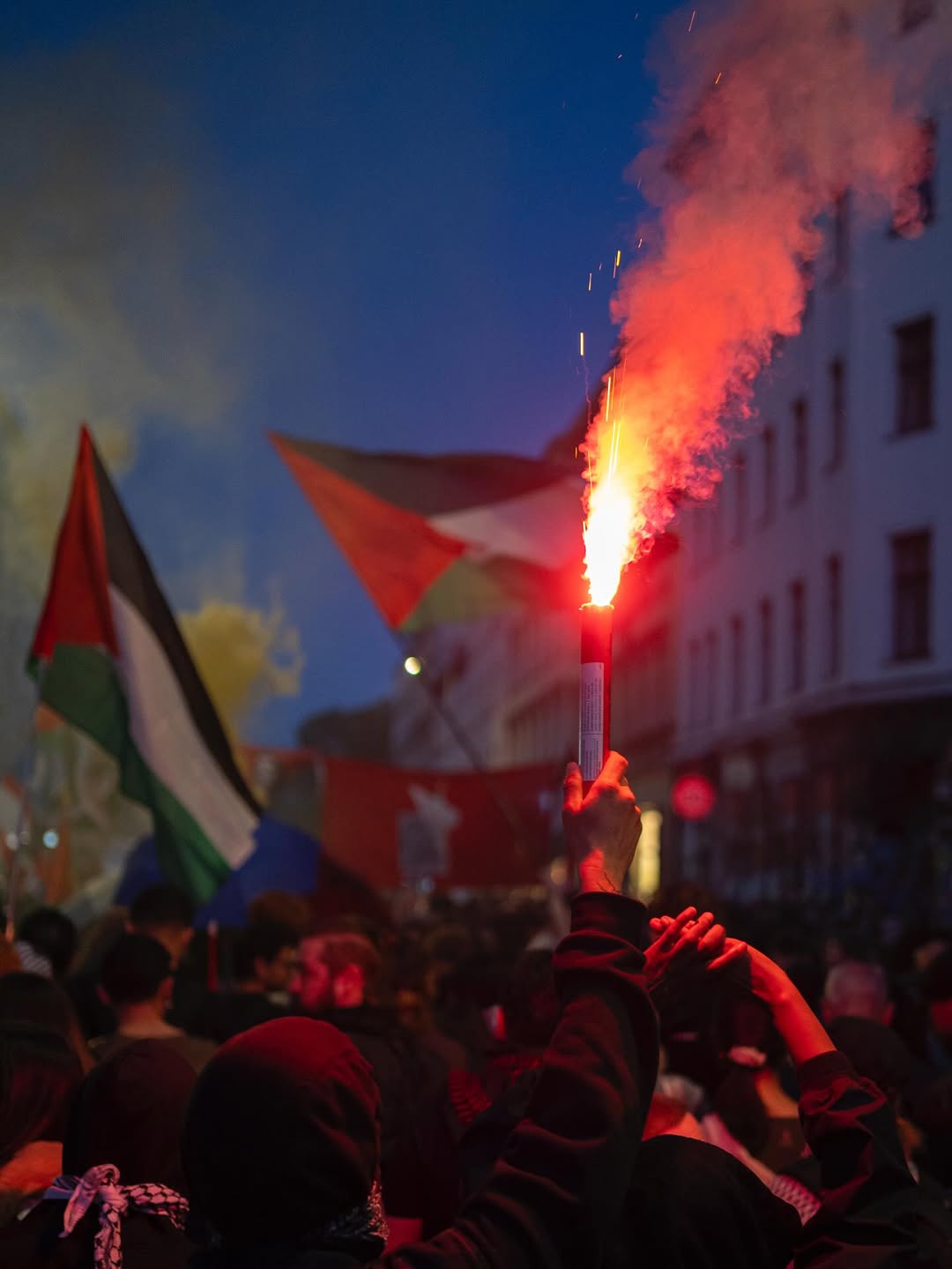
This year, Berlin’s May Day demonstration, organised by several internationalist, leftist and communist groups, and proudly in support of Palestine, was met with a different kind of repressive hurdle. A few hundred meters after the protest left Oranienplatz, it collided with a large concert taking over the route, leaving extremely limited space for protesters to pass and find their way through. It was only after hours of efforts and resilience from the organisations, stewards and demonstrators that the protest was able to carry on together. The concert in question was organised by Die Linke. Several organisers called out this event as sabotage, sowing division and part of a broader strategy of appeasement.