
Matthias Monroy is a journalist and researcher monitoring police and border violence in the European Union. He is an editor for Bürgerrechte & Polizei/CILIP and nd, and writes his own blog. Today we talk with Matthias about the push to transform Berlin into a “Drone City” and a hub for military tech companies.
Hi Matthias, could you briefly introduce yourself?
My name is Matthias, and I’ve been involved in anti-repression work for almost exactly twenty-five years. This started after I attended the G8 summit in Genoa, where I was arrested. I was among the hundreds of people who were abused by the police, and I later went through a lengthy legal case against them, which I ultimately won.
Since then, I’ve focused particularly on the international dimensions of repression, primarily at the European level, looking at how police forces and border police cooperate across countries.
A lot of your recent work seems to be focused on drones. Is there a particular push to transform Berlin into a “drone city”?
I would say yes. Of course, Berlin is also home to various other forms of military technology. One example is the Rheinmetall Pierburg plant in Wedding, where cartridges for artillery ammunition are produced.
But many drone manufacturers are also based here with branches or even headquarters, as are other companies in the aerospace sector. Airbus, for example, has a site in Berlin, or Hensoldt and Germandrones.
Drone technology should be understood in a broad sense. It also includes areas such as artificial intelligence, automation and electronic control systems, sensor technology as well as satellite technology. The development of these technologies is actively supported by the Berlin Senate, including by Mayor Kai Wegner, who has signed various agreements aimed at attracting aerial arms companies to the city. His predecessor Franziska Giffey was also engaged in the matter.
Can you tell us how and why Berlin is trying to lure defense-tech companies to the city?
There’s clearly been a major militarization in the last years in the sense that there has been much more investment not only in the German military but also in the war in Ukraine which has massively accelerated the use of drones. We are speaking of millions of mostly small “First Person View” drones which are produced and bought every year – by both sides.
Germany saw only slow developments in the sector before. There had been startups, mainly based in Bavaria, back in the 2010s. Now, with the federal government providing substantial funding for the Ukrainian military, many drone companies have moved there to test their technology under combat conditions. Berlin wants to become part of this military “ecosystem,” as they call it.
Essentially, the city government is now trying to attract investors using the usual methods, which is mostly funding research or giving loans by the Investitionsbank to startups, and the drone sector contains a large number of them.
What has become especially important in this field is artificial intelligence. Military drone technology is advancing toward automation at an astonishing pace. Every time your opponent automates something, you have to respond by becoming even faster. That means the human operator—who, in principle, is supposed to remain “in the loop” —is, in practice, being increasingly sidelined.
That is why AI companies have become so important. And Berlin wants to be part of that as well.
Recently, there’s been an agreement between Kai Wegner and IAI (Israel Aerospace Industries) to establish the Berlin Aerospace and Defense Innovation Center. Can you tell us more?
This is, first and foremost, a framework agreement, it isn’t a contract in the legal sense. There will presumably be contracts later, but for now Berlin has signaled politically that it wants IAI to establish a presence in Berlin, specifically in Adlershof.
And IAI is really not just some ordinary corporation. It is one of the major companies in this field. And, as far as Germany is concerned, apart from Rafael Advanced Defense Systems, IAI is the major Israeli company that the government has contracts with.
This deal has another perspective. We have seen the so-called funding scandal regarding the pretended fight against antisemitism in Berlin, with this whole Christian-democratic swamp, so to speak, being investigated in a parliamentary committee. We saw how accusations of antisemitism and efforts to combat antisemitism can be instrumentalized in order to silence criticism of Israel. And on the other hand, from the same swamp, now a huge state-owned company in Israel is supported. As long as there are some Israeli partners involved, it can be presented as doing something against antisemitism.
One very important catalyst is the “European Leadership Network”(ELNET), a pro-Israel lobbying organization that was specifically founded for this purpose: to bring European (mostly German) companies together with Israel. For the military sector they created a “ELNET Security & Defense Initiative” to facilitate investments also in drones and their defense.
ELNET also organizes parliamentary delegations to Israel. By now, a three-digit number of members of different German parliaments have traveled to Israel on accompanied trips.
Since October 7, for example, the trips have often included visits to kibbutzim that were attacked by Hamas and other groups, followed by visits to arms manufacturers. IAI is very frequently on the itinerary. And on the way from the kibbutz to IAI, there might also be a stop for a wine tasting at an Israeli winery that sells products to Germany—so these are clearly economic promotion trips.
However, it is not clear which kind of IAI technology is actually supposed to be brought to Berlin. IAI has a very broad portfolio. It could also involve satellite or sensor technology.
But what they have stated very clearly is that it is also about production: it concerns research and development as well as manufacturing.
To what degree is there an integration between tech developed for border control and tech used for the military?
Border surveillance has been steadily expanded, and military technology is playing an increasingly important role in it. This is why I would definitely say that there has been a broad process of militarization at the EU’s external borders, primarily on land and at sea. Drones are a particularly clear example because they are relatively unambiguously military technology.
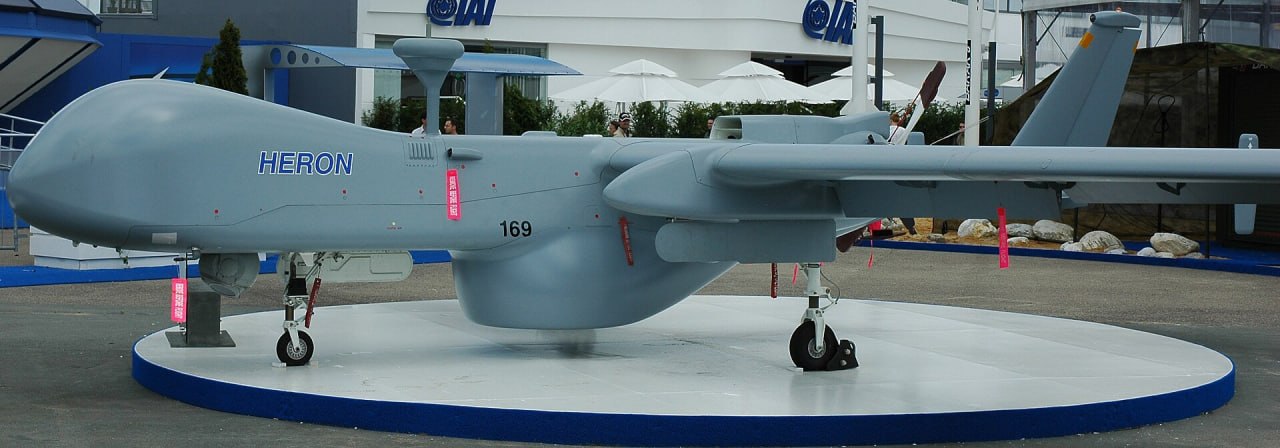
These drones are actually the same types—perhaps even the very same assets—that the German armed forces have operated. One example is the Heron, made by IAI.
For around 25 years they have had two main drones in their product line: the Heron 1 and the Heron TP, which is the successor model. The Heron 1 is a reconnaissance drone, while the Heron TP can be armed.
Both have been used from the very beginning by the Israeli military in conflicts, and also during periods without a formal war, for example, in Gaza.
The German armed forces, too, operated the Heron 1 for a long time in Mali and Afghanistan, but eventually wanted armed drones. So the Bundeswehr returned its Heron 1 drones and has now received Heron TP drones.
That started in 2020-2021. Around the same time, Frontex began using Heron 1 drones in the Mediterranean. So it is actually possible that they could be the same aircraft—the ones that the Bundeswehr had handed back and that were then used for Frontex operations. A very clear example of militarization.
Also, up to 1000 feet, the drones are not flown by the Bundeswehr, and they are in general not flown directly by Frontex. Instead, Airbus is the main contractor for both, responsible for operating and maintenance. Airbus is a European corporation, but its responsible defense division is based in the German city of Bremen.
The company essentially subcontracts part of the work to the Israeli company IAI, receives the drones from them, and also trained some pilots. In other words, German taxpayers paid to train pilots, which then fly missions for Frontex.
These very large drones are still a relatively new technology compared with conventional aircraft, and because their operation involves a lot of licences and approvals, you cannot simply acquire a large drone and say, “We’re going to fly it around land borders now.” This regulatory process takes time, and only very few countries allowed flights in domestic airspace for drones like Heron TP—and Germany is one of them.
For this, the Mediterranean has effectively become a testing ground before bringing large drones to the land borders.
Over the past few decades, the EU has invested a great deal of money in developing drones, sensors and other technologies. Is there some kind of pipeline that eventually allows these technologies to be used by the Bundeswehr?
For example, I remember that there was a European project called Talos. It was a robotic vehicle meant to patrol the borders. If that technology actually exists now, could the Bundeswehr go somewhere, look at it, and say, “That’s interesting, we’d like to use that too”?
Talos is a very interesting project.
Such security research projects are funded by the European Commission. Participants typically receive between €4 million and €10 million in funding, and they always involve three different sectors.
First, there are the end users or stakeholders. In the case of EU-funded security research projects focused on border protection these are border agencies from different countries.
Then there is the supply side: industry, meaning companies that already have some form of technology.
Finally, there are research institutes. These are either universities or organizations such as the German Aerospace Center.
The border agencies define a need, industry says, “We have the technology,” and the research institutes figure out how to bring everything together. They also carry out the accompanying ethical research, for example, asking whether using a particular technology would violate existing laws, and which laws would need to be changed to make its use possible. So it’s not ethical research in the sense that we might normally understand it; rather, it’s about determining how the technology can be made acceptable.
This is the standard approach in EU projects.
The Talos armored vehicle, for example, was completed around 2012. The Israeli company IAI was involved in the project, and had already built a similar vehicle for the military. The main difference was that the Israeli vehicle had wheels, while the one developed for Frontex had tracks. Otherwise, they looked fairly similar—and the Frontex version was unarmed.
Those two prototypes were never actually deployed anywhere.
The idea behind these EU security research projects is to develop prototypes. After that, the participants go home and decide what to do with the new knowledge they’ve gained or partners they found. Alternatively, the prototypes are showcased at trade fairs for police and military personnel.
If you’re asking about the pipeline, one of the most important places is these trade fairs. There are specialized exhibitions, both large and small
Border agencies attend and say, “We’re dealing with too much migration. We need to do something about it.”
Then there are the vendors, who say, “Well, take a look: we have this great new satellite technology.”
Most of these events, like the annual “European Police Congress” in Berlin, are not simply sales exhibitions. They are what are known as conference trade fairs, meaning they include talks alongside the exhibition. Companies pay for these speaking slots: the more money you contribute, the more panel discussions you can participate in.
On those panels, you might be sitting alongside politicians—often ones with hard-line positions—or, for example, alongside the head of Frontex.
The Transnational Institute and Stop Wapenhandel recently published a paper called Border Labs Reports– How Universities Power Europe’s Border Regime. The report uncovers the role universities play “in the development, perpetuation and expansion of ‘Fortress Europe’.”
Interestingly, Berlin universities seem absent from this report. Do you think there’s still a culture in Berlin that prevents this university-defence nexus to take hold? Is that changing?
I think that’s simply because there are more struggles here to preserve the civil clause [commitment by academic institutions to engage exclusively in non-military research]. There are clusters [of companies producing military tech], for example around Munich, where a lot of the aerospace industry is based. There is another cluster in Bremen with a strong focus on satellite technology.
And of course, a civil clause stands in the way of creating such a cluster. But Giffey and Wegner have explicitly announced that they want to encourage universities to become involved, to bring them into this whole vision of Berlin as a drone hub.
I would say, however, that these are still struggles that can be won: universities can continue to push for ensuring that they do not participate in this kind of military research.
There is a very interesting example from the early 2010s, when the Eurosur border surveillance network was established with Frontex’s headquarters in Warsaw serving as the central hub. The idea is that all EU member states, or more specifically all Schengen states with an external border, contribute information within Eurosur. Frontex can, if they find it useful, share it with other actors.
Satellites play a significant role in this. As I mentioned, Bremen is one of these hubs, and there are people there who conduct research into satellite technologies. The EU’s satellite program, which is now called Copernicus, was previously known as GMES (Global Monitoring for Environment and Security). The name itself is quite interesting because it reveals the dual nature of the technology.
In short, the same satellites that the EU launches into space to measure things like melting polar ice caps can also be used to observe what is happening at borders.
There was a campaign in Bremen by leftists working in these institutes or academies that said basically “Yes to the environment, no to security.” It did not stop the program, but it definitely created public awareness. People said: we care about preventing the polar ice caps from melting. But we oppose the use of these technologies for Frontex operations.
Something similar could potentially be done in Berlin.
When Kai Wegner and, at the time, Franziska Giffey were promoting Berlin as a drone hub, they also released some figures. They said there were around 130 companies involved in military technology and around 430 involved in dual-use technologies in the Berlin area.
Perhaps it’s worth briefly explaining the term dual use: Even a company like Bosch, for example, which manufactures batteries—a perfectly ordinary civilian technology—can become part of military technology if those batteries are installed in military vehicles.
So our struggles could focus on this dual-use technology: fighting to ensure that they remain focused on civilian purposes.
Do you see a particular influence of far right movements on the violent European border regime?
Currently, yes. Historically, I’m not really sure. These kinds of border technologies were also introduced under Social Democrat governments.
One example would be the Spanish exclaves of Ceuta and Melilla on the Moroccan side. People live there since decades in makeshift camps in the forests, hoping that they can somehow climb over the fence to the EU. Those borders have become increasingly fortified: the fences have been made higher, and the tops are secured with razor wire. If someone tries to climb over it, it can cut deeply enough to cause someone to bleed to death.
There was a lot of criticism of this in Spain because people were seriously injured by it. Then, when the Social Democrats won the elections, they said they were going to do something about it.
But they did not remove the razor wire. Instead, they replaced the 80 mm blade version with the 20 mm version to make it “less lethal.”
Similarly, drones used at the external borders were already being deployed in Italy before the right-wing parties began gaining influence there.
But what is definitely true in the military sector is that there are companies that are currently being heavily supported by people like Peter Thiel.
And the worrying thing is that, in my view, the worst is still ahead of us. Germany is one example.
All the police and secret service technologies that have been acquired—and continue to be—will eventually be operated by an AfD-led interior ministry after upcoming elections in East German federal states and, possibly, on federal level. Also, all the surveillance laws that are currently being passed with the support of the Social Democrats could be used by the AfD next year against migrants, minorities or political opponents—ICE in the US is a very good example.
At the moment, many of these tools are still officially aimed at combating human smugglers, which means organised crime, and not against migrants simply because they are migrants (with a gray area here, as migrants themselves are often accused of being smugglers). But this will definitely change, under an AfD government. That is why in my opinion there should be a general moratorium regarding surveillance technologies in Germany.