This article is the fourth piece in the series Neo-Nazis and Anti-Fascism in Germany since the 1990s. The rest of the series can be found here.
Last year Julia Klöckner, President of the Bundestag (CDU) declared, ‘One flag flies over the German Bundestag—black, red and gold.’ Thereby, she put an end to the recent tradition of raising the rainbow flag during Christopher Street Day (Pride) celebrations. The order covered the entire premises, to the extent that the police were called on Stella Merendino (Linke) for displaying a progress flag in her office.
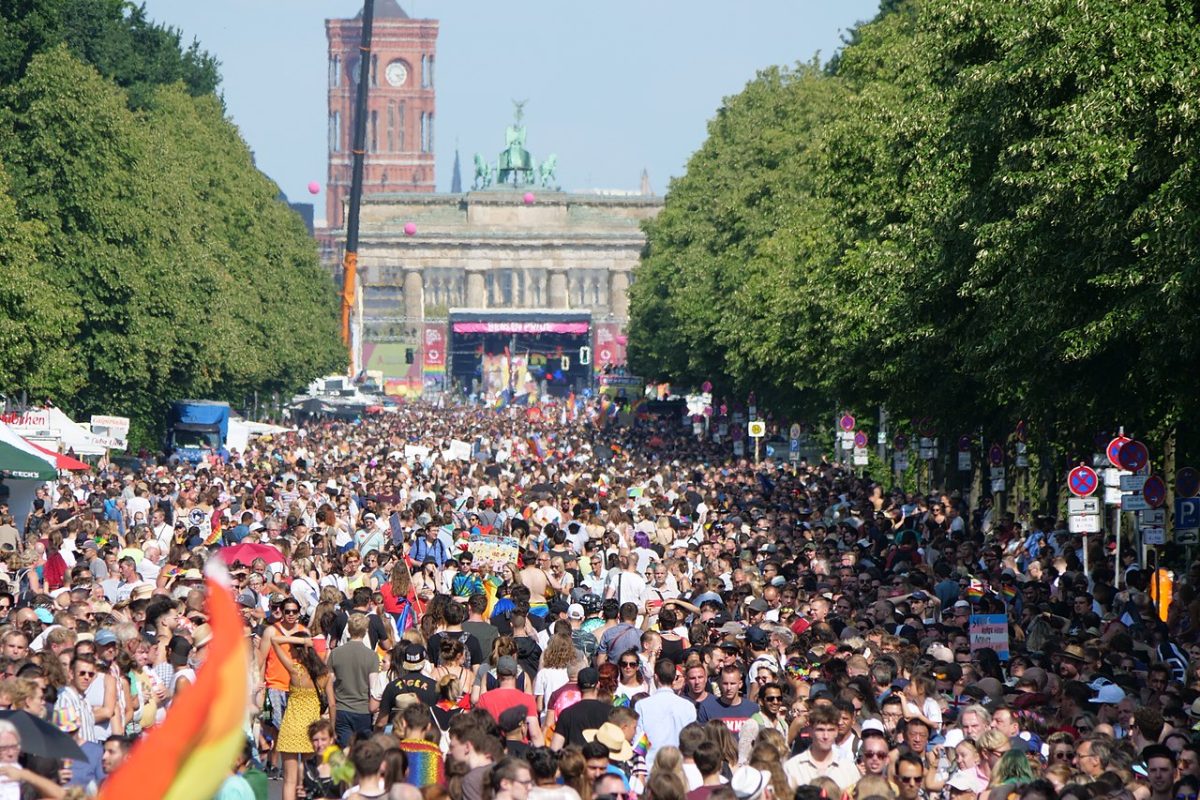
Klöckner’s move came at a time when the presence of far-right disruption at CSD across Germany had begun to tangibly rise. 2024 in particular saw a high number of counter-demonstrations. While CSD in Berlin has lost meaning as a progressive event with sponsorships by large corporations and the distribution of rainbow coloured Israeli flags, smaller events across the country provide much needed visibility. They are also often the most vulnerable. According to a CeMAS (Center for Monitoring, Analysis, and Strategy) report, the two largest CSD events of 2024, Berlin at 250,000 and Kölln at 65,000, were met with 28 (7:62 500) and 13 (1:5000) counterprotestors, respectively. The largest counter protest was in Bautzen, a city of 38,000 in Saxony, attracting 700 to a CSD demonstration of 1 000 participants (7:10). In Zwickau (population 88,000), 400 counterprotesters showed up at a CSD celebration of 800 (1:2) and Görtlitz saw an opposition of 460 to 700 participants (slightly over 2:3).
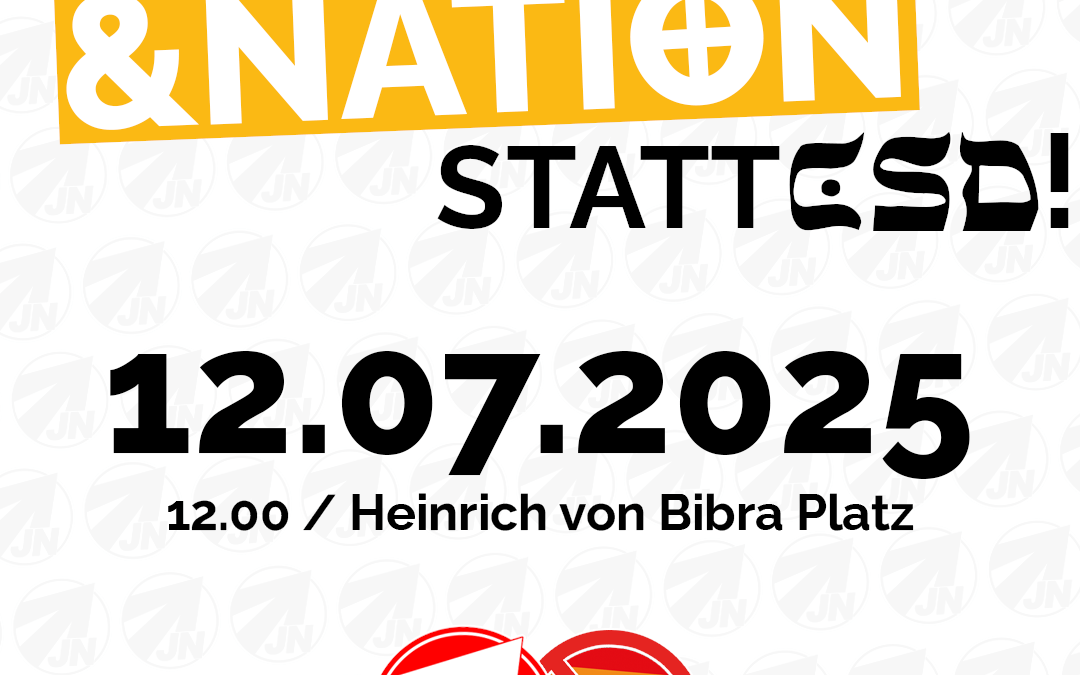
The report describes the participants as young, eager to use violence, and seduced by neo-Nazi movements through mainstream social media platforms such as Instagram or Whatsapp and to a lesser extent, TikTok. The largest account aimed at youth is that of Deutsche Jugend Voran (DJV), with just under 5,000 followers as of March 1, 2026. Another youth organisation with a strong presence among neo-Nazis is the Junge Nationalisten (Young Nationalists), who advertised for their Hessen counterdemonstration with graphics stylising ‘CSD’ similar to Hebrew characters.
The interest in CSD demos stems from ideology regarding traditional family as a tool for advancing nazi eugenics. Der III. Weg (the Third Way), a political party that openly commits itself to ‘German socialism’ and the ‘restoration of a whole Germany to its rightful borders’ also inscribes in its programme, ‘The nation needs German children!’ Under this point, they declare their opposition to marriage equality and ‘gender doctrine’ on the grounds that these disrupt the ‘natural bond’ between heterosexual couples and their children. On their blog are countless posts celebrating events disrupting CSD celebrations. They, and groups sharing similar sentiments, use CSD as an opportunity for counterprotest, taking advantage of the occasion for their own visibility to win favour for ideas that were long taboo in German society.
Der III. Weg is a fringe party, receiving a negligible number of votes in elections and with a membership of just 950. However, the ideology they tout, easily classified as neo-Nazi-adherent, is seeping into broader society veiled in ‘critical’ views of queer visibility.
The AfD on the other hand, can no longer be regarded as safely distant at the fringes of the political spectrum. With polls regularly reporting that around 25% of the population would vote for them, the AfD trails just behind the CDU in popularity. Yet, over half of AfD voters harbour right extremist views. In addition to measures against migration, their signature theme, the AfD enshrines ‘giving the confidence to have children’ and ‘a clear family ideal’ in its programme.
The party’s family politics echo those of Der III. Weg—that a family consists of a mother, father and children—and the Nazi party. Deputy parliamentary leader of the AfD, Beatrix von Storch, is the organiser of Demo für Alle, which serves the sole purpose of painting queer people as a force working to dismantle a ‘traditional family’ image. Despite the name, Demo für Alle is not a key player in the CSD counterdemonstration game, however they lend credence to such demonstrations by providing pseudoscientific arguments against queer visibility in all forms in countless blog posts and pamphlets available on their website. Compared to other outlets holding advertising similar views, their homepage appears professional and legitimate, with sections for ordering pamphlets en masse and a shop with ‘Tradwife’ mugs and baby onesies that say ‘I identify as an attack helicopter’.
The intuitive explanation for queerphobia on the extreme right is that queerness challenges the notion that intimate relationships are primarily for reproduction. Non-reproductive relationships and bodies deduct from propagating a ‘superior’ European, white race. Every German in a same-sex relationship is a German not spontaneously producing blond-haired, blue-eyed children to inherit the nation.
And yet, queer people make up only 12% of the population in Germany. Furthermore, this statistic includes identities that don’t necessarily exclude a same-sex partnership. While presenting diverse family structures and ‘gender ideology’ as a threat to conservative norms, one in five citizens remaining childless hardly constitutes a threat of extinction, especially considering that 20% of German women have no children in their lifetime, a number which has remained relatively stable since the 1960s. This considered, the degree of energy and blame seems disproportionate if not counterproductive, given that an attempt to erase queer people, even if successful, wouldn’t move the eugenicist right closer to their goal in any meaningful way. Surely this has occurred to at least some neo-Nazi organisers and AfD politicians.
Beyond an argument of racial purity and dominance is the utility of the queer community as a common enemy. The far right constructs this enemy well by intertwining LGBTQ+ rights with child abuse. In their blog, the Junge Nationalisten condemn ‘early sexualisation and the promotion of homo-propaganda such as CSD’. The concept of ‘early sexualisation’ is a recurring theme among adherents to the ‘traditional family as the ideal family’ principle. On the right, it is a catch-all term used to describe legitimate issues of concern such as pornography exposure in childhood, grooming and internet safety to beneficial interventions such as research based sex education and school curriculums that foster tolerance of LGBTQ+ fellow citizens (the flyer ‘Diverse schools: Rainbow ideology in place of education’ specifically categorises participation in CSD demos as ‘early sexualisation’).
Demo für Alle, in their leaflet titled ‘Creeping Pedophilisation’ begin by pointing out real dangers facing society’s most vulnerable members—children—then quickly veers into coupling the threat of sexual abuse with queer rights (in addition to, briefly and inexplicably, the anti-nuclear movement). They claim that gays and pedophiles have a history of ‘going hand and hand’, basing their argument largely on a reckless, unethical and abusive series of experiments in which boys were placed in the foster care of convicted child sex offenders conducted in Germany by Helmut Kentler. Kentler was gay. The leaflet neglects to mention that the single greatest source of child sexual abuse by a substantial margin is the family, and the single most frequent perpetrator is the central figure of the ‘traditional ideal’, a victim’s biological father. Furthermore, it criticises approaches to pedagogical prevention work, positing ‘Trans and gender ideology free media’, ‘protecting natural mother-father roles’, and the abolition of full-day childcare as alternative solutions.
That such discourse ignores the realities of sexual violence against children in Germany renders transparent the true intention behind far-right motivation in ‘protecting children’. Fighting against one of society’s most painful problems and greatest sources of fear is a stance difficult to argue with. Unfounded scapegoating of the queer community on this backdrop creates an evil ‘them’ as a stand-in for liberalism and a benevolent ‘us’ that characteristically is the opposite; heterosexual, traditional, conservative. CSD demonstrations are the time when this fictitious opponent is most visible, and therefore the opportune moment for neo-Nazis to perform their ‘morality’ in opposition. They use these occasions in a similar way as intended—to show others who may be in hiding or against them that they are no longer afraid and ashamed. But rather than celebrating diversity and love, they center their actions around hate, exclusion, and nationalism.
The connected arguments against a mother-father-children family image and childcare outside the home offer a promise to the young men and teen boys who make up the majority of neo-Nazi presence and CSD demonstrations. Young men in Germany today have lower overall education levels than women of the same age. Fewer years of education constitutes on its own a risk factor for right-wing radicalisation. In addition, it means that women are surpassing men in projected life outcomes on some scales. Men from this demographic in particular also express anxiety over their dating prospects. The far right preys on the vulnerabilities of young men with a narrative about recovering traditions that restore them to the top of the social hierarchy. Recent viral findings showed that a significant number of Gen Z men have beliefs rooted in misogyny. A third agree that wives should ‘obey’ their husbands, a quarter disapprove of independence and self sufficiency in women, and one in five think that women ‘should never initiate sex’. In all cases, less than half as many baby boomer men agreed with the same statements. With policies that ultimately cause more social inequality to the detriment of an already precarious majority, the far right distracts young men and boys who, faced with sinking education levels, relationship difficulties, and global crises for as long as they can remember, with the promise of power over women. Taking advantage of this vulnerability works—the counterprotests are overwhelmingly young men; the 28 arrests made in connection with a plot to attack Berlin’s CSD were exclusively male, 14 of them under 18.
In 2025, there were more CSD events than ever before. Incidences of far-right violence nearly doubled in comparison to 2024, with documented cases totalling 112. Most of these occurred in smaller cities and towns in the East. Fortunately, acts of solidarity at 2025 CSD events show promise in mitigating the danger—CSD participation tripled in Bautzen, drowning out 500 neo-Nazi counterprotesters. Pride Soli Ride helped coordinate transportation to threatened events from Berlin and other cities. A number of East German CSD events allied to call for solidarity, publishing a statement that outlines ways of offering support. Antifascist organising meant that many of the most at-risk demonstrations were afforded some protection in 2025. Despite the sharp and alarming increase in queerphobia in Germany in recent years, those with positive attitudes toward queer life still greatly outnumber those who reject it. With the first CSD events only weeks away, mobilising this population is essential—not just as an act of solidarity, but also as a stance against facism.