Editorial note: This is the English version of a text which was originally published in German in April 2026. Although the immediate US war against Iran is either over or suspended, we believe that the article contains useful insights from the point of view of an Iranian socialist in Germany. It is also part of an ongoing discussion, to which we welcome further contributions.
Since February 28th, the United States and Israel have been attacking Iran. At the same time, Israel has launched a ground offensive against Lebanon, thereby advancing its plan for a “Greater Israel” in the region. This imperialist assault on Iran and Lebanon must be placed in the context of the ongoing genocide in Palestine and the recarving of the map of West Asia as one of the world’s most oil-rich regions.
The attack on Iran, which has been subjected to sanctions by Western imperialists for years, is no coincidence. Since October 7th, 2023 the Western imperialist powers and Israel have systematically weakened the so-called “axis of resistance” one force after another. This axis was intended to shield the Iranian regime from such attacks and to secure its hegemony as a regional power.
However, this attack on Iran has also been made possible against the backdrop of the failure of the Arab Spring: In Egypt, the revolutionary uprising was crushed and a US-friendly regime was installed through a military coup. In Syria years of civil war led to Assad’s downfall and his replacement by a pro-American dictator.
Through the Abraham Accords, the US has sought to strengthen economic, political, and military ties between Israel and Arab states in the region, while maintaining its extensive network of military bases and security partnerships, which provide strategic infrastructure for US military operations, including against Iran.
It is therefore unsurprising that solidarity movements against Israel’s war in Gaza and against the US-Israeli war on Iran have emerged across the Arab world, including in countries whose governments are closely aligned with the United States and its regional order. Particularly notable examples include Jordan, Egypt, Tunisia, Bahrain and Kuwait, where popular mobilization has at times directly challenged, or been constrained by, governments’ foreign-policy orientations.
A defeat of Israel and of the United States by Iran could strengthen the working classes of the region—provided that a political party and movement capable of advancing these class struggles exists.
The regime in Iran remains one of the greatest obstacles to the self-organization of the working class. It does so not only within Iran, but also in other countries, by fostering petty-bourgeois reactionary movements that crush workers’ organizations.
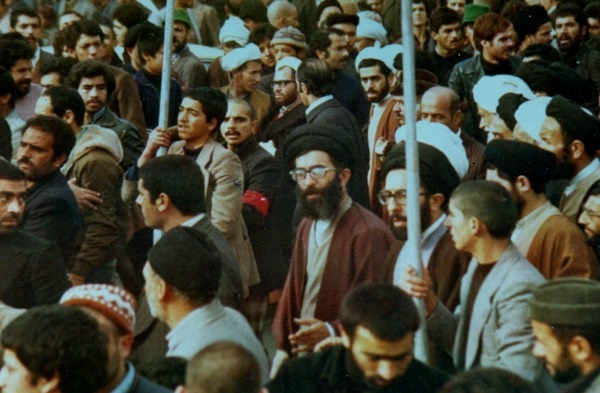
In some countries—Pakistan, Bahrain, and Iraq, for example—demonstrations followed the killing of Ayatollah Ali Khamenei. In many cases, anger at people’s own miserable conditions is expressed through religious ideology. Religious movements and sentiments reflect the “inverted world”, yet they provide no analysis of its causes and no sufficient answers for ending suffering in this life.
Inversely, many people in Iran rejoiced at Khamenei’s death, instinctively seeing him as nothing other than a bloody class enemy. Yet even here, joy at the removal of an oppressor must not obscure the fact that the rulers of the United States and Israel are also class enemies and that their bombs will bring no liberation.
While we in the West must clearly focus on demanding an immediate end to the war against Iran and an end to the genocide in Palestine, we must have no illusions about what a victory for the Islamic Republic would mean for workers and oppressed people in Iran. During last year’s twelve-day war, dissident workers were already subjected to intensified repression, including arrests, imprisonment and executions on accusations of espionage.
The existence of spies, even in high-ranking offices within the regime itself, is no secret. Yet this fact is used as a pretext to eliminate any form of left-wing dissent inside the country. That brutal repression has continued amid the latest round of war.
The Islamic Republic continues to execute people on a daily basis, including workers and participants in the January uprising who are prosecuted on espionage charges, as well as people driven into the drug trade by extreme poverty, while the most powerful drug-trafficking networks in the country are themselves linked to the IRGC. At the same time, the regime’s repression of Kurdistan (Rojhelat) continues unabated.
Class Struggle and the State in Iran
Before turning to the position of socialists in the imperialist centers of the West and of socialists in Iran, we must first step back and examine the class character of the Iranian state and class struggles in Iran.
In the 1979 revolution, oil workers brought down the last Shah of Iran through months of strikes. These strikes were financed from the resources of the „bazaaris“, the petty bourgeoisie, which was ideologically under the influence of the mullahs. Under the Shah, many bazaaris had faced persecution and imprisonment—which is why Khomeini was living in exile in Paris at the time.
This revolutionary period also allowed left-wing forces, many of whom had been imprisoned in the notorious Evin Prison, to catch a breath of fresh air and to reorganize. It was a festival of the oppressed. Workers’ councils (“shorahs”) emerged. These were strike committees born out of the revolution that took control of workplaces after the old regime collapsed and managers and owners fled. They arose spontaneously from the practical necessity of organizing production themselves. They were comparable to the Soviets in Russia in 1917.
The decisive difference from the Russian Revolution was the absence of a revolutionary socialist party. This could have made the difference in a situation of dual power, in which the state and the old capitalist class stood on one side, and the workers and middle classes on the other. Such a party could have driven out both the old and the new capitalist classes and counterposed the dictatorship of the proletariat to the dictatorship of capital. This would have meant the genuine democratization of society, with workers, peasants, and other petty-bourgeois layers taking an active role in its social, cultural, political, and economic life under working-class leadership.
The Iranian left, however, had little real influence within the shorahs. As a result, class consciousness and the living reality of class struggle could not develop into recognition of the necessity of proletarian dictatorship. In „Workers and Revolution in Iran“. Assef Bayat shows in great detail what demands and contradictions existed within the shorahs. Ultimately, political and economic demands were not linked together, and there was no common political objective.
This made it easy for Khomeini and the Islamic counterrevolution to install their own managers in the enterprises. A national ideology was conveyed through religion: “We are all Muslims fighting against the United States.” Behind this slogan all class differences disappeared.
This does not mean, of course, that socialists must be anti-religious or that they cannot organize Muslim workers and petty-bourgeois layers in common struggle. The decisive question is what one is fighting for and under which political program (cf. „International Socialism, issue 110“).
Chris Harman shows in „The Prophet and the Proletariat“ how the occupation of the American embassy was a decisive turning point, especially among young people and students, who were the social base of many left-wing parties and organizations. Khomeini succeeded in drawing many leftists behind him.
Yet the politics of this left were shaped above all by Stalinism and Maoism. The Stalinist Tudeh Party had already pursued a popular-front policy under Mossadegh—the first “democratic” president of Iran—by supporting sections of the national bourgeoisie. It was therefore hardly surprising that its diminished remnants also supported Khomeini in 1979.
The Fedayin-e-Khalq (Majority faction), a guerrilla movement that emerged in the 1960s, likewise supported the new national bourgeoisie around Khomeini in line with Maoist theory, because like the Tudeh they believed revolution would proceed in stages: first a bourgeois-democratic revolution, and only later a socialist revolution under working-class leadership.
In doing so, they ignored the central lessons of the Russian working class in 1917, as well as, for example, the experiences of the Chinese proletariat in the 1920s. The Russian Marxist Leon Trotsky summarized these lessons in his work „The Theory of Permanent Revolution“: in countries with belated capitalist development, only the proletariat itself can carry out the democratic tasks—by moving toward socialism through the expropriation of the bourgeoisie.
In semi-colonial countries, the national bourgeoisie occupies a comparatively weak position in relation to the imperialist bourgeoisie. It is therefore compelled to manouver between the proletariat and the imperialists. At times it relies on national unity and makes compromises in an attempt to win over the proletariat; at other times it makes compromises with the imperialists in order to remain competitive.
Confirmation of this can be seen in the IMF-oriented neoliberal reforms introduced in Iran during the 2000s. Some of these had to be reversed partly because of resistance from the working class and partly in the interests of preserving the autonomy of Iran’s own bourgeoisie.
Elsewhere, Trotsky wrote in the „Transitional Program“ of 1938: “The policy of the proletariat of backward countries … is compelled to combine the struggle for the most elementary tasks of national independence and bourgeois democracy with the socialist struggle against world imperialism.”
More concretely: in countries with delayed capitalist development, bourgeois-democratic rights cannot be realized without a struggle against imperialism. The oppression of women is so acute in Iran because imperialism creates the material basis for the uneven development of capitalism on a global scale. Through the subjugation of entire countries and the super-exploitation of their working classes, it ensures that pre-capitalist social relations—such as the dominance of religion in everyday life—continue to exist alongside factories in which workers, for example, produce Apple phones.
Thus, the struggle for self-emancipation in (semi-)colonial countries is inseparably bound up with the national question. A series of transitional demands is necessary, foremost among them the demand for a constituent assembly (a bourgeois-democratic assembly), which would make it possible for the working class to struggle for political hegemony alongside the regime.
The Iranian parliament is unsuited to this task, since the working class is not allowed to appear there through its own independent organizations. The regime controls parliament, which in reality plays only a minor political role alongside the Supreme Leader, the Guardian Council, and the Revolutionary Guards. Committees must be founded that take over the state functions of the regime themselves—the provision of medical care, the distribution of food, and the sharing of information.
The working class must organize itself around a transitional program in which democratic demands are first raised against the regime: the right to organize, the right to assemble, freedom of expression, and so on. In this way it can gain confidence and connect these democratic demands with proletarian power through the conquest of state power itself.