First, one group of journalists writes that the president has signed a decree introducing a minute of silence. Now, every day at 9:00, the entire country must fall silent in memory of the victims of the war. These texts usually include an exhaustive list of who can be considered a victim. As you might expect, the men who died while trying to escape conscription are not included in that list.
Then a second wave of journalists joins in. They add details: pedestrians and vehicles must stop in the street for exactly 60 seconds during the minute of silence. Violations may result in a fine.
Later, a third wave appears – the debunking one. It turns out that kids in public schools are not required to kneel during the minute of silence. It turns out that fines will not be imposed on pedestrians, but only on drivers, and only in exceptional cases.
Be that as it may, the very idea of a minute of silence could be quite worthy. There is nothing wrong with honoring the memory of the dead. It becomes repulsive only at the moment when grief is turned into an obligation.
***
I scroll through the news in bed at night. My eyes hurt, but I keep going. And suddenly I catch myself thinking that reading news about nuclear war no longer scares me, it entertains.
The modern world is suffering from vision problems. A new symptom is the inability to plan. In 2026, I cannot say where I will be in five, seven, or ten years. I cannot even be sure within what borders the country that issued my passport will exist or whether it will exist at all.
What will happen to the EU? Will the United States leave NATO? What will become of NATO if that happens? What will happen to Russia after Putin? Will there be a third world war? And if there is, will it bring about the end of the era of nation-states?
Ukrainian journalism makes almost no attempt to answer such questions. It does the opposite: it clouds the future with sugary propaganda that produces new corpses on the battlefield. Then it publicly takes offense when someone criticizes the customer of the propaganda – the authorities.
Society is not the same as the state. But Ukrainian journalism persistently pretends that there is no difference between the two. It also never tires of repeating that no one is interested in cultural news. News about science drowns in reports about inflation, prisons, and the front line. This is not an accident, it is a mechanism.
Mikhail Bakunin believed that the liberation of the people begins with education. Modern journalism makes education unfashionable, placing thieves, celebrities, and scandals on a pedestal. Today I want to hold a mirror up to contemporary Ukrainian journalism, because its reflection is the best proof of its worthlessness.
***
A few facts about culture that no one cares about.
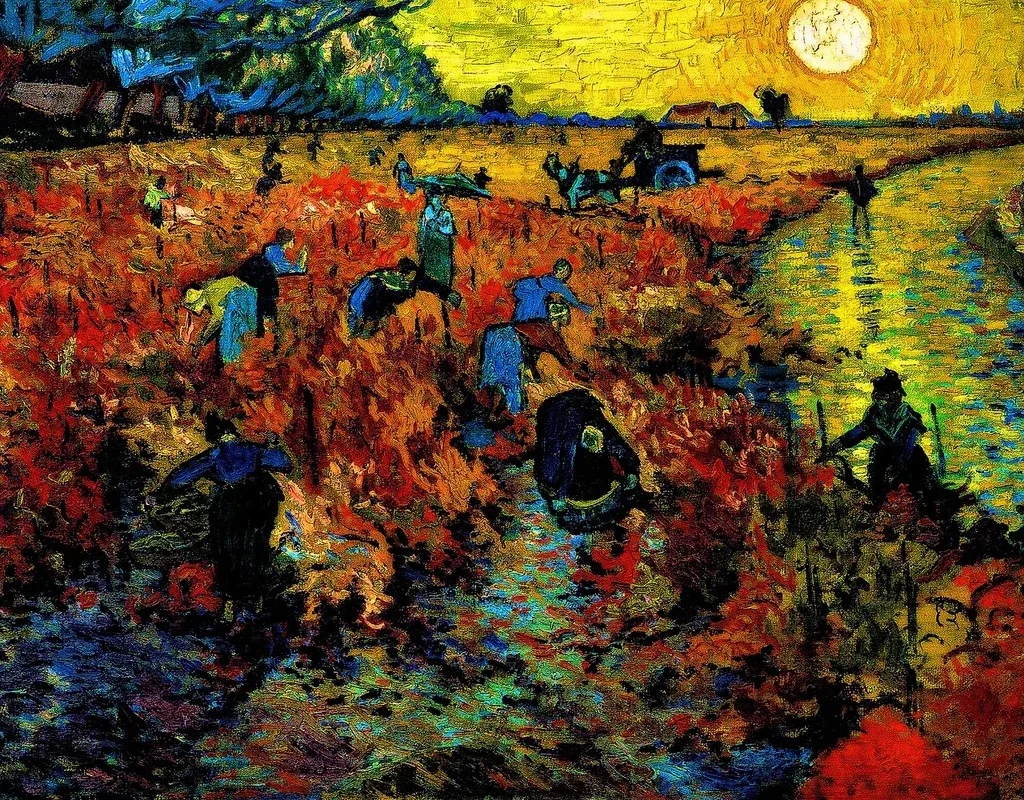
During his lifetime, Vincent van Gogh sold only one painting – The Red Vineyard. It was bought by the Belgian artist Anna Boch in 1890 for about 400 francs.
In his short life, van Gogh managed to paint around 900 works and more than a thousand drawings. He died an unrecognized artist.
Today, his paintings are worth tens and hundreds of millions of dollars.
The problem with journalism is that it is almost always interested only in what has already been recognized. What is already expensive. What has already become success.
But culture almost never looks important at the moment it is happening.
***
Symbolic initiatives are increasingly replacing real problems. Streets are being renamed. Sometimes even cities, though mostly small ones. All of this is explained by a noble goal: get rid of the Soviet legacy.
But journalism is not only about transmitting facts. It is also about a critical view. Questions. Is this necessary? What will it change? Perhaps the same resources should have been directed to the front?
Journalism, like the judicial system, is supposed to be impartial. But when news outlets are funded by political parties, impartiality becomes a luxury.
And as for the judicial system… try for a moment to imagine that the biblical line “judge not, and you shall not be judged” was meant literally… about courts. That changes a lot, doesn’t it?
***
On social media, a woman writes that her husband has been mobilized. She has one newborn child. A rented apartment. Almost no money. She asks: what should she do?
Society remains calm. It believes that the state acts fairly. After all, everyone knows that men with three or more children are not mobilized. If she has fewer than three children, then she should manage. The state must have decided this for a reason, and therefore there must be good grounds for it.
After some time, another post appears. Another woman writes that her husband has just been mobilized. She has three children. She also asks: what should she do?
Society remains indifferent, because it believes that the state is fair. If her husband was mobilized, then the children must not be his. Ukrainian journalism does not cover this.
***
A separate genre of Ukrainian journalism is news about how the world admires Ukraine. An ambassador of some country says a few polite words, and soon an article appears.
The headlines sound almost religious: “the world applauds,” “the entire internet laughs at Russia,” “Ukraine is protecting Europe from World War III.” Sometimes a single Facebook post is enough to turn it into the reaction of all humanity.
With politicians, it is even simpler. They write an emotional post, and journalists republish it as news. The politician is irritated. The politician is outraged. The politician is proud.
This is how the news feed gradually turns into a strange genre: a transcript of other people’s emotions presented as reality. And this is a subtle form of control through emotions.
***
From the perspective of anarchism, there is no mystery here. The state demands sacrifices, and society rushes to justify this demand. When reality does not match the rules, people do not question the rules, they begin to question people.
This is how power works: it shifts responsibility onto the victims themselves. The state does not even need to defend itself. Ukrainian journalism does it for it.
***
Control rarely looks like control. More often, it looks like a news feed. Some topics disappear, others are repeated until they begin to seem like the only ones that matter. This is how a field of attention is formed.
In the morning, you open a news website. The front. The front. Support from the whole world. A scandal involving a politician. A drunken fight. By evening, you are already convinced that this is what reality consists of.
Not because you were forbidden to think about anything else. Simply because no one reminded you of anything else. And meanwhile, somewhere, hiding from forced mobilization, a new van Gogh is wasting away in poverty.
This is exactly how one form of power works – the management of attention.
***
But there is another kind of control – a commercial one.
Suicide, death, deep analysis – all of this is too dark. Too pessimistic. And if advertising money comes not from political parties but from brands, brands do not want to see their ads next to something sad.
Pessimism does not sell well. Intellectualism does not sell well either. But there is one problem: it is difficult to be truly intellectual and not arrive at pessimism.
***
Ukrainian journalism is less and less about enlightenment and more and more about service. It no longer explains the world, it transmits the language of power. Orders. Slogans. The “correct” emotions. Questions disappear; instructions remain: how to think, what to feel, whom to support.
Journalism, which was supposed to expand the space of thought, begins to patrol it. In the end, it turns not into an observer of power, but into its inconspicuous assistant. This assistant does not wear a police uniform, but it has the same instinct for control.
And here a simple question arises: is Ukrainian journalism different from journalism in your country?
The state rarely forbids thought directly. It is much more convenient when journalism does it for the state. And so it happens that the eyes see the decaying corpse of the state, but the nose does not smell its stench, and therefore the brain thinks that everything is fine.
Explore more from Ilya Kharkow on his website.
Read Hidden Stories or support the work here.