
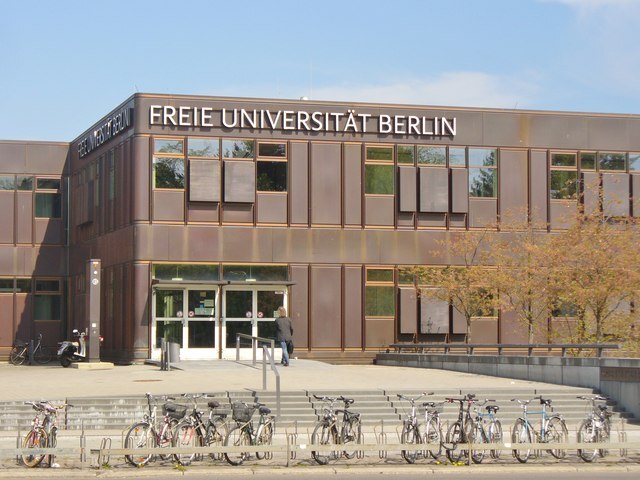
On Monday, April 13th, the Berlin Regional Court ruled on the attack on Lahav Shapia – a student known for his staunch support of Israel and campaigns against pro-Palestinian activists. No antisemitic motive could be established in the assault Shapira had suffered by a fellow student on the campus of the Free University. This ruling overruled an earlier decision by the local court.
Notwithstanding this decision, the Regional Court again sentenced A. to a prison term for aggravated assault. The sentence of two years and six months is more lenient than the original sentence of three years, but it rejected the accused’ lawyers appeal for probation.
In February 2024, a few months into Israel’s ongoing genocide in Gaza, Shapira and A. happened to meet in a bar in Berlin-Mitte. Both were studying to become teachers at the Freie Universität (FU) Berlin. The initial conflict between the students became physical and A., with a background in martial arts, happened to injure Shapira. In court A. state that he was not seeking to cause severe or even lasting damage.
The attack had been preceded by a dispute at FU Berlin. Shapira had removed posters against the Israeli genocide at the FU, which had been hung as part of a pro-Palestinian occupation of a lecture hall. The two men did not know each other personally, but were active in the same chat groups, where students had debated the genocide and anti-Palestinian climate at the university. In these groups, Shapira and others advocated a pro-Israeli stance.
At the court in April, the question of the actual physical attack was never put up for debate. A. confessed early on that he had beaten Shapira. According to the public prosecutor, the “detective work” in the first trial tried to prove a specifically antisemitic motive for A. While the local court last year had spoken of an “antisemitic outburst of violence,” the appeal chamber of the Regional Court now saw things differently.
According to the presiding judge, there was no evidence that the defendant had an antisemitic attitude. Since the exact content of the act could not be reliably reconstructed, the court did not consider the motive proven beyond doubt. A., who lost his place at the FU and suffered from month of racist campaigning against him, had always denied an antisemitic motivation.
His defense lawyer emphasized, for example, that the exchange between the two men in the chats had been respectful for a long time, even though they argued over Israel-critical positions. A. had merely argued that it was wrong of Shapira to tear down the posters. Even in the first instance, no antisemitic statements by A. had been found during the taking of evidence.
The Berlin Regional Court’s decision to sentence A. to two and a half years in prison for aggravated assault, despite explicitly rejecting any antisemitic motive, exposes a deeply troubling logic.
The court admits that there is no evidence of antisemitic intent, no hate-driven ideology, no proven link between the defendant’s political views and the attack. Yet he is sent to prison. Meanwhile, Lahav Shapira — a person who actively removes pro-Palestinian posters, participates in creating a hostile online environment, and has now taken legal action to suppress campus solidarity with Palestine — is framed as a pure victim. His own political stance in support of a state that commits a life-streamed genocide is rendered invisible.
This case is not an outlier. It is a textbook example of how Germany’s judiciary systematically criminalises Palestinians and their supporters, in particular People of Colour, while sanitizing those who defend and advocate the inconceivable violence of the Israeli state.