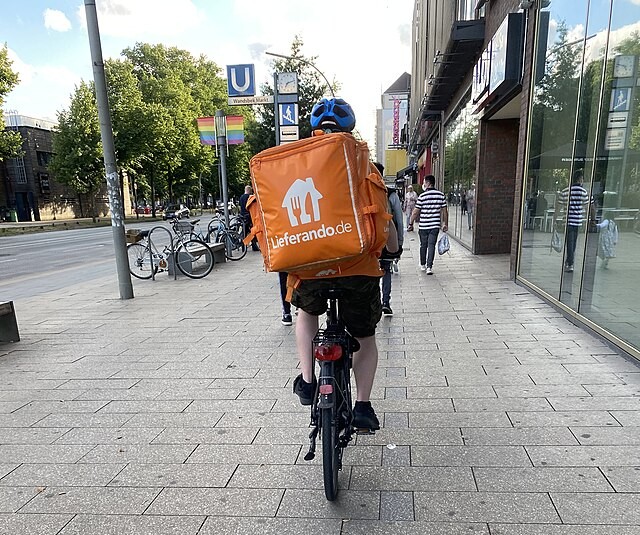
After it became known last year that Lieferando wanted to transfer 2,000 jobs to a “shadow fleet” of subcontractors and bogus self-employed workers, the works councils have suffered another setback in their fight for good working conditions and co-determination.
In its decision in proceedings 7 ABR 40/24, 7 ABR 23/24, and 7 ABR 26/24, the Federal Labor Court (BAG) declared the works council elections of several Lieferando works council committees to be invalid. The decision is also of considerable significance for a large number of other companies, especially those in the so-called platform economy, which manage their “employees” primarily digitally.
Essentially, the proceedings to be decided by the 7th Senate concerned the question of whether works council committees can be elected in spatially and organizationally distinct delivery areas (so-called remote cities) even though there is no physical management authority on site. In the opinion of the works councils, this is irrelevant, as management is carried out entirely digitally anyway, in particular via the mobile phone app used by the employees.
However, the court (continues to) link the works council eligibility of organizational units primarily to traditional management structures. The decision thus fails to recognize the reality of platform work, in which employees are managed digitally and perform their work exclusively and separately in their respective delivery areas. It is precisely there that the specific working conditions, stresses, and conflicts arise that make co-determination necessary.
“If co-determination depends on whether there is an office with managers somewhere, then works constitution law is no longer appropriate for the modern world of work,” explains Julia Warkentin, chair of the general works council.
“How exactly is a works council based in Dortmund supposed to represent the interests of employees in eight cities from Gelsenkirchen to Bielefeld to Bremerhaven? Platform work is real, it takes place on site – and employees need accessible representation of their interests there. Anything else weakens democratic participation in the workplace!”
The BAG’s decision also carries the risk that employers will be able to exert targeted influence on works council structures by centralizing and shifting control functions. In purely digital companies, for example, it is easy to assign delivery areas that operate independently to other administrative centers and thus get rid of “troublesome” works councils due to changing operational structures.
“This decision shows that legislators urgently need to adapt works constitution law to the reality of the platform economy,” demands Marius Schaefer, lawyer for the general works council (law firm Meisterernst Düsing Manstetten).
“The EU Platform Economy Directive must be transposed into German law by the beginning of December 2026. The federal government is called upon to also adapt the outdated concept of a “business” in works constitution law. It is equally important to implement the direct employment requirement demanded by the Conference of Labor and Social Affairs Ministers of the German States and the NGG trade union in this industry in order to maintain regular employment relationships.”
The works councils at Lieferando will continue to work together with the NGG to ensure that employees in digital and decentralized work structures are not excluded from democratic participation and good working conditions.