This article is the seventh piece in the series Neo-Nazis and Anti-Fascism in Germany since the 1990s. The rest of the series can be found here. It is also the second part in a two-part interview with Migrantifa Berlin, the first part is available here.
You are a migrant group, but you work in German. For some of our readers that might seem contradictory. Why is working in German important?
Mala: We actually discussed this question for a very long time – what terminology we want to use, and how we define ourselves as a group. The basic points that we arrived at were, first, that we understand ourselves as a group for all people affected by racism, and we intentionally formulate that in a very open way. But in reality – and especially as the group developed over the years – our language politics mainly follows from the actual composition of the group.
We are not a diaspora group. We are not a group made up of people who all come from the same country and organize together in exile. Most of us are second or third generation migrants – often described as people with a Migrationshintergrund [migration background] in Germany – and most of us were largely socialized here. Given this, using English as our main language would actually exclude many people. We do have comrades who mainly speak English or who speak German as a second or third language. But if we decided to run the entire group in English, in the hope of attracting a different kind of migrant community, we would lose just as many people. Especially considering the kind of neighbourhood work we do and the neighbourhoods that we come from, German is simply the common denominator. It makes us more broadly accessible than working in English would.
Sam: And specifically in Berlin, English can create a different kind of accessibility in many spaces. For example, in refugee self-organization the working language is often English. But for the areas we are active in – Kreuzberg, Neukölln, and Wedding – and especially for the communities we come from, German is simply the more practical language.
Mala: I’ll tell you an anecdote. I once went to a café with my parents where everyone working there only spoke English. Totally fine. My mother tried to order in German because she only speaks Turkish and German. When she realized that the person only spoke English, she smiled and tried to communicate by pointing at things. And the waitress was really unfriendly about it – rolling her eyes and everything. And I thought: this is exactly what you mean about the traditions that certain languages stand in. In Berlin, English isn’t just inclusive – it’s also the language of very privileged expats who come here and then roll their eyes at my migrant mother when she wants to order in German.
I think that anecdote captures a lot. What about other languages? How multilingual is your work?
Sam: A lot of it comes down to translation. Over the years, especially in our neighborhood work, we’ve tried to translate almost everything we distribute in writing. But importantly, we translate into the languages actually present in specific districts. Arabic and Turkish are very prominent languages, but Berlin – especially towards the north and the east – has many other languages as well. The open composition of our group reflects that reality quite well, and our membership often mirrors the communities present in Berlin.
In addition to this multilingual aspect, it’s also important for us to confront reactionary or conservative tendencies within migrant communities. Examples include clearly naming Turkish fascist structures, or understanding how such groups sometimes try to appropriate Palestine solidarity. In such cases we insist on a left revolutionary perspective, which often means saying “neither this nor that” – because there are very few well-developed analyses that aren’t either state ideology, or something similarly limited. So we also argue internally and debate a lot. Being affected by racism doesn’t automatically produce a political position; we still have to develop one. For example, working together with Sudanese comrades can challenge simplistic narratives about an “Arab identity” being inherently liberatory.
You mentioned political education as part of your practical work. Could you say what kind of educational work you do?
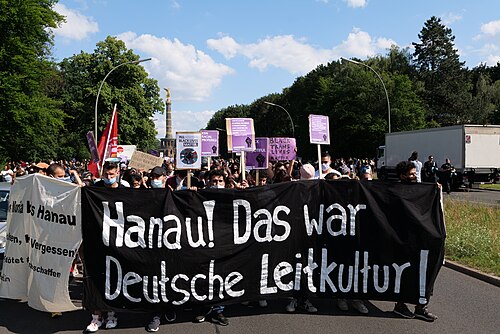
Sam: We try to use concrete political developments as entry points for broader analytical and historical discussions. For example, around the anniversary of the Hanau attack, we ask: “why do we say Hanau is not an isolated case?” We turn that into an open educational format explaining these continuities, similar to what your series is trying to show. I think that many of these cases and experiences haven’t been very present in people’s minds, regardless of whether they grew up here, or whether they haven’t been in Germany very long. The longer the group exists and the younger the membership gets, the more we notice that many of them have never even heard about Rostock or the NSU. So we try to constantly return to the question: what tradition do we see ourselves in, and how does a historical understanding help us respond to what’s happening now?
Mala: Especially in the German left there’s often this distinction made between theory and practice. We don’t really see it that way. We need to know our history, and we need to be able to analyze the situation we’re in. To do that, it’s important to learn things and to know things, which means reading and exchanging ideas with each other. The point of being in a group isn’t to be the smartest person in the room or the one who talks the most. As a group we have the ambition to learn together: sharing texts, reading them together, giving presentations, having discussions. It’s the responsibility of the group to create that space, because people come from very different backgrounds.
In Germany generally, but also in Migrantifa’s work, commemoration seems to play a much more central role than I’m used to from my home country. What is the purpose behind this focus on commemoration?
Mala: Well, it becomes important in Germany, a country where our lives count for less, and where there is often no official remembrance at all. To be clear, our goal is not to fight for official remembrance. What we want is for these things to not happen in the first place. But in the 1990s you could have a chancellor saying we “don’t want mourning tourism here”. Or when Emiş Gürbüz, whose son Sedat Gürbüz was murdered in Hanau, raises questions about the actions of the police while speaking at an official memorial, they are attacked by all the German parties. In a context where people are murdered and their lives erased, it’s important that we take the space to ensure these people are not forgotten. That space doesn’t really exist in Germany otherwise.
But we don’t stop there. That’s why on the anti-racist day of struggle, February 19th, we hold both a commemoration and a demonstration. It’s not only about creating a space to mourn and remember our siblings. It’s also about understanding and analyzing why this happened and what we can do to prevent it from happening again.
Sam: And I think on another level it also has a lot to do with our approach to political action. If we were a mostly male group, or one that didn’t operate with a feminist basic consensus, the kind of commemorative and mourning work we do would probably look very different. Because I think many people’s first emotional connections – the things that bring them into political action – are often overlooked. In the classic narrative of left political action, it’s all about anger and the urge to act. But what often gets lost is grief and the feeling of being overwhelmed. We try to connect to these feelings. When we say things like “from grief to anger” or “to remember means to fight”, we don’t mean that the first has to disappear for the second to happen. We see them as necessarily connected, and we try to create spaces where that connection can exist.
One good example of resistance to state authority over who can be mourned is the small memorial at Oranienplatz for victims of police violence and racist violence, which was installed in 2020. For two years it was repeatedly torn down by the district authorities every few weeks or months. It’s not even a large monument. This memorial pushes back against the idea that people affected by the violence of this state should only mourn quietly or privately. Instead, remembrance, grief, and memory can produce resistance.
Where do you see things going in terms of Germany’s political situation, including the rightward shift of institutional politics and growth of neo-Nazi groups?
Sam: One really important lesson from 2020 is not to accept easy liberal answers. That’s a role we still have to play, especially in antiracist spaces. Refusing to buy into these narratives that say we just need more diversity and inclusion, or more party members in Die Linke or Die Grünen, in order to defeat the fascists. I’m exaggerating, but in many subtler ways this is still being sold to us. And I think we have to keep intervening there and saying “the state is not going to save you”. Instead, we have to act and let analysis guide us.
Mala: Very often when people talk about the Nazi period, they like to imagine that they themselves would have been in the resistance. People imagine difficult times as this huge catastrophe that suddenly crashes down on them, which is the point at which they imagine they would act. But that’s not how it works. If the AfD were in power, it would be bad, but Germany didn’t need the AfD to ban the KPD, to help build Frontex, to let thousands of people drown in the Mediterranean, and to tear people out of their sleep and put them barefoot onto deportation planes. This is already happening.
And what do you think the Left should focus on in this situation? What would you say to your comrades reading this?
Sam: Connect struggles. Because the forms of state violence we face are the same. Many of the forms of repression that have targeted Palestine solidarity, Rote Hilfe or the Budapest Komplex in recent years, for example, were developed over the decades before with Kurdish comrades, and even before that with the persecution of other leftists. Seeing these continuities in the present as a point of connection is important. This means developing forms of action that involve much more coalition-building than might be comfortable. Like sitting down with a union, where not everyone has perfect anti-racist vocabulary, but it’s clear that the strategic or political goal is shared – we need to focus a lot more on that.
And I think what’s really important in the Berlin context is to take neighbourhoods along when we take to the streets. Not to get caught up in this split between politically active people and the odd public sphere; this idea makes us vulnerable. That’s what neighborhood work is about.Mala: Yeah, everything is fucked up, but we shouldn’t fall into dispair. We can’t do everything at once, but every person can contribute a little, or at least keep the little flame burning towards revolution. This flame is kept alive through us.