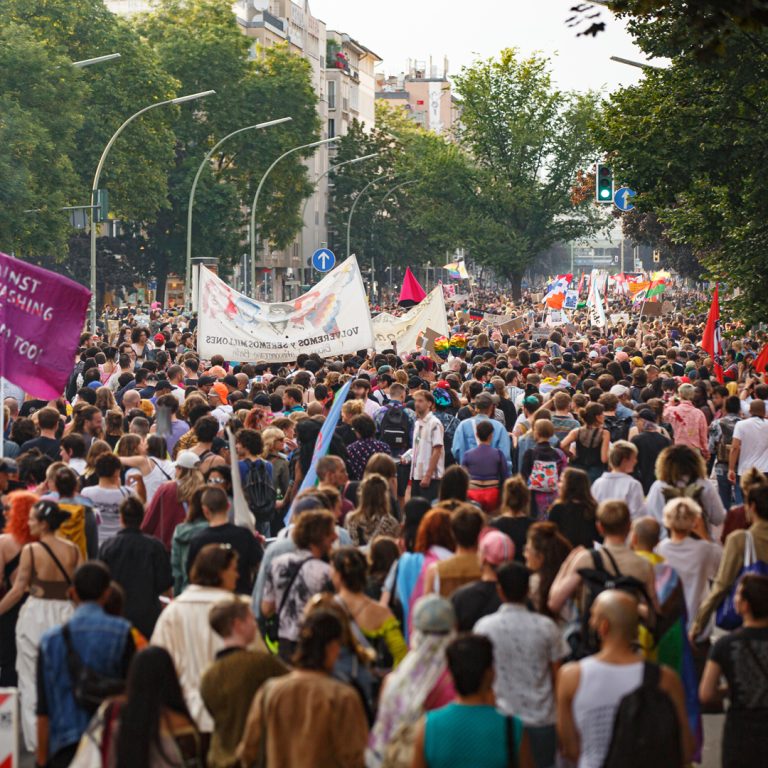
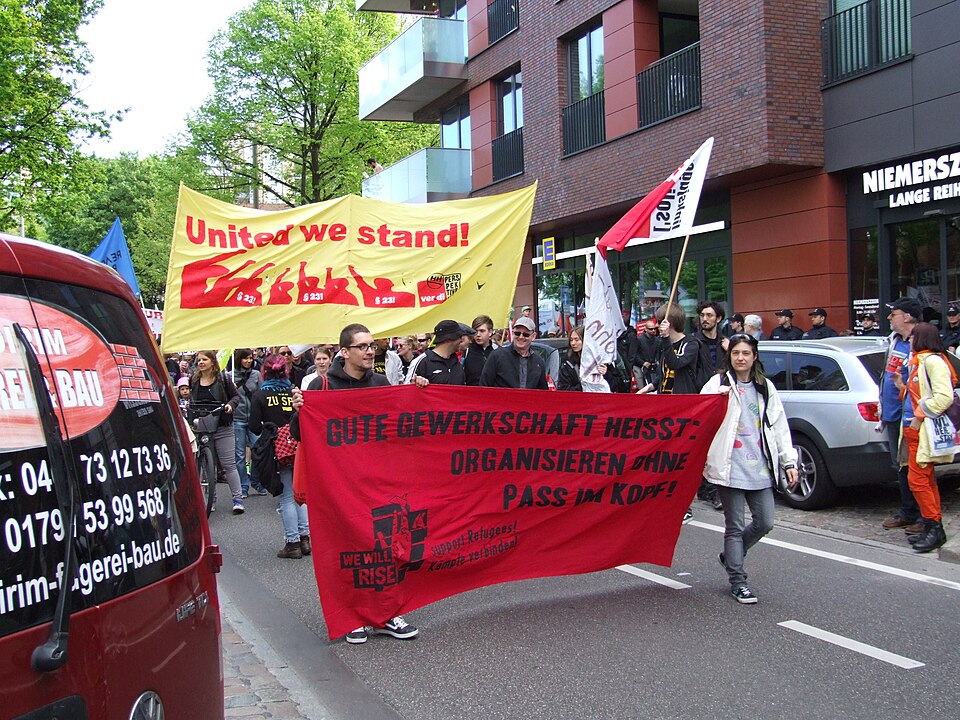
Over 40% of residents in Berlin have a migration background. It is one of Germany’s most international cities. Berlin’s diversity is what makes this place feel like a world of worlds—full of communities, unique spaces, and (ostensibly) opportunities for everyone. When it comes to the task of building working class power, Berlin’s international community offers serious potential by providing fresh perspectives from so many diverse backgrounds and lived experiences. Unfortunately, this potential is rarely tapped into adequately, and the roadblocks erected by Germany’s laws, institutional bureaucracies, and even its formal labor institutions have done much to demoralize and restrict the migrant community that contributes so much to making this city what it is.
Still, there are plenty of activists—many of them migrants themselves—working within formal and informal labor organizations to change things for the better. Having myself been involved in labor organizing in Berlin over the past year, I wanted to get a better idea of both the challenges and opportunities for building worker power among the migrant community in this city. To that end, I had a series of recorded conversations with contacts and colleagues who work or volunteer as labor activists, researchers, and union organizers. This article will be the first part of a short series derived from these conversations. My aim is to introduce readers to some of the peculiarities and challenges involved in labor organizing in Germany while highlighting the voices of some of those engaged in organizing migrant workers in Berlin.
Ver.di
This first part will highlight the voices of two union staff organizers working for the 2 million strong German service workers’ union Ver.di (Vereinte Dienstleistungsgewerkschaft). I sat down with Daniel Gutiérrez, a union secretary for Ver.di who has been living in Berlin for eleven years now. Daniel works with the Kollektivesbetrieb und Tariffarbeit (KBTA), a team tasked with developing new organizing methods for the union. We were joined by Amanda Ripley, a researcher and organizer with Ver.di’s Projekt der Zukunft der Mitgliedergewinnung. Amanda moved to Berlin three years ago and has also been helping Daniel further an organizing training program called MATCH (Mitglieder Aktivierung Training for Change). Through their various initiatives, Daniel and Amanda are experimenting with ways to expand and circulate organizing skills at workplaces with high numbers of migrant workers.
“We developed a number of different initiatives, like the All Union Stammtisch, which is meant to be a site where workers can build community together across workplaces and get the understanding that they are part of a movement”, says Daniel. “We have the monthly membership meeting, which is basically an incubator for organizing committees, and we have the MATCH program now, which is meant to massively expand our capacity to circulate organizing know-how”.
Effective organizing is a skill which must be cultivated like any other. Prominent labor organizers like Jane McAlevey and her battle-tested Organizing for Power program have made it clear that while anyone can learn to be a labor organizer, the methods to be an effective one are not self-evident. Rather, “organizing is a craft we learn and never stop practicing”. The MATCH program was developed as a way to encourage “peer-to-peer” organizing, facilitating both an education in the fundamentals as well as skill-sharing among workers at different workplaces.
Amanda explains: “Daniel trained nine of us in an initial cohort […] to get up to speed on different organizing frameworks, theories, strategies, tactics, then assigned each of us to one or two other workplaces to help coach them along”. The trainings include techniques on holding one-on-one organizing talks with workers, an overview of German labor law, and the difference between simply joining a union versus fighting for a collective bargaining agreement.
I asked Daniel to elaborate on the centrality of migrant labor organizing in these projects: “A few years back Frank Werneke, the president of the union, said that Ver.di has to become a migrants union, and so as part of that broader directive my job is to come up with structures, practices, and techniques that could help build that vision”, he says. “I use the Berlin tech and startup sector as my experimental playground, where I’ve worked hard to develop a bunch of different structures”.
The work comes at an important time. Union membership in Germany is declining, and while the manufacturing and public sectors maintain relatively high union density, the service and tech sectors have long been neglected. By deliberately centering the training around sectors which contain high numbers of migrant workers, these programs seek to organize workplaces which play an increasingly important role in the overall economy—a prerequisite to providing the labor movement with the leverage it needs to affect real change.
Challenges of Organizing Migrant Workers
Germany is infamous for the sluggish pace at which its institutions adopt new technologies, practices, and ways of thinking. Trade unions are no exception. As an industrial union (one of Europe’s largest), Ver.di is tasked with representing the interests of millions of workers across the country. Its massive size means it is able to exert an impressive amount of economic leverage, but it also makes adaptation to changing circumstances a slow and bureaucratic process. Ver.di operates at the local, state, and federal level, with five divisions (Fachbereiche) covering different job categories. Each division has its own internal structure across various administrative levels, and to an outsider the organizational makeup of the union can be as intimidating as it is confusing. Those who are still in the process of improving their German skills can find it exceptionally difficult to obtain the information or support they need.
Daniel acknowledges the union’s internal obstacles to organizing migrant workers, and insists on practicality and a reflection on how trade unions developed throughout German history: “We have historical hangovers […] we have a German staff that doesn’t speak a lot of foreign languages, and so that creates issues inside of the union. It is an issue that our entry forms or signup forms are in 20 different languages, but once you come inside, the materials are mostly German”. Daniel sees this issue as a problem with German institutions overall: “I don’t think that this is a Ver.di problem, this is, in general, a German problem, a problem of German institutions and their necessity to open up. At least here, there’s a recognition that we have to do this”.
Of course, the language barrier is only one obstacle hindering the capacity for migrant workers to understand their rights, let alone organize their workplaces. Amanda touches on an important point which is likely unfamiliar to many coming from outside of Germany—the expectation to pay dues before a unionization campaign has succeeded: “People have to pay the 1% dues before they get any benefit from it. In the US you don’t pay any union dues until you have a contract, and that makes it a lot easier to get people on board.”
A successful unionization campaign does bring about all kinds of tangible benefits for the workers involved—but the process is a struggle, and struggles inevitably come with risks. Migrant workers are often severely underpaid, especially in the service sector. Given the dire state of Berlin’s housing and affordability crisis, it should be expected that those in vulnerable economic positions will often be averse to contributing financially to a unionization effort that could take many months to even get off the ground. But the money itself isn’t the only factor: “People’s visas are often attached to their jobs”, says Amanda. “That is something that can be used to discipline workers and make them afraid of taking action.”
Domestic workers in Germany and those who possess permanent residency can more comfortably take risks with the assurance that they will have full recourse to their legal rights, even if the process is notoriously slow. Migrant workers, on the other hand, are often stuck with temporary contracts, and companies like Lieferando are attempting to strip them of their rights through subcontracting arrangements with third-parties. Due to the way German work visas are generally granted, migrant workers are presented with the very real threat that they could be forced to leave the country long before they are eligible to benefit from the union’s benefits and protections. This is why cultivating effective international solidarity is so important: unions, to regain their strength, need to bring migrant workers into their ranks. Migrant workers, in order to navigate the unique challenges that stand in the way of their full potential, need the support of unions and Germany’s domestic workforce.
On the question of solidarity between domestic workers in Germany and those who have migrated here, Daniel points to the material and historical conditions: “Half a century of neoliberalism has really collapsed our understanding of what does organization mean? What is a union? What is solidarity? And I feel that most of the time these are empty words that we have to perpetually redefine”, says Daniel. “I don’t think there’s enough [solidarity] between migrants and Germans, I don’t think there’s enough between the workers of the world”. This, then, is the challenge for organizers, activists, and educators: clarifying to workers, regardless of their background, that at the end of the day, our struggles are necessarily intertwined.
This is particularly challenging amid the rise in anti-immigrant sentiments throughout the world. When crises intensify people search for causes—and migrants become easily identifiable scapegoats. Amanda notes that “there’s systemic racism everywhere, there are language problems everywhere… but I think that there’s also maybe something in Berlin in particular that’s very special, because it is a city of outsiders, and even a lot of Germans who moved to Berlin feel like outsiders in some ways”. Still, she adds “I think that there’s a strong leftist history that draws people to Berlin.”
The far-right Alternativ für Deutschland, now Germany’s most popular political party, obtained its first surge in momentum following anger at Angela Merkel’s policy to welcome Syrian refugees. Meanwhile, the current government headed by Chancellor Friedrich Merz has continued to sow distrust against migrants while introducing a dangerous new series of austerity measures. These new reforms will have a disproportionate impact on the most vulnerable and precarious by, among other things, extending the ability of employers to keep workers on temporary work contracts—maintaining pressure against migrant workers on work visas.
Regardless of the challenges, as a “city of outsiders” with a long history of leftist struggle, Berlin’s working class maintains a number of advantages. Germany’s system of labor relations is built on a strong foundation won by the hard struggle of the labor movement in this country over decades and centuries. As Daniel insists, “it is already remarkably better that you could have works councils, that you could have trade unions, that you could have Bildungsurlaub, which is educational vacation that the employer has to pay for, and with which you can go and attend union education events. This is a remarkable advantage compared to our British or American or Irish counterparts…. We can take time from capital’s accumulation process… and educate workers in that time.”
The key is to ensure that these rights and benefits are understood, accessible, and guaranteed to all. But while Germany’s unions have often been criticized for their sluggish bureaucracies and conservative tendencies, some have shown a willingness to adapt and innovate. For example, during the pandemic Ver.di organizers famously demonstrated how effective an innovative organizing approach can be through a successful month-long hospital workers strike in Berlin. By emphasizing mass-participation of the workforce, incorporating them directly into negotiations, the strike won impressive benefits for the workforce. In order for mass-movement organizing to continue winning in the future, Germany’s labor movement will need to further emphasize initiatives designed to build solidarity between migrant and domestic workers.
Pushing Forward
Of course, Daniel and Amanda are themselves both migrant workers in Germany, whose perceptions of their work is in part shaped by this experience. Commenting on her own experience moving to Germany, Amanda says “as a migrant, you’re disenfranchised, and we have been schooled by neoliberalism to think that you just vote every four years, or however often your elections happen, and you wait, and that’s as good as it gets. You wait for the people to change things and fix things. Here, because that default option is taken away from us, we look for other structures, and this, I think, is a lot more powerful when you organize and get people to do things themselves”.
Daniel answers similarly: “I felt that moving to Germany, I was moving into a world that I could not transform, that I had to accept, and I really longed for that kind of democratic potential to transform the world around me. I think that the reason that there is such a good amount of success through the structures that we’ve built is because I’m not the only one that feels this. Especially in 2026 in the wake of the pandemic, in the wake of ascendant fascism, in the wake of climate catastrophe, and global superheating, and the lack of political action thereof. I think there are a lot of people that are hungry to do something about it. They just lack an avenue where they could express this desire for political efficacy”.
I ended the conversation by asking Daniel and Amanda what it is that motivates them to keep fighting for a better world. Here are their answers:
Amanda: “My nieces, I’m just trying to make the world better for them and for the other kids in the world”.
Daniel: “At the end of the day I am ultimately moved by a profound sense of love for my friends and my family, for my community, and for the potential of the future. And I see that in my kid, and this is what keeps me going”.