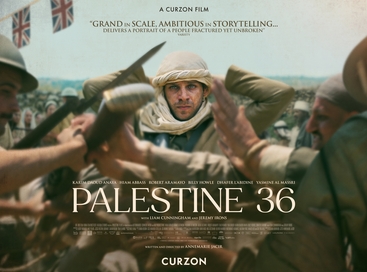
We start with footage of Palestine in the 1930s. Jerusalem, Jaffa, and other towns and cities are teeming with life. We see market traders, and men herding goats and camels. But this is not some rural hinterland. We also see dockers working in the ports. The footage—some old sepia archive shots, some made for this film—helps disprove the myth that Palestine pre-1948 was either a desert or a land without a people. Anyone who claims otherwise is either mistaken or deploying mischievous propaganda.
Cut to a train arriving in Jerusalem station. News vendors call out familiar headlines: “Tensions in Nablus!”, “British crack down hard on protests!” A young man, Yusuf, arrives from the village of Al-Basam. Almost immediately, armed British troops demand to see his papers. Yusuf heads towards a large house where he, and we, first meet Kholoud—a bustling woman wearing a fez and a man’s suit, who is busy bashing the keys of an old typewriter.
Kholoud is an Oxford-educated journalist. She writes for the newspaper owned and edited by her husband Amir, but she has to use a man’s name: Ahmed Canaani. She asks Yusuf what people are saying in the villages. Unrest is brewing throughout Palestine, which is something that inspires Kholoud. Amir is wealthy, and seems less radical than his wife (later he will tell her: “I adore you even if we don’t agree on everything”). He gives Yusuf a job as his chauffeur and tells him to clean the car.
We move to Ramallah to an open air event for which Amir, Kholoud, and their circle have dressed up. This is the launch party for the Palestine Broadcasting Service, the second national radio station in the Arab world, after Cairo. High Commissioner Sir Arthur Wauchope is particularly proud of the project, which he presumably sees as his way of bringing civilisation to the heathen natives. After announcing that “a new page in history is written today,” Wauchope invites an Orthodox rabbi and an imam to make speeches.
The Brits do not come out of Palestine 36 looking well—and rightly so. Wauchope, as played by Jeremy Irons, is reminiscent of Peter Cook’s portrayal of Harold Macmillan in Beyond the Fringe. He is an aristocrat who is unable to come to terms with the decline of the British Empire. He patronises the locals, telling them that “together we can create a united and peaceful Holy Land.” It is not that Wauchope looks down on Palestinians. As they are not Englishmen, he is barely aware of their existence.
Captain Orde Wingate, in contrast, belongs to a new, rising class. He is a racist who despises Palestinians. He has learned enough words of Arabic to be able to give them orders, but is just as likely to simply shoot them dead. Wauchope may represent the old way of running things, but the region will be increasingly run by the ideas propagated by people like Wingate. Wingate’s troops order Palestinians to leave their villages, and then blow up their homes, whether they have left or not.
The third major British character is Thomas Hopkins, Wauchope’s private secretary. Hopkins is a liberal who, to Wingate’s consternation, has immersed himself in Arab culture. His closeness to the Palestinians means that he acts as the voice of dissent inside meetings. At one stage, he points out: “We’ve shut down every Arab printing press, we’ve banned newspapers, censored their mail, and intercepted their telephone calls, we’ve set up check posts and curfews, we’ve even taken away their bloody livestock.”
Yet while Hopkins is able to articulate dissent, he is unable to effect change. The repression that he describes in his outburst is not the result of bad decisions but is intrinsic to the British colonial project. By the end of the film, Hopkins has given up his post and is ready to return home, defeated. When he tells his friend Kholoud about his decision to quit Palestine, she understands, but tells him that as a Palestinian she does not have that option. Unlike him, she says: “I’m not a tourist.”
Palestine 36 is an indictment of the British occupation of Palestine and shows how so many of today’s problems are simply a continuation of what has been going on for 90 years and more. Following a “terrorist” attack, occupants of a neighbouring village face collective punishment, checkpoints are used to restrict movement and intimidate civilians, flags are banned, and walls are built to separate and imprison people. The Israelis may have intensified this sort of repression, but much of it was started by the Brits.
But this is not just a film about evil British occupiers. Primarily it is about the Palestinian population, how they resisted and how they were driven to resist. Early on, we meet dockers who are mainly interested in making enough money to survive. Then, promised overtime payments are not paid. A barrel which they are hauling onshore is dropped, and it opens to reveal guns to be used against the Palestinian population. Not everyone starts the film as a radical, but they are radicalised by their unbearable experiences.
We next hear that a general strike has been called. The angry dockers join the strike. In a largely flawless film, I think the general strike could have been handled better. It rumbles along in the background, and then, after several months, it is called off. We don’t really learn why, nor are we shown the nature of the strike. Is it a mass withdrawal of labour aimed at shutting down the occupation’s economy, or is it just business men not turning up to work? In reality it was a bit of both, but I’d have liked to see more here.
Class differences—and how they affect people’s relation to the resistance—are considered, though. While dockers lose their jobs and farmers their homes and land, well-heeled community leaders hold discussions about how they can collaborate with the Brits. Amir, the newspaper editor, opposes the general strike and starts running a column by a fictitious Palestinian writer. It turns out these articles are written by a Zionist group set up for this purpose. All Palestinians suffer from colonialism, but they do not suffer equally.
The story is told from many perspectives—maybe too many for the audience to remain on top of things. Father Broulos is an Orthodox priest who preaches stoicism instead of resistance. Broulos is one of the many characters who tries—and fails—to find a middle way out of the conflict. His very existence confuses the Brits, who are used to categorising and demonising the Palestinians as Muslim terrorists (little change here). When a Christian resistance group produces a flag with a cross on it, the confusion deepens.
Palestinian resistance does not just belong to the men. We are also told the stories of women and girls, not least Kholoud’s angry resistance. There is a scene on a bus where British soldiers spend so much time harassing the male passengers that the women are able to hide the weapons which someone had brought onto the bus. We also spend some time with the villager Rabab, who lives with her parents and daughter Afra. Both Afra and Rabab have obviously inherited grandmother Hanan’s resilience.
The film keeps coming back to Yusuf, as he moves between the country and the city. At first, Yusuf is not really interested in politics, but as things develop, and his family is directly affected, he feels himself drawn into the resistance. But Amir tries to win Yusuf for the Muslim Association, which has been set up by the Zionist Commission to undermine Palestinian resistance. The newspaper editor gives his poor dogsbody money to buy a suit. It looks like Yusuf will play a counter-revolutionary role until real life intervenes.
Yusuf’s trajectory is reflected by that of the docker Khalid, who was equally unpolitical until his lack of overtime payments prompted the workplace dispute at the beginning of the film. Khalid’s political development is quicker than Yusuf’s, and it is not long before he is a leading resistance fighter, boarding trains and collecting solidarity payments from passengers. What might sound like extortion is actually a display of how much support Palestinian guerillas had in the wider population.
As the film develops, Palestinians’ hopes of justice disappear. The Peel commission announces partition in which a Palestinian state is denied and over half of Palestinian land is taken away. Palestinian newspapers are closed down and their printing press destroyed. British officials like Hopkins, who had offered Palestinians at least verbal support, start to recognise their own impotence. The various characters who had attempted to look at both sides of the conflict are forced to make a choice.
Some critics have complained that the Jewish settlers barely appear in this film, but this is not their story. Settlers attack villagers and burn down property, but they are not the main danger to the Palestinians—for the moment at least. This film is set in 1936 and 1937, when Palestinians had much more to fear from British colonialism than the not-yet-Israelis. There is a certain radicalism in this point of view, which sees that the main enemy of the Palestinians is not the Israeli leaders, but their Western imperialist backers.
Annemarie Jacir wrote a Director’s Statement in which she said: “Palestine 36 is a period film, but I never conceived it as something of the past. It has always been current, relevant and alive. Sometimes critical, never nostalgic, always searching. Set in a time I never lived, Palestine 36 is deeply personal. We do not choose the circumstances of our lives, we do not choose war or the million painful moments we learn to survive. Sometimes we choose how we react to them.”
There is a common recent statement: “it didn’t start on October 7th”. This is often taken to mean that the suppression of Palestinian rights started with the Nakba in 1948. Palestine 36 shows how it didn’t start in 1948 either. British interference in 1936 Palestine enabled the expulsion and murder which followed. While colonies in Africa and Asia were able to overthrow their imperial masters, British (and later US-American) imperialism were able to retain a subject state in this strategically important oil region.
Two dedications are hidden in the film’s end credits. The first says: “For our people in Gaza in the years the world failed you”; the second: “no olive oil was spilled in the making of this film”. This combination of statements is a telling sign of director Jacir’s ability to combine radical politics with good humour. Among the last voices that we hear are chants in Arabic: “Down with colonialism” and “Revolution.” As these chants become popular once more, they have found their expression in this superb film.