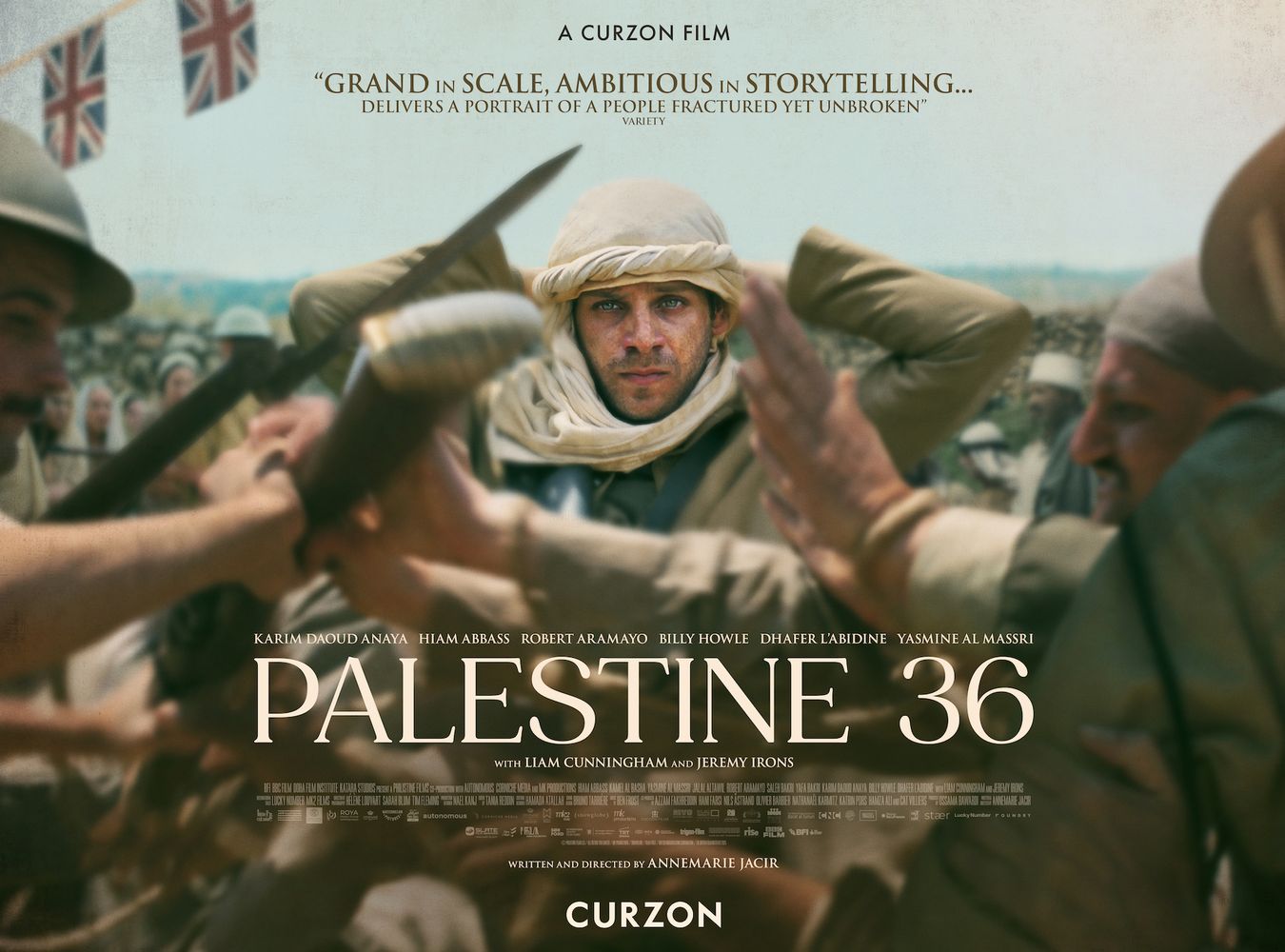
Hi Annemarie. Thank you for making a great film. Can we start with one question. Most histories of Palestine start in 1948 or maybe later. Why was 1936 so important to you?
The uprising of 36 is arguably the longest and largest anti-colonial uprising, and the six month strike was the longest strike to date. It spread to the whole country. I think it marks a very critical moment, because although the revolt was crushed in 1939, it really sets the stage for 1948, which, as you said, is usually when we talk about Palestinian history.
I don’t think it’s possible to talk about 48 without understanding what happens in 1936-39 with this uprising. The political leadership is exiled. There is no longer a leadership in the country. One out of every 10 Palestinian men is in prison or killed. It has a huge effect on the country; that has to be part of the conversation.
The first proposals for partition, starting with the Peel Commission, are all things that I think are really important to know when we talk about Palestine.
One of the interesting things about moving to 1936 is that it shifts the focus away from the Israelis and the Jewish settlers and more to the British. What do you think was the role of Britain leading up to ‘48?
I definitely wanted to talk about that, to explore the role of the British in this. Palestine is often called one of the last colonies. And all the lessons from everywhere else, like India, were put into practice here. The British and the French carved up our entire region according to an agenda that would serve them.
We feel this today very much. It’s still here. I think much of what we’re dealing with today is a result of that, and the fact that many governments are still complicit in it.
Something that’s often missing from the discussion is that the 1948 Nakba was around the same time as the liberation of India, and then the partition of India. It’s also the beginning of anti-colonial struggles in Africa and Asia
There’s a scene in the film where you see the men on the horses come in and if you speak Arabic, you hear that his accent is Syrian. I wanted to flirt with the fact that there was an anti-colonial revolt happening against the French in Lebanon and Syria. There was a connection between what was happening to the Palestinians and the Syrians and the Lebanese.
It’s also often forgotten that anti-colonial struggles are often connected, or that there’s movement between them. That scene is a reference to that. The scene is a lot about unity which was lost. Colonialism divides and separates. When we hear the way he’s talking in this scene about unity—that unity is gone today, unfortunately. That divide-and-conquer strategy worked and it’s still at play.
Could you say something about the role class plays in the film? We see that all Palestinians are affected by the occupation, but they’re not all affected equally, and they don’t respond in the same way.
For sure. Class was important. This revolt in particular was a farmer-led revolt. Then you also have Khalid at the port. The film talks about the working class and what was happening at the port. This film was always about groups of people in different classes, each dealing in their own way.
Kholoud, an upper class journalist supports the revolt, but in a very different way. They are affected differently. The brutality of the army, for example, is something that the villagers are confronted with on a regular basis.
For the British in the cities and diplomatic life, and the kind of life that Kholoud and Amir experienced, there were parties, there were clubs, there was movement, there were good times. They didn’t see the brutality of what was happening in the countryside. And unless you knew about it, you could even pretend it didn’t even exist.
Quite often resistance struggles are portrayed as being just about men with guns. Your film spends a lot of time also talking about the resistance of women. I guess this was a choice on your part.
It’s just the reality, because you have a revolt, but it’s not just men with guns. That’s not what a revolt is. It’s also this woman, Kholoud in the city, a journalist who is involved through writing articles. There’s also a woman in the countryside, the mother of the little girl who never picks up a gun, but she’s bringing food to the fighters.
These are all moments of what revolt is. But maybe not in the typical ways we see revolt. The whole film takes place at this very critical moment. But I’m less interested in the battle scenes or clashes.
I’m more interested in the father and son, this boy walking home with his father and getting stopped by the soldiers and getting searched, and the humiliation that that boy feels at that moment; the question in his mind of why his father doesn’t respond in a stronger way. Why is his father smiling in this moment that he finds so uncomfortable?
These little things are more interesting to me as a film maker than the big men with guns. I like that phrase.
There’s one thing I’d have liked to see more in the film, and that is of the general strike. It’s always there in the background, but it’s something that’s just there. I know you don’t have the time to show everything, but what was the thinking behind this?
There’s a lot I would love to have spent more time with. I agree with you. I think that the general strike was an incredible moment and a very important one. And we do feel the strike, but it’s not delved into as much. There’s just so much to say. There’s so many stories during this period that I focused on other things, I guess.
What do you think are the similarities and the differences between occupation and resistance in Palestine in 1936 and occupation and resistance in 2026?
I live in a place where we are surrounded by checkpoints to go from point A to point B. Our bodies are searched. Our hair is searched. Our fingers are searched. There are curfews. You need a transit pass. You need this. You need that. The borders are closed. Printing presses are shut down.
Everything that the film deals with is still happening right now—administrative detention, a young man being tied to a car and driven out—which the British often did. They would tie somebody to a car to get out of a village, so that they would protect themselves with a human shield.
The day we shot that scene, the same thing happened in Nablus. A Palestinian man was tied up to an Israeli military vehicle, and it happened to be caught on a news camera, so people saw it. But this happens all the time. The army comes crashing in and out of villages and towns.
There’s nothing in the film that feels far away or not relatable. There’s the collective punishment, the wall. I could go on and on. Everybody talks about Palestine today and the wall. But the concept of the wall came from the British. Liam Cunningham’s character, Charles Tegart, made the first proposal to build a wall. So, past and present are absolutely blurred.
The film ends with defeat, but it also ends with hope. We hear people shouting “Down with colonialism” and “Revolution,” I guess we should hope that defeat 90 years ago doesn’t mean that Palestinians will lose again
I hope so, and it’s why for me that the last image of the film is this little girl with her hair down, barefoot and running. Where she’s running to, I know for myself, but it doesn’t really matter. She’s like a light to me. Afra was always this light in the film, and she represents perseverance. No matter what, you just continue and you keep going.
Do you have Afra’s hope?
I do. I try to work on that. Without it, we don’t have anything else. I believe hope is important, because otherwise, we’re in darkness.
Have you got plans for what you do next?
I’ve got a couple of projects I’m thinking about. But one thing is recovering from this one and taking care of myself a little bit. Making this film was extremely difficult and became infinitely more difficult. It took years more to make it, stopping and starting production. It took a toll mentally, emotionally, and politically. You look out the window, and you know what’s happening here is not good.
So, I’m trying to sort of take care of myself. I’m also thinking about a few projects. I don’t want to wait 10 years to make the next one, though. I can’t do that.
How important was it that you held out and filmed in Palestine, rather in the neighbouring states?
For me, it was very important. Some things we could not shoot in Palestine, and we had to shoot in Jordan. But then we came back and finished the film in Palestine. It’s very important to me that Jerusalem was Jerusalem, and not another country that looks like Jerusalem.
This is one thing I kept telling the crew. We are the refugees of the world. 75% of Palestinians are refugees. I don’t want this to be a refugee film. It’s really important that we push to do what we can. Maybe next year we won’t be able to do it. But right now, we have to fight for keeping our feet on the ground.
We live here, we have to hire locally. We have to work together. We’re talking about an independent film industry. You have to live and work and make things in the places that you’re talking about. I think it’s important.
If someone sees the film and is inspired, what do you want them to do?
Talk about it. We barely made this film. It was on, off, on. We never knew if we would be able to finish it. Everybody just went crazy to do it and to put it out there.
Now it is out there. So, if somebody watches it, this conversation—this connection—is important. It’s important that there’s an audience after people put everything in order to make this film. And the reason is because we want to connect. We have to connect with each other in this world.